Why You Keep Taking the Work Back
Why You Keep Taking the Work Back
You handed it off. Then you took it back. The fire reached your desk, and your hand moved before your mind did. This is Silent Collapse™, the quiet state where a capable leader runs all day and leads nothing. You are not disorganized. You keep taking the work back because the work holds something in place. Read the manifesto for the whole of it. For now, name the habit plainly and look at what it costs.
On this page
- The short answer
- Key takeaways
- The hidden pattern
- The RAMS™ reframe
- What this looks like
- The architecture of your return
- Questions leaders ask
Key takeaways
- Taking the work back is not weakness. It is identity doing its job.
- The task is holding your sense of who you are. That is why your hand reaches.
- You can stop the surface habit this week with one audit and one rule.
- The deeper cause sits underneath, at the level of state of being.
- Baz Porter® architects the return with the RAMS™ framework.
The short answer: why taking the work back feels like leadership
You take the work back for two reasons. One is on the surface. You believe you are faster, so you reclaim the task to save time. The other sits underneath. The work is load-bearing to your identity. When you let it go, you feel yourself go quiet. So you reach for it again, and call the reach help. The surface reason you can solve alone. The deeper one is why the pattern returns. This is the state Baz Porter®, The Sovereign Leadership Architect, rebuilds beneath high performance. Not more effort. A return to the work only you can do.
The hidden pattern underneath taking the work back
There is a classic piece of management research on this exact move. In the Harvard Business Review article "Management Time: Who's Got the Monkey?", William Oncken and Donald Wass showed how a manager accepts a problem that belongs to someone else. The problem jumps to the manager's back. The team member leaves lighter. The leader leaves loaded. You have lived this. Every fire you touch becomes yours to feed.
The second layer is about who you are, not what you do. Research by Herminia Ibarra in the Harvard Business Review, in "The Authenticity Paradox", describes how leaders cling to a familiar version of themselves under pressure. The new way of leading feels false at first. The old way, doing the work, feels real. So the capable leader reclaims the task to feel like themselves again. The habit is not laziness. It is a search for a self that the task used to carry.
Name this and the pattern loses its cover. You are not taking the work back to help. You are taking it back to stay recognizable to yourself.
The RAMS™ reframe: from collapsed to sovereign
The RAMS™ framework has five pillars: Results, Attitude, Authenticity, Mastery, and Systems. Each one shifts when you stop reclaiming the work.
Results. Collapsed, you measure the day by tasks you cleared. Sovereign, you measure it by what only you moved. The first fills your hands. The second moves the company.
Attitude. Collapsed, taking it back feels like service. Sovereign, you see it for what it is. It is the quiet theft of your team's ownership. Every task you reclaim teaches them to wait.
Authenticity. Collapsed, the work is who you are, so letting go feels like vanishing. Sovereign, you lead from a self that stands without the task. The work stops being your proof.
Mastery. Collapsed, you prove skill by doing. Sovereign, mastery becomes restraint. The hardest rep is leaving the work where it belongs and not touching it.
Systems. Collapsed, every handoff loops back to you. Sovereign, the layer holds because you handed over the decision, not only the task. You built the right, not just the chore.
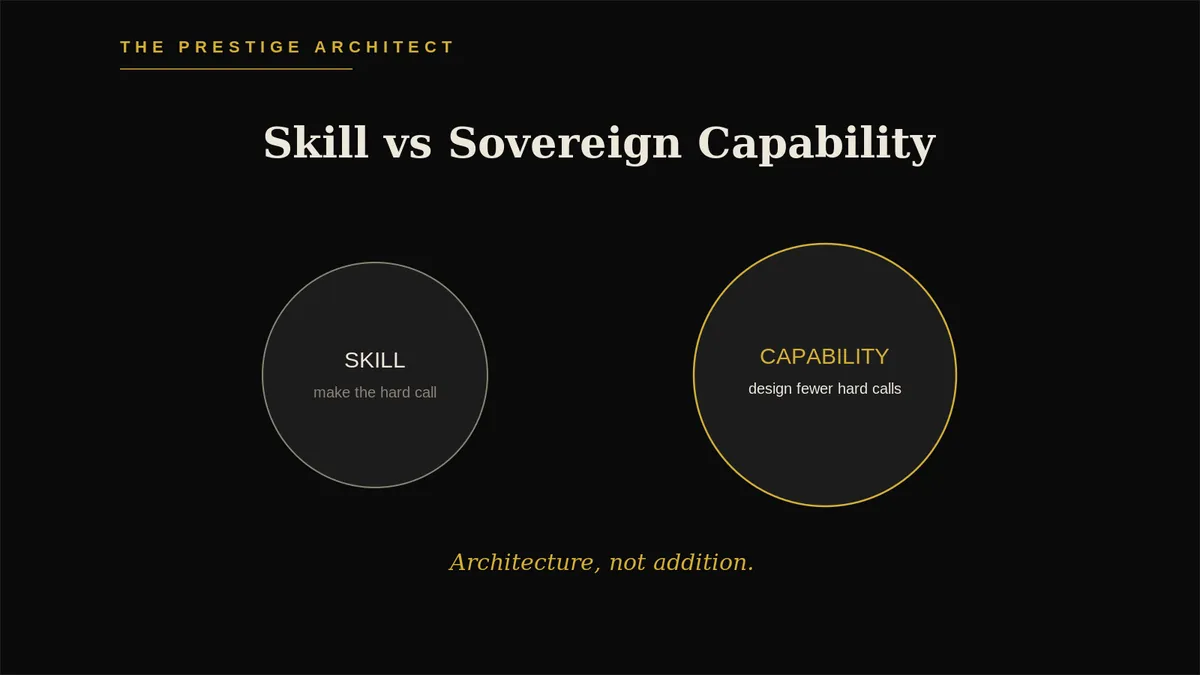
Here is the contrast in plain terms.
- Collapsed: you clear tasks. Sovereign: you move what only you can move.
- Collapsed: reclaiming feels like help. Sovereign: reclaiming is theft of ownership.
- Collapsed: the task is your identity. Sovereign: your identity holds without it.
- Collapsed: doing proves you. Sovereign: restraint proves you.
- Collapsed: work loops back. Sovereign: the layer holds the work.
You did not lose the day to the fires. You lost it to your own hand, reaching for work that was never yours to hold.
You can start the first move alone. Run a handback audit this week. Write down the last ten things you did. Mark each one Mine or Theirs. The Theirs ones are the work you took back. Then set one rule. When a fire routes to you, hand back the decision within one day, not the task. Give the person the right to choose. Keep your hands off the doing.
That rule will hold for a while. Then your hand will reach again, because the deeper cause is still live. If you want the part you cannot reach alone, book the Fast Future Freedom Blueprint™, the free 60-minute identity audit. Start the Fast Future Freedom Blueprint here.
What this looks like in a real seat
The leaders I sit with who run all day almost always trace it to one habit. They do not have a delegation problem. They delegate well. Then they quietly pull the work back when no one is watching. They rewrite the deck. They answer the email that was not theirs. They step into the call to fix the moment. Each reach feels small. Together they rebuild the collapse by hand. The seat looks full and leads nothing. The work only they can do waits, untouched, because their hands are full of work that belongs to the layer below. The return starts when they catch the reach and let it drop.
The architecture of your return
The audit and the rule are the self-serve start. They solve the surface. They will not hold the identity underneath, because that part is not a time problem. It is a state of being. You reach for the work because, without it, you are not sure who you are in the room. That is not a flaw to manage. It is identity infrastructure to rebuild.
This is the work Baz Porter® architects. Not effort. Return.™ A return to a self that leads without needing the task to prove it. When that self is in place, your hand stops reaching, and the layer you built finally holds. If you are ready to rebuild it, apply for the Fast Future Freedom Blueprint™. Apply for your Fast Future Freedom Blueprint and start the return.
Questions leaders ask about taking the work back
What does taking the work back mean?
It means you delegate a task, then quietly reclaim it. You rewrite the work, redo it, or step in to finish it. The task returns to your desk. In Silent Collapse™, this is why a capable leader runs all day and still leads nothing. The habit feels like help, but it keeps the fires routing to you.
Why do I keep taking work back after I delegate it?
Two reasons sit under it. On the surface, you believe you are faster, so you reclaim to save time. Underneath, the work holds your sense of who you are. Letting it go feels like disappearing. So your hand reaches for it again. The surface reason you can solve. The deeper one needs identity work.
How do I stop taking the work back this week?
Run a handback audit. List the last ten things you did and mark each Mine or Theirs. The Theirs items are what you reclaimed. Then set one rule. When a fire routes to you, hand back the decision within a day, not the task. Give the person the right to choose and keep your hands off the doing.
Is delegating the same as not caring?
No. Reclaiming the work is what trains your team to wait. When you hand over the decision and leave it there, you give them ownership. That is care with structure. You still set the standard. You stop being the one who carries every task to the finish.
What is the RAMS™ framework and how does it help here?
RAMS™ stands for Results, Attitude, Authenticity, Mastery, and Systems. It is the framework Baz Porter®, The Sovereign Leadership Architect, uses to rebuild the identity beneath high performance. For this habit, it shifts you from proving yourself by doing to leading from a self that holds without the task. The Fast Future Freedom Blueprint™ is where that return begins.
About the author
Baz Porter® is The Sovereign Leadership Architect. He rebuilds the identity beneath high performance, so leaders decide, lead, and live from a self that is genuinely their own. He works with accomplished people who look strong on the outside and feel unseen on the inside. His work begins underneath the visible problem, at the level of state of being.