How to Stop Over-Explaining in the Room
You make your point. Then you keep talking. You add the reason. Then the reason behind the reason. By the fourth sentence, the room has moved on. The thing you actually said is buried under everything you said after it.
This is not a word problem. It is a state. Baz Porter® calls it Silent Collapse™: the quiet place a capable leader reaches when the voice that built everything stops trusting itself in the room. You over-explain because some part of you is no longer sure you will be backed. The padding is a request to be allowed to have spoken. The manifesto names this state plainly, and names the way back.
On this page
- Key takeaways
- The short answer
- The hidden pattern under over-explaining
- How to stop over-explaining, one pillar at a time
- What this looks like in the room
- The architecture of your return
- Frequently asked questions
Key takeaways
- Over-explaining is not a lack of clarity. It is a lack of trust that you will be backed.
- The extra sentences read as doubt, not depth. The longer you go, the less sure you sound.
- The move back is one structure: one claim, one reason, one full stop.
- The pull to add more sits at the level of identity, not technique.
- You can start the practice this week. The source of the pull is the deeper work.
The short answer
To stop over-explaining, state your point in one sentence. Give one reason. Then stop. The extra sentences are not information. They are self-justification, and the room hears them as doubt. RAMS™ treats this as a Sovereign Leadership™ problem, not a speaking-skill problem. The clearest voice in the room is usually the one that says the least. You are not trying to talk better. You are trying to trust the first sentence enough to let it stand alone.
The hidden pattern under over-explaining
Over-explaining looks like generosity. It is usually fear. Two findings make the mechanism clear.
People manage impressions hardest when they doubt their standing. Leary and Kowalski (1990), in Psychological Bulletin, showed that we work to control how we are seen most when we feel our image is at risk. The more you doubt you will be backed, the more you explain. The explaining is the doubt, made audible.
The second finding is sharper. Hosman (1989), in Human Communication Research, found that hedges and piled-up qualifiers lower how competent a speaker seems. The extra words do not add weight. They remove it. You sound less certain the longer you go.
Put the two together. You over-explain because you are unsure. And the over-explaining makes you sound unsure. It is a loop that feeds itself. The way out is not more words chosen better. It is fewer words trusted more.
How to stop over-explaining, one pillar at a time
RAMS™ is five pillars: Results, Attitude, Authenticity, Mastery, Systems. The return runs through all five.
Results
Results come from the point, not the padding. One clean sentence lands. Four sentences dilute it. Say the decision. Name the one reason. Let it sit. The room acts on what it can hold, and it can hold one thing.
Attitude
Attitude is the belief that your point can stand without a defense. You do not owe the room a trial. You owe it a position. State it, then stop. If a question comes, answer that one. Do not answer the ten no one asked.
Authenticity
Authenticity is saying what you mean in your own plain words. Over-explaining is a performance of reasonableness. It hides the real sentence inside safer ones. Your voice returns when the first sentence is the true one, said without a cushion around it.
Mastery
Mastery is the discipline of the single statement. Make the point. Give one reason. Stop talking. The pause that follows is not emptiness. It is authority. Most people rush to fill it because the silence feels like exposure. The composed leader lets it work.
Systems
Systems make it repeatable under pressure. Use one structure every time: one claim, one reason, one full stop. Write the claim in six words before the meeting. Say those six words first. Everything after is optional, and most of it is not needed.
Here is the contrast, in the room:
- Collapsed: you make the point, then defend it before anyone argues.
- Sovereign: you make the point, then let the silence ask the question.
- Collapsed: you answer the objection no one raised.
- Sovereign: you answer only the objection that comes.
- Collapsed: your best sentence is third, buried under qualifiers.
- Sovereign: your best sentence is first, and it stands alone.
You are not out of things to say. You said the real thing, and then you talked over it.
If you want to find where the doubt under the over-explaining actually lives, start with the Fast Future Freedom Blueprint™. It is a free 60-minute identity audit. You leave knowing the one room where your voice first went quiet.
What this looks like in the room
The leaders I sit with who over-explain almost always trace it to one room. A table where, once, being right was not enough to be backed. They learned to pre-pay for every point with reasons. The habit kept them safe then. It costs them now.
Years later, the pattern is still running, in rooms where they already hold the authority. They make a sound call, then bury it under a defense no one needed. The team hears a strong leader who seems unsure. The fear is old. The explaining is current. Naming that first room is where it starts to stop.
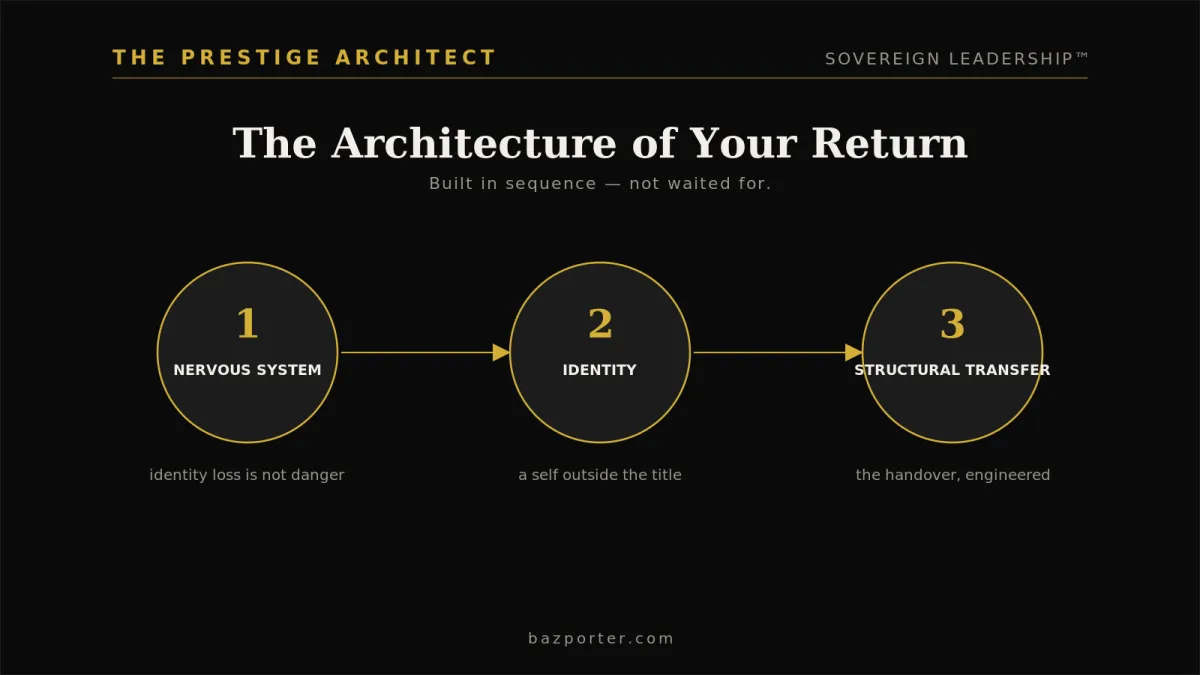
The architecture of your return
You can start this yourself this week. Say the point. Give one reason. Stop. You will feel the pull to add more. Do not. Count to three in the silence and let the room carry it.
That first move is real, and it works. But the pull itself has a source you cannot see from inside the habit. It sits at the level of identity, not technique. It is the quiet belief that your voice needs a permit to be in the room. That belief is not undone by speaking shorter. It is undone underneath, where it was formed.
That is the work that does not happen alone. Bring it to the Fast Future Freedom Blueprint™, the free 60-minute identity audit. We find the room, name the belief, and begin the return to the voice that was always yours. This is a return, not a repair. The voice is not gone. It went quiet.
Frequently asked questions
What does it mean to over-explain at work?
Over-explaining is saying a thing once, then saying it again in other words, then defending it before anyone pushes back. The point is made, then padded. At work it shows up as long answers to short questions, and reasons stacked on reasons. The information was complete three sentences ago.
Why do I over-explain when I already know I am right?
Because knowing you are right is not the same as trusting you will be backed. The explaining is aimed at that gap, not at the facts. You are pre-answering a doubt in the room, or in yourself. The certainty is there. The safety is what you are still trying to buy.
How do I stop over-explaining in meetings?
Use one structure: one claim, one reason, one full stop. Write your claim in six words before the meeting and say those words first. When the pull to add more arrives, stay silent and let the room respond. Answer only the question that actually comes.
Is over-explaining a sign of low confidence?
Often, though not always. It can be a trained habit from a room where your word once was not enough. The research on powerless speech shows that piled-up qualifiers lower how competent a speaker seems. So the habit does not only come from low confidence. It also feeds it.
How is over-explaining different from being thorough?
Thorough means the listener has what they need to decide. Over-explaining means you keep going after that point, to settle your own nerves. One serves the room. The other serves the fear. The test is simple: if the extra sentence is for you, not for them, it is over-explaining.
Baz Porter® is The Sovereign Leadership Architect. He rebuilds the identity beneath high performance, so leaders decide, lead, and live from a self that is genuinely their own. He works with accomplished people who look strong on the outside and feel unseen on the inside. His work begins underneath the visible problem, at the level of state of being.