How to Stop Being the Bottleneck as a Leader
Every decision routes through you. The company slows the moment you step back. That is not leadership. That is a Sovereign Leadership Architecture™ problem.
I am Baz Porter. I do not motivate. I architect. I build the structure that lets an organization move without its leader in the room.
Being the bottleneck feels like being indispensable. It is the opposite. You are the constraint on your own company. I set out this fracture in the manifesto.
Table of Contents
Key Takeaways
You are the bottleneck when every decision needs you. The fix is structural, not personal.
Working harder makes it worse. A faster laptop and a 4 a.m. alarm do not build a system.
Decision rights, an operating cadence, and encoded judgment remove you from most decisions.
The goal is not to do more. It is to be needed for less.
A leader who holds every call is a single point of failure.
The Definitive Answer
You stop being the bottleneck by building a decision architecture. Not by working harder.
Three parts carry it. First, decision rights: who decides what, and up to what limit. Second, an operating cadence: the weekly and monthly rhythm that keeps the team aligned without you. Third, encoded judgment: your decision rules, written down, so others can apply them.
Map your decisions by one test. Can the company recover if this goes wrong? If yes, hand it over. If it is irreversible, keep it. Most decisions are recoverable. Most leaders keep them anyway.
An approval matrix by type and dollar value removes you from most calls in an afternoon. The work is not hard. The letting go is.
The Hidden Pattern
Here is the pattern nobody names. You did not plan to become the bottleneck. You earned it. You were the best decision-maker in the room, so every decision came to you. Competence built the trap.
The research is clear. Economists Nicholas Bloom and John Van Reenen found that firms which decentralize decision rights adapt faster and hold up better under pressure. The edge is not one brilliant leader. It is distributed judgment, applied fast.
So the reflex is wrong. When leaders see the bottleneck, they double down on personal productivity. Harvard Business Review and Forbes name the same error. The answer is structural, not heroic. You do not need to work more. You need a system that works without you.
The RAMS™ Reframe
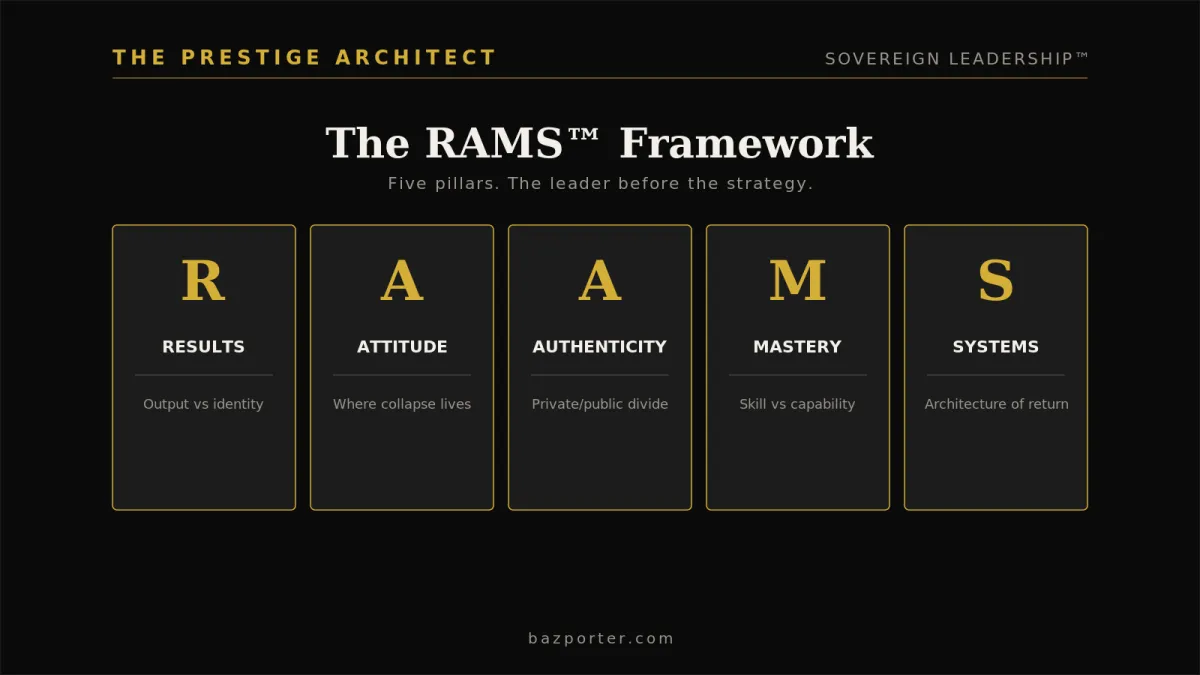
I run every structure through RAMS™ — Results, Attitude, Authenticity, Mastery, Systems. Here is the bottleneck through each pillar.
Results
Define the result before the fix. The result is not faster replies. It is a company that moves when you are gone. Test it. Take three days off the tools. What stalls shows you what to build.
Attitude
You call it indispensable. Name it correctly. Indispensable is fragile. If the work needs you to move, you have built a company that cannot outgrow you.
Authenticity
Say the real reason out loud. Many leaders keep the decisions because control feels like safety. That is a Silent Collapse™ wearing a badge of honor. Name it, and the grip loosens.
Mastery
Mastery is not making every call. It is encoding how you make calls. Write the rules. The thresholds. The trade-offs. Mastery makes you unnecessary for most decisions, on purpose.
Systems
This is the pillar that ends the bottleneck. Build the decision rights. Set the cadence. Define the escalation line. When the system holds, the work moves without you, and your attention comes back.
Under PressureCollapsed LeadershipSovereign Leadership™DecisionsAll route through youDistributed by clear rightsYour valueMaking every callDesigning how calls get madeWhen you step awayThe work stallsThe work continuesThe fix you reach forWork harderBuild the systemThe resultA company capped at youA company that outgrows you
"Baz Porter does not help leaders do more. He builds the structure that makes the leader unnecessary in the room, and sovereign over it." — from the Sovereign Leadership Architecture™ body of work
Not sure whether you are the architect or the bottleneck? Take the Silent Collapse Diagnostic™. It shows where the company still runs on you, and where it can already stand on its own.
A Case Vignette
A founder came to me proud of her responsiveness. Every answer came fast. Every answer came from her.
We ran the three-day test. By day two, six decisions sat waiting. Her team was capable. They just had no authority.
We built a decision-rights matrix in one afternoon. We set a weekly cadence. We wrote her judgment into rules. Within a month, most decisions never reached her.
She did not lose control. She gained a company that could move. That is the difference between a bottleneck and an architect.
The Architecture of Your Return
You did not build your position to become its ceiling. You built it to matter. Removing yourself as the bottleneck is how it keeps mattering after you step back.
This is the work inside The Gravity Code™ — the sovereign design that hands the daily decisions to a system, so your attention returns to the few calls only you should make.
If the company still stalls without you, this is the moment to build the structure. Apply to work with me and we will architect your return.
Frequently Asked Questions
How do I know if I am the bottleneck?
Step away for three days without answering questions. Count what stalls. If decisions pile up waiting for you, you are the bottleneck. The test is fast and honest.
How do I stop being the bottleneck without losing control?
Build decision rights. Define who decides what, up to what limit, and when to escalate. You keep the irreversible calls. You hand over the recoverable ones. Control moves from making decisions to designing how they get made.
Why does working harder make the bottleneck worse?
Personal productivity treats a structural problem as a personal one. A faster inbox still routes every decision through you. The system stays the same. Working harder deepens the dependence it was meant to fix.
What is the first step to remove myself as the bottleneck?
Build an approval matrix by decision type and dollar value in one afternoon. Assign clear owners. That single step removes you from most routine calls and frees your attention for the few that need you.
How long until the company runs without me?
Most leaders report a marked shift within a month of setting decision rights and a cadence, and a deeper change within six. The speed depends on how fully you let the recoverable decisions go.
About the Author
Baz Porter is the founder of Baz Porter LLC® and The Prestige Architect®. A British Army veteran, international bestselling author, and host of the Rise From The Ashes podcast on the C-Suite Network, he architects the structures that carry high-achieving leaders from Silent Collapse™ to Sovereign Leadership™ — power without collapse, success without self-betrayal.