How to Stop Rehearsing Before You Speak
How to Stop Rehearsing Before You Speak
You already know what you want to say. You have known it for years. Still, you rehearse before you speak. You run the words in the car. You script the opening line. You trim the phrasing, then trim it again. This is Silent Collapse™, the quiet state where the voice went still and the rehearsing grew loud. The leader who once spoke plainly now over-prepares every line. If you want the deeper read on how that state forms, start with the manifesto.
You are not out of things to say. You have gone quiet, and the rehearsing is the sound of it.
What you will find here
- The short answer
- Key takeaways
- The hidden pattern under the rehearsing
- The RAMS™ reframe, pillar by pillar
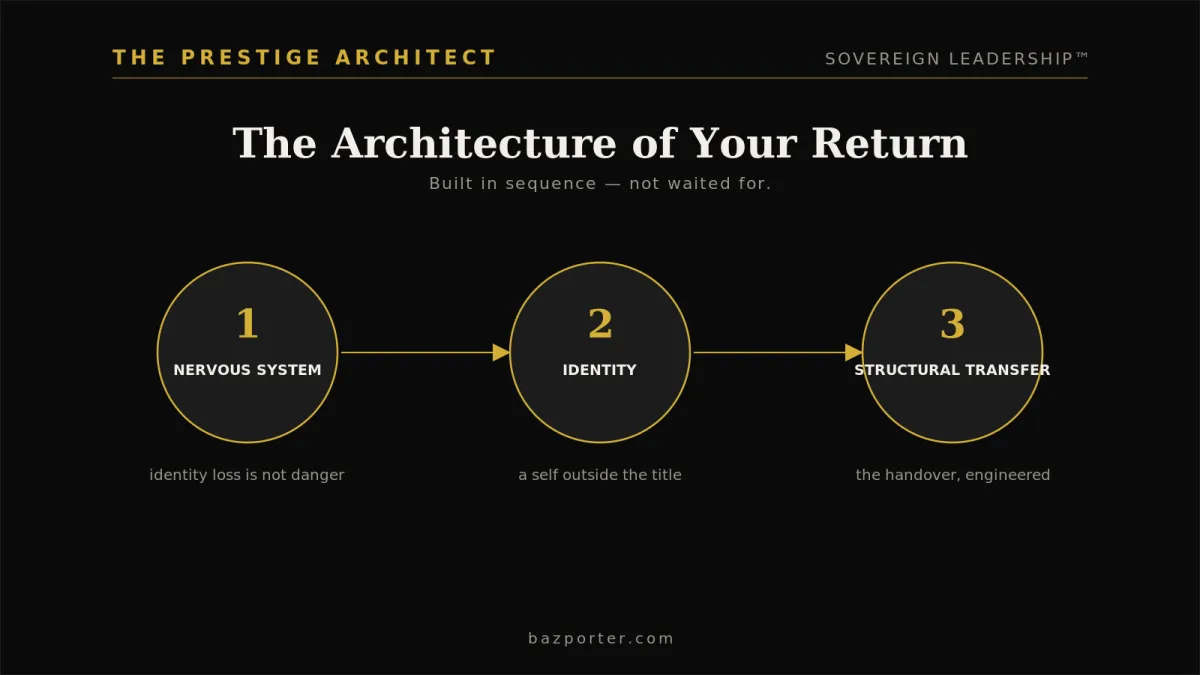
- The architecture of your return
- Questions leaders ask
How to stop rehearsing before you speak
To stop rehearsing before you speak, you stop treating the room as a test. You already carry the point. The work is to trust it live, not to pre-write it. Prepare the one idea, not the exact words. Then let the sentence form in the moment. Rehearsing feels like safety. It is the opposite. It pulls you out of the room and into your own head. You end up listening to your script instead of the people in front of you. The return is simple to name and steady to build. You speak from what you already know, and you let it land as it is. The voice you are trying to script is the voice you already have.
Key takeaways
- Rehearsing is not readiness. It is self-doubt wearing a suit.
- Over-preparing the words makes your delivery stiffer, not stronger.
- The room notices your scripting far less than you fear.
- Prepare one clear idea, never the exact phrasing.
- The return is to your own voice, not to a new one.
The hidden pattern under the rehearsing
Here is the part no one names. Rehearsing does not protect your performance. It degrades it. When you watch your own words as you say them, you choke the very skill you built.
Researchers call this attention to execution. Beilock and Carr studied skilled performers under pressure in 2001. They found that self-focus, close attention to each step of a practiced skill, made expert performance worse, not better (Beilock and Carr, 2001, Journal of Experimental Psychology: General). Your voice is a practiced skill. You have led rooms for years. When you script and monitor each phrase, you turn a fluent act into a careful one. Careful sounds flat. Fluent sounds like you.
There is a second study worth holding. Gilovich, Medvec, and Savitsky named the spotlight effect in 2000. People consistently overestimate how much others notice them (Gilovich, Medvec, and Savitsky, 2000, Journal of Personality and Social Psychology). You believe the room is grading your sentences. It is not. The audit you fear is the one you run on yourself. So the rehearsing serves no reader. It only feeds the loop.
You do not have a words problem. You have a trust problem wearing the costume of preparation.
The RAMS™ reframe, pillar by pillar
RAMS™ is the framework beneath the return: Results, Attitude, Authenticity, Mastery, Systems. Rehearsing touches all five. So does the way back.
Results. You think rehearsing raises your odds. The result is a stiffer, slower voice that lands with less weight. Prepare the idea and the result improves. The room hears a leader, not a script reader.
Attitude. The rehearsing carries a belief. It says your plain word is not enough. That belief is old, and it is wrong. Your plain word built the career you have. Treat it as sufficient, because it is.
Authenticity. A rehearsed line is a line you are performing. The room feels the gap between the person and the script. Authenticity closes that gap. You say the true thing in your own cadence. People trust what sounds lived, not what sounds learned.
Mastery. Mastery is not more preparation. It is the nerve to speak from what you already hold. You stop drafting and start trusting. The pause before a real sentence is mastery, not a gap to fill.
Systems. You need a repeatable way in, not willpower. Before a room, write one sentence: the single idea you want to leave. One idea, never the wording. Walk in with that and nothing else. The system removes the script and keeps the signal.
Collapsed voice versus sovereign voice
- Collapsed: scripts the opening. Sovereign: prepares one idea.
- Collapsed: watches each word land. Sovereign: watches the room.
- Collapsed: speaks to avoid a mistake. Sovereign: speaks to be clear.
- Collapsed: edits in the car for an hour. Sovereign: names the point in a line.
- Collapsed: waits until the words are perfect. Sovereign: speaks when the idea is true.
If you want the first move done with you, the Fast Future Freedom Blueprint™ is the free 60-minute identity audit. It reads the state underneath the rehearsing, not the symptom on the surface.
The architecture of your return
The leaders I sit with who over-prepare almost always share one thing. They trace the rehearsing to a single room, years back, where their plain word was not backed. They learned to pre-build every sentence so no gap could be used against them. The scripting kept them safe once. Now it keeps them quiet.
You can start the return on your own this week. Pick one meeting. Prepare only the idea, one written sentence. Then speak it live, unscripted, and let the pause do its work. You will feel the pull to pre-write. Name it and let it pass. That is the self-serve first move, and it is real.
The part you cannot reach alone is the room that taught you to rehearse. That belief does not live in your calendar. It lives at the level of identity, in who you decided to be after that room. That is the work of counsel, not another checklist. The Fast Future Freedom Blueprint™ is where the deeper cause gets named and the return gets built. This is not change for its own sake. It is the return to the voice that was always yours, the one that set rooms before the room went quiet.
Questions leaders ask
Why do I rehearse what I already know?
Because rehearsing feels like control in a room where you once felt exposed. It is not about the content. You know the content. It is about a fear that your plain word will not be backed. The rehearsing is a guard you built, and it outlived the threat.
Is over-preparing a sign of weak confidence?
Often, yes. Over-preparing the exact words tells the room you do not trust your own live voice. Confidence is not more scripting. It is the nerve to speak the idea as it forms. Prepare the point, then let the sentence come.
How do I speak without scripting every word?
Write one sentence before the room: the single idea you want to leave. Carry that and nothing else. When it is your turn, say the idea in your own cadence. The words will arrive because you already own the thought.
Why does my point land flat even when I prepared it?
Because a rehearsed line sounds rehearsed. The room hears the script, not the person. When you monitor each word, your delivery turns careful and careful reads as flat. Speak from the idea and the weight returns to your voice.
What is the first step to trust my voice in the moment?
Choose one low-stakes meeting this week. Prepare only the idea, never the phrasing. Speak it unscripted and sit in the pause afterward. One true, unrehearsed sentence rebuilds more trust than an hour of drafting.
About the author
Baz Porter® is The Sovereign Leadership Architect. He rebuilds the identity beneath high performance, so leaders decide, lead, and live from a self that is genuinely their own. He works with accomplished people who look strong on the outside and feel unseen on the inside. His work begins underneath the visible problem, at the level of state of being.