Why You Shrink in Meetings You Used to Own
You used to set the room. Now you make yourself smaller in it. You drop your voice. You take the smaller chair. You let the point go. If you shrink in meetings you used to lead, this is for you. Silent Collapse™ is the name for this quiet. It is the state where a capable leader keeps delivering and slowly goes small in the rooms that matter most. You are not out of ideas. You have gone quiet. This is not weakness. It is a pattern, and patterns can be read. The manifesto behind this work starts right there, with the self that went quiet and the return that brings it back.
On this page
- What shrinking in meetings really is
- Key takeaways
- The hidden pattern underneath it
- The RAMS™ reframe: back to full size
- A pattern I see
- The architecture of your return
- Frequently asked questions
Key takeaways
- Shrinking in meetings is a protective reflex, not a flaw.
- Your body reads a high-stakes room as a status threat.
- Silent Collapse™ names the quiet. The return brings your voice back.
- One un-trimmed point per meeting starts the shift this week.
- RAMS™ rebuilds presence through reps and systems, not force.
What shrinking in meetings really is
Shrinking in meetings is the quiet habit of making your presence smaller than your position. You trim the point before it leaves your mouth. You lower your voice. You defer to the loudest person. You hold the strong view back. It is not a confidence problem you can will away. It is Silent Collapse™, a protective response to a room your nervous system reads as a threat. The way back is not force. It is architecture.
You still do the work. The numbers still hold. On the outside you look strong. Inside, you feel unseen. That gap is the whole point. The world sees output. You feel yourself getting smaller. It rarely shows up as one big moment. It shows up as a hundred small retreats. A point not made. A chair pushed back. A sentence that ends early. Naming the gap is the first honest step.
The hidden pattern underneath it
Your body treats a high-stakes room like danger. Research on social-evaluative threat shows the pattern clearly. When status feels at risk, the body releases cortisol and triggers a withdrawal response (Dickerson and Kemeny, 2004, Psychological Bulletin). You get quiet. You get small. A second line of research shows social rejection registers in the brain much like physical pain (Eisenberger, Lieberman, and Williams, 2003, Science). So the room does not just feel hard. It registers as a threat to guard against.
Shrinking is the oldest protection there is. Make yourself small, and the danger may pass. That reflex kept your ancestors safe. In a boardroom it costs you the room. The reflex is not faulty logic. It is old logic, running on data that no longer applies. The body is doing its job. The job is just aimed at the wrong target.
Here is one move for this week. Before the next meeting, pick one line you will not shrink on. One point. Say it in the first ten minutes. Say it at full volume. No disclaimer in front of it. Then run a short audit. Each time you go small, write down the trigger. Name the room. Name the person. The pattern will show itself fast. That is the self-serve first move, and it is real.
The RAMS™ reframe: back to full size
RAMS™ rebuilds presence from the inside. Five pillars. Results, Attitude, Authenticity, Mastery, Systems.
Results. Results come from the point you actually make. A trimmed point moves nothing. Decide what the room needs. Speak to that, and let the rest go.
Attitude. Attitude is the stance you hold before the first word. Walk in as the person the room already respects. You earned the chair. Sit in all of it.
Authenticity. Authenticity is the match between what you think and what you say. Shrinking breaks that match. Every trimmed point is a small self-betrayal. The return is plain. Say the true thing, once, without the hedge.
Mastery. Mastery is reps, not nerve. You do not need more courage. You need more at-bats. One honest line per meeting. Then two. Presence is a trained muscle.
Systems. Systems hold the gain when nerve runs low. A pre-meeting note. A standing first point. A three-word reminder on your screen. The system speaks when the feeling says hide.
Here is the contrast, plainly.
- Collapsed: you take the smaller chair. Sovereign: you take your chair.
- Collapsed: you lower your voice to pass. Sovereign: you speak at your true volume.
- Collapsed: you defer the point. Sovereign: you make the point.
- Collapsed: you wait to be invited in. Sovereign: you enter on your own timing.
- Collapsed: you edit yourself into agreement. Sovereign: you hold your own view.
You did not lose your voice. You trained it to hide. Training can be reversed.
The first move above starts the shift. The deeper cause sits under the room, in the identity that learned to go small. You cannot see that part from inside the meeting. The Fast Future Freedom Blueprint™ is the free 60-minute identity audit where that part gets named. It is the one door. Start there.
A pattern I see
A pattern I see often. The leaders I sit with who have gone small almost always trace it to one room. A season where speaking cost them. A person who talked over them. A win that got claimed by someone else. The body learned the lesson. Smaller is safer. The habit outlived the room that taught it.
They are still capable. The old threat is long gone. The shrinking stayed behind like a scar. Naming that one room is where the return begins. The story is not who they are. It is what they learned. What was learned can be unlearned.
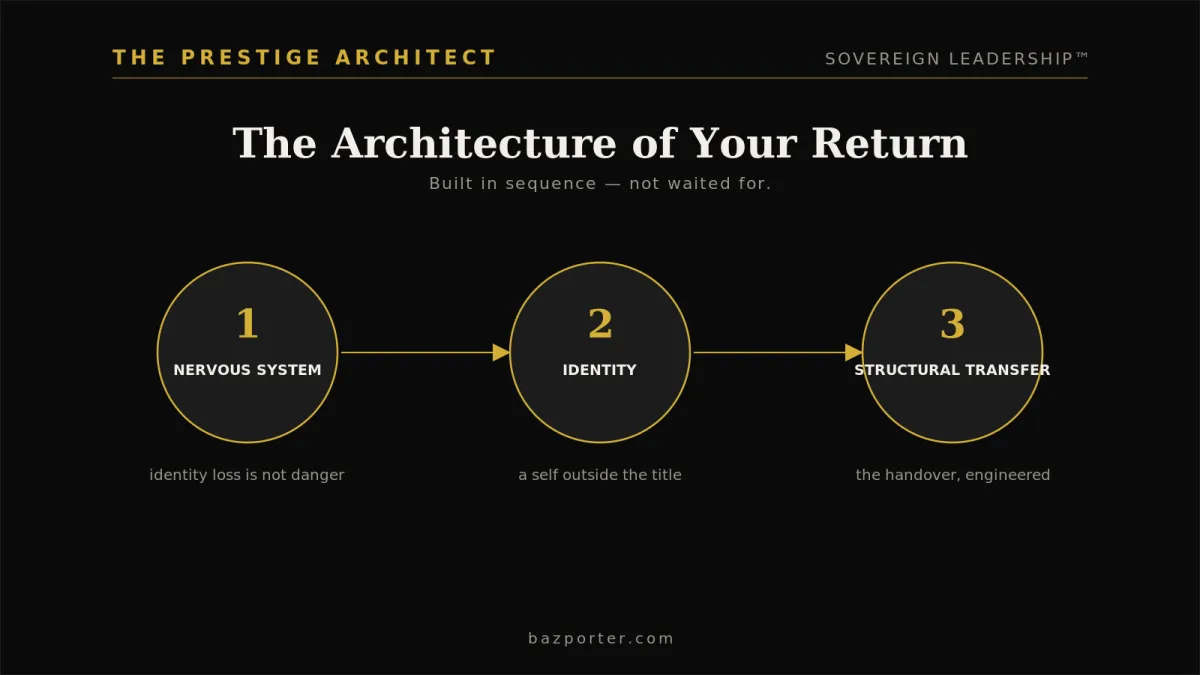
The architecture of your return
The return is not a pep talk. It is architecture. You rebuild the self underneath the performance, so presence stops costing you. That is Sovereign Leadership™, the work of leading from a self that is genuinely your own. This is not a new you. It is the return of the one who was always there. Return.™
You do not get there by trying harder in the next meeting. You get there by changing what the room means to you. That change happens below the surface, at the level of state of being. When you are ready to start, apply for the Fast Future Freedom Blueprint™, the free 60-minute identity audit. One door. One real first step.
Frequently asked questions
Why do I shrink in meetings I used to lead?
You shrink in meetings when your body reads the room as a status threat. It is a protective response, not a loss of ability. Silent Collapse™ is the name for that quiet. The habit can be retrained once you see it.
Is shrinking in meetings a confidence problem?
Not only. Confidence is the feeling on the surface. The real driver is a learned protection pattern under the feeling. You change it with reps and systems, not willpower alone.
How do I stop making myself smaller at work?
Pick one point you will not trim, and say it early, at full volume. Then audit each time you go small and name the trigger. Small reps rebuild presence faster than one big leap.
What is the difference between being quiet and shrinking?
Quiet can be a choice you make on purpose. Shrinking is a reflex that costs you the room. One is strategy. The other is self-protection running on old data.
Can I rebuild my presence without forcing it?
Yes. Force fades the moment nerve runs low. Architecture holds. The Fast Future Freedom Blueprint™ is where that rebuild starts, with the identity underneath the room.
Baz Porter® is The Sovereign Leadership Architect. He rebuilds the identity beneath high performance, so leaders decide, lead, and live from a self that is genuinely their own. He works with accomplished people who look strong on the outside and feel unseen on the inside. His work begins underneath the visible problem, at the level of state of being.