How to Build a Self-Trust Operating System
How to Build a Self-Trust Operating System
Every leader in Silent Collapse™ hits the same quiet wall. The decisions still get made. The trust behind them is gone. You sign off, then you replay it. You choose, then you audit the choice at midnight. This is not a character flaw. It is a load failure. Read the manifesto and you will see the pattern named plainly.
What follows is the build. Not a pep talk. A standing system that returns your judgment to you, one rule at a time.
On this page
Key takeaways
Self-trust is the output of a system, not a mood.
You cannot decide your way back to confidence.
Fewer decisions plus one standard restores judgment.
A written record ends the midnight replay.
The rebuild follows RAMS™, pillar by pillar.
What a self-trust operating system is
A self-trust operating system is a fixed set of rules that decides how you decide. It sets what you rule on. It sets what you hand off. It sets what you ignore. It holds one standard, not a shifting mood. It keeps a written record, so past calls stop haunting you.
The word system matters here. A mood comes and goes. A system runs on a heavy day and a light one. Trust returns because the process is stable, even when you are not. You stop grading your gut. You start running a method you can point to. That shift is the whole game.
The hidden pattern behind lost judgment
Here is what the evidence shows. Judgment rarely erodes from weakness. It erodes from volume. Work on decision fatigue finds that choice quality falls as choices stack up across a day (Harvard Business Review). The mind spends the same budget on a large call and a tiny one.
Spend that budget on forty small calls, and the important one starts at empty. The felt result is doubt. The real cause is an unmanaged load. Behavioral research separates fast, automatic thinking from slow, effortful thinking, and shows the slow system tires under sustained demand (American Psychological Association). Your instinct did not leave. It got buried under traffic. Clear the traffic, and the doubt has nowhere to stand.
The RAMS™ rebuild, pillar by pillar
The RAMS™ method rebuilds trust in order. Results, Attitude, Authenticity, Mastery, Systems. Each pillar removes one source of doubt.
Results
Define the outcome each decision serves. A call with no target cannot be judged. Name the result first, and the choice narrows itself. Half of your hardest decisions get easy the moment the target is written down.
Attitude
Treat doubt as data, not verdict. Doubt flags a missing input. It does not prove you are wrong. Log the doubt. Check the input. Then decide with the gap closed instead of the alarm ringing.
Authenticity
Decide from your own standard, not the room. Borrowed judgment feels safe and ages badly. When you rule to please the loudest voice, you lose the thread of your own. Your standard is the only one you can defend at rest. Return to it on purpose.
Mastery
Practice the same decision shape until it is reflex. Reps build a floor under you. The floor is what confidence stands on. A call you have made a hundred times does not drain you. It runs on rails you laid.
Systems
Write the rule down and let it run. A rule on paper survives a bad night. A rule in your head does not. This is the pillar that holds the other four in place. It is also the one leaders skip first.
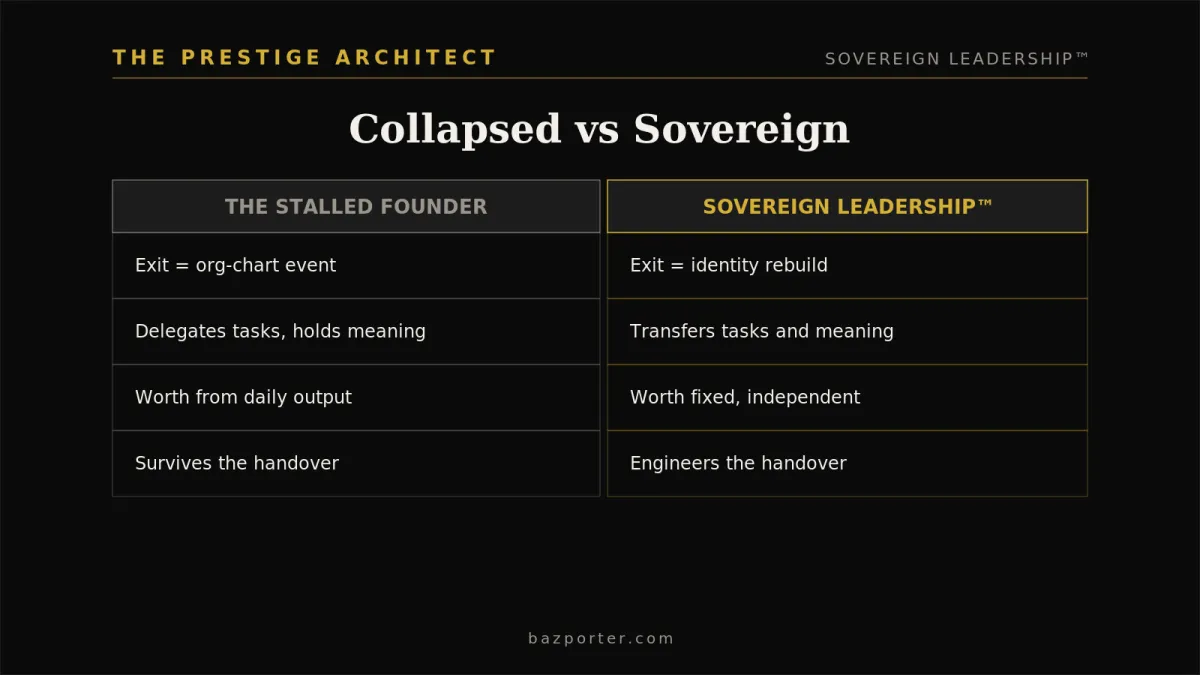
Set side by side, the two states are stark.
Collapsed: every decision starts from zero. Sovereign: most decisions run on a default.
Collapsed: you carry each call in your head. Sovereign: the record carries it for you.
Collapsed: doubt stops the work. Sovereign: doubt triggers a check, then the work goes on.
Collapsed: the standard shifts with your mood. Sovereign: the standard holds when the mood does not.
You do not feel your way back to trust. You build it, one rule at a time.
If that midnight replay runs every night, start with the Silent Collapse Diagnostic™. It shows you where your load is leaking and which pillar to build first.
A leader who ran it
One executive I counseled ran a nine-figure unit. She still rewrote the same email four times. Her calendar held close to sixty decisions a day. None of them carried a written standard. Her team read her hesitation as distance. She read it as failure.
We cut the decision count first. We set defaults for anything under a clear threshold. We built one page: the rule, the target, the record. Inside three weeks the replay stopped. Her judgment did not get sharper. Her load got lighter. The trust was there the whole time, under the volume. The system simply dug it out.
The change held because it lived on paper, not in her willpower. On her worst day, the page still ran. Her team stopped reading hesitation into her silence. She stopped auditing calls she had already made well. That is the mark of a working system. It protects your judgment when you have the least energy to defend it.
The architecture of your return
Your return is not a feeling you wait for. It is a structure you install. You name the results. You set the defaults. You keep the record. You defend one standard on the days you least want to.
This is the work of an architect, not a striver. Willpower runs out by evening. A system does not. Build it once and it carries the weight you have been carrying alone. When you are ready to build it with counsel, apply through the Silent Collapse Diagnostic™. We map your load and design the system that ends the doubt.
Questions leaders ask
What is a self-trust operating system?
It is a fixed set of rules for how you make and record decisions. It defines what you rule on, what you hand off, and what you ignore. The rules hold across good days and hard ones. Trust returns because the process is stable, not because your mood lifted.
How do I stop second-guessing my own decisions?
Give each decision a written target before you make it. Second-guessing feeds on vague goals. When the target is clear, the call either meets it or does not. You check the record instead of replaying the memory at 2am.
Why do I trust my judgment less as I lead more?
Because the volume of decisions rose faster than your system for them. More scope means more calls each day. Without defaults, every one drains the same budget. The felt drop in trust is a load signal, not a decline in ability.
Can I rebuild self-trust without more willpower?
Yes, and willpower is the wrong tool for it. Willpower runs out by evening. A system does not. You install defaults and a record once, then they carry the weight for you across every day that follows.
What is the first step to build one?
Count your daily decisions for two days. Then cut every call that does not need you. Set a default for the rest. That single move frees the budget your hardest decisions require.
About the author
Baz Porter® is the founder of Baz Porter LLC and the architect of Sovereign Leadership™. He counsels executives out of Silent Collapse™ and back into a return to their own judgment, using the RAMS™ method. His work rebuilds the leader before it rebuilds the strategy.