Self-Sabotage: Why You Undermine Your Own Success
By Baz Porter®, The Prestige Architect™
You are capable. You have the ideas. Yet the work that matters most stalls right before it is done. That pattern has a name. It is self-sabotage, and it runs quietly under Silent Collapse™.
This is not laziness. It is not a discipline problem. It is a protection reflex. Part of you keeps the work unfinished on purpose. An unfinished thing cannot be judged. It cannot fail in front of anyone.
So you start over. You chase the next idea. You rebuild from zero every week. And each restart tells you the same lie: that you cannot do this. You can. First read the manifesto, then let me show you the mechanism underneath.
In this article:
Key takeaways
What self-sabotage really is
The hidden pattern
Why willpower makes it worse
The RAMS™ reframe
One leader's return
The architecture of your return
Questions leaders ask
Key takeaways
Self-sabotage is a protection reflex, not a flaw in your character.
Unfinished work cannot be judged, so part of you keeps it unfinished.
The reflex gets stronger as the stakes rise, not weaker.
You do not end it with more willpower. You end it with structure.
RAMS™ gives you five levers to close the loop for good.
What self-sabotage really is
Self-sabotage is when a capable person acts against their own stated goal. You say you want to finish. Then you do the one thing that guarantees you will not. You open a new tab. You start a new build. You question the whole plan on the day it was due.
Psychologists call the core move self-handicapping. You place an obstacle in your own path. If the work then fails, the obstacle takes the blame, not you. Your sense of ability stays safe. Your progress does not. This is the quiet trade Lisa never agreed to, yet makes every week.
Read the pattern honestly and it stops looking like weakness. It looks like a system doing its job. The job is to protect you from a verdict. The cost is that nothing ever ships.
The hidden pattern
In 1978, two researchers named this move. Steven Berglas and Edward Jones called it self-handicapping in the Journal of Personality and Social Psychology. Their finding was simple and hard to hear. People protect their sense of ability by building a ready-made excuse.
A missed deadline is one excuse. A last-minute pivot is another. A shiny new idea that pulls focus from the old one is the most common of all. Each one gives you cover. If it does not work out, you were not really trying yet.
Here is the part almost no one says out loud. The reflex gets stronger the closer you get to a real win. A new level of income or visibility reads as unfamiliar. Your nervous system reads unfamiliar as unsafe. So it pulls you back to the striving you know. Harvard Business Review has documented how strong performers stall themselves right at that threshold. This is Silent Collapse™ wearing a productive mask.
Why willpower makes it worse
The common advice is to try harder. Push through. Want it more. That advice fails here, and it fails for a reason.
Willpower treats the symptom as the problem. But the reflex is not short on effort. It is doing exactly what it was built to do. When you attack it with pressure, you confirm the fear that started it. Now the stakes feel even higher. Psychology Today describes self-sabotage as a self-protective habit, not a motivation gap. You do not out-push a protection reflex. You out-build it.
The RAMS™ reframe
You do not end self-sabotage with pressure. You end it with architecture. RAMS™ runs five pillars: Results, Attitude, Authenticity, Mastery, and Systems. Here is each one applied to the finish line.
Results
Define done before you begin. Write the one outcome that counts. When done is vague, the work expands forever, and vague work has no finish to fear. A clear finish line removes the hiding place.
Attitude
Stop reading the restart as evidence. It is not proof that you cannot do this. It is a reflex firing on schedule. Name it as it happens. A named reflex loses most of its grip on you.
Authenticity
Tell the truth about what you fear. Not the deadline. The verdict on the other side of finishing. When you say the real fear plainly, it stops steering you from the dark. This is where the return begins.
Mastery
Master one loop, then close it. Pick the single project that matters most right now. Finish it before the next idea gets a vote. Completion is a skill. You build it the way you built every other skill, by repeating it.
Systems
Build a container that finishes for you. One project in progress. One weekly review. One place your work lives. Systems carry you when the reflex returns, and it will return. That is not failure. That is the design.
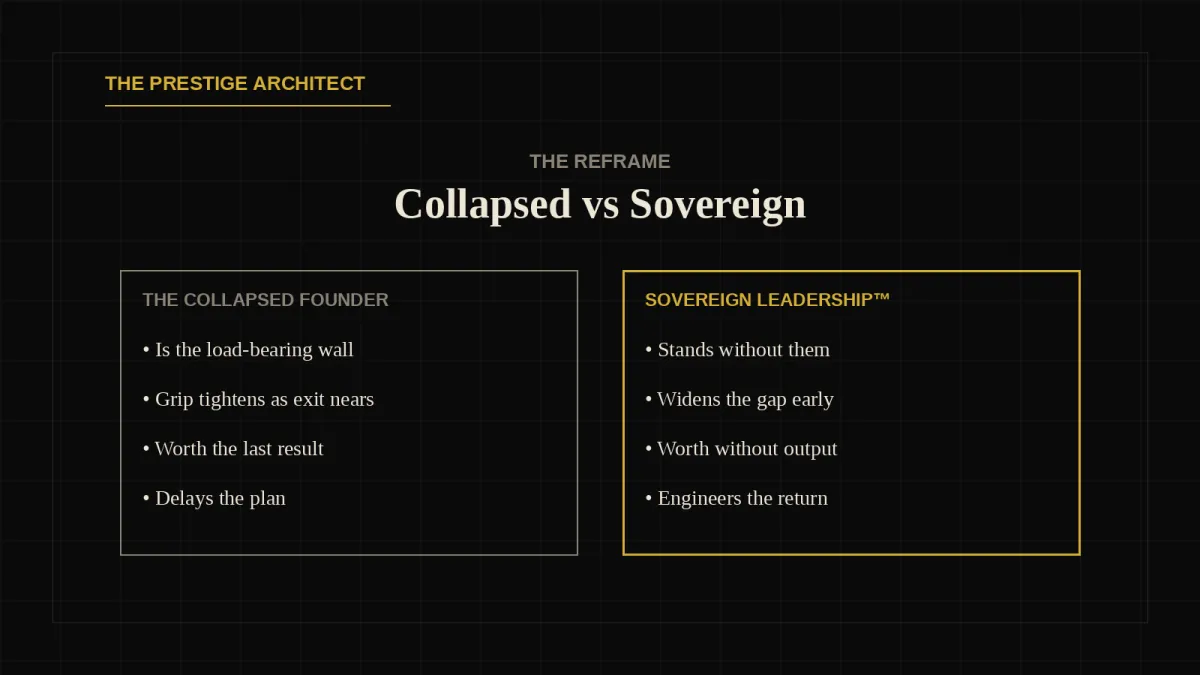
Collapsed versus Sovereign:
Collapsed: ten projects open, none shipped. Sovereign: one project closed, then the next.
Collapsed: a new idea the moment it gets hard. Sovereign: the same idea, seen all the way through.
Collapsed: rebuild from zero every week. Sovereign: one system you return to.
Collapsed: the restart proves you cannot. Sovereign: the finish proves you can.
Baz Porter does not motivate. He does not inspire. He architects the return.
If you see yourself in this, start with the Silent Collapse Diagnostic™. It shows you where the reflex lives and what it has cost you.
One leader's return
A founder came to me with nine unfinished builds. Each one stalled near eighty percent. Smart, funded, respected by everyone but themselves. And quietly certain they were a fraud about to be found out.
We did not add willpower. We closed one loop. One project, one finish line, one week. The relief did not come from the finish itself. It came from proving the old story wrong. The story that they could not do this. They could, and now they had the receipt. That is Sovereign Leadership™. Power without the collapse running underneath it.
The architecture of your return
You do not need another idea. You need a finish. The pattern is old, but it is not who you are. It is a reflex you can outbuild, one closed loop at a time.
Name the fear. Define done. Close one loop. Then repeat until finishing is simply who you are. When you are ready to build that structure with real counsel, apply through the Silent Collapse Diagnostic™. That is the first gate, and it is where the work starts.
Questions leaders ask
Why do high achievers self-sabotage?
Because success feels less familiar than striving. A real win moves you into territory you have never held. The nervous system reads that unknown as unsafe and pulls you back. So the achiever recreates the struggle they know by undermining the win they earned.
What is self-handicapping?
Self-handicapping is placing an obstacle in your own path on purpose. Berglas and Jones named it in 1978. If the work then fails, the obstacle takes the blame instead of your ability. It guards your self-image and stalls your progress at the same time.
Is self-sabotage a fear response?
Yes, most of the time. The fear is rarely about the task itself. It is about the judgment waiting after you finish. Unfinished work cannot be judged, so part of you keeps it open to stay safe.
How do I stop sabotaging my own work?
Start by defining done in one clear sentence. Then close a single loop before you allow a new idea to start. Name the fear out loud so it stops steering you from the dark. Structure, not willpower, is what ends the cycle.
Is self-sabotage the same as procrastination?
They overlap, but they are not the same. Procrastination is delay. Self-sabotage is a wider set of moves that protect your self-image, including delay, sudden pivots, and quitting near the finish. Procrastination is one tool the larger pattern uses.
About the author
Baz Porter® is The Prestige Architect™ and the founder of Baz Porter LLC®. He guides high achievers from Silent Collapse™ to Sovereign Leadership™. Power without performance. Peace without retreat.