Why the Same Problems Keep Coming Back
You solve it on Monday. By Thursday it is back. The same problems keep coming back to your desk. The same fire. The same face at your door. The same question you answered last month. This is Silent Collapse™. It is the quiet state where a capable leader runs all day and leads nothing. Baz Porter® is The Sovereign Leadership Architect. He names the way out a return, not more effort.
On this page
- Key takeaways
- Why the same problems keep coming back
- The hidden pattern
- The RAMS™ reframe
- A pattern from the room
- The architecture of your return
- Frequently asked questions
Key takeaways
- The same problems keep coming back because you fix the event and keep the rule that caused it.
- A recurring fire is a design signal. Something underneath is still open.
- You cannot see the cause from inside the fire. You are standing too close.
- The first move is yours. Name the one problem that returns most, and write the rule that ends it.
- The deeper cause sits at the level of identity, not tasks. That is where the real work is done.
Why the same problems keep coming back
The same problems keep coming back because you solve the symptom and leave the structure. You answer the question. You put out the fire. You never change the condition that produced it. So it returns on schedule. Recurring problems are not a sign you are failing. They are a sign the real work has not been named. In RAMS™ terms, the system beneath the fire was never built. The exit is not more speed. The exit is a return to the work only you can do. That work is quiet. It rarely feels urgent. So it waits, and the fire comes back in its place.
The hidden pattern
There is a name for this loop. Organizations stay stuck in single-loop learning. They correct the error and protect the rule that caused it. Chris Argyris showed this in the Harvard Business Review. Smart, capable people fix the symptom and defend the assumption underneath. The error returns because the governing belief never moves. Double-loop learning changes the rule itself. That is the move most leaders skip.
Attention is the other half. William Ocasio, writing in the Strategic Management Journal in 1997, showed that what leaders attend to decides what gets resolved. When your attention lives inside the daily fire, the structure never gets your attention. So the structure never changes. The problem comes back because it was the only thing you looked at.
Put the two together. You keep the rule and you watch the fire. Both keep the loop alive. The pattern is not weakness. It is the predictable result of a day spent reacting.
The RAMS™ reframe
RAMS™ has five pillars. Results, Attitude, Authenticity, Mastery, and Systems. The recurring problem touches all five.
Results. Count the fire, not the win. A solved symptom feels like a result. It is motion, not progress. Measure whether the problem returned.
Attitude. Stop treating each return as bad luck. A repeat is data. It shows you where the structure is thin, and what you have avoided naming.
Authenticity. You keep taking the fire back because you believe only you can hold it. That belief is the real loop. Name it plainly and out loud.
Mastery. Mastery is not solving faster. It is solving once. Build the move that ends the class of problem, not the single instance in front of you.
Systems. A recurring problem is a missing system. Name the rule, write it down, and give it an owner who is not you. A rule only you hold is not a system.
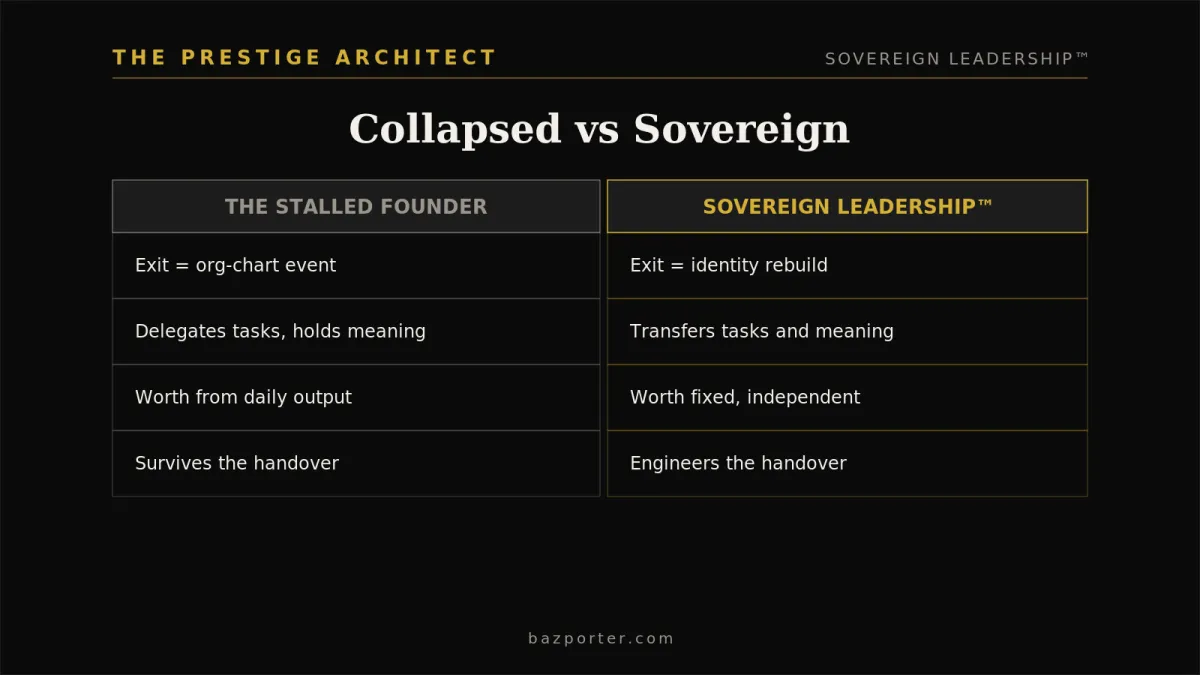
Here is the contrast, felt in the body.
- Collapsed: you answer the same question every week and call it leadership.
- Sovereign: you answer it once, build the rule, and the question stops coming.
- Collapsed: every fire feels like yours because every task looks equal.
- Sovereign: you name the irreducible work and let the rest find its owner.
- Collapsed: you are busy, and the same problems keep coming back.
- Sovereign: you are quiet, and the structure holds.
You do not have a time problem. You have a structure the fire keeps exposing.
Start here this week. Pick the one problem that returns most. Write the rule that would end it. Hand the rule to one person. That is a real first move, and you can make it on your own. For the part you cannot see from inside the fire, the Fast Future Freedom Blueprint™ is the free 60-minute identity audit that finds it.
A pattern from the room
The leaders I sit with who keep fighting the same fire almost always trace it to one room. A decision that was never fully made. A standard that was never said out loud. A role that was never truly handed over. The fire is downstream. It returns because the source is still open. When they name the source, the fire loses its fuel. Not every problem clears at once. The repeating one almost always does. The work is quiet and it does not look heroic. That is why it gets skipped. And that is why the problem keeps coming back.
The architecture of your return
You can end one loop on your own. You cannot see the loops you are standing inside. That is not a skill gap. It is closer to physics. No one reads the room they are in. The recurring problem that costs you most is usually tied to who you believe you must be. That belief is invisible from the inside. This is Sovereign Leadership™, and it is built at the level of state of being, not tasks. Not transformation. Return.™
The Fast Future Freedom Blueprint™ is where that work begins. It is a free 60-minute identity audit. You leave with the one pattern under your recurring fires named, and the first structural move to end it. Apply, and bring the problem that keeps coming back.
Frequently asked questions
Why do the same problems keep coming back in my team?
They return because you solve the symptom and keep the rule that created it. Researchers call this single-loop learning. The error repeats until the governing rule changes. Name the rule, not just the incident.
How do I stop firefighting the same issues as a leader?
Pick the problem that returns most often. Write the standard or decision that would end it. Give that rule an owner who is not you. You stop firefighting when the structure, not your attention, holds the line.
Is it normal to feel busy all day but not in control?
It is common, and it has a name. Silent Collapse is the state where you run all day and lead nothing. Busy is motion. Control comes from naming the work only you can do. The feeling is a signal, not a verdict.
What is the RAMS framework and how does it help with recurring problems?
RAMS stands for Results, Attitude, Authenticity, Mastery, and Systems. It treats a recurring problem as a missing system and a hidden belief, not a time shortage. It moves you from solving faster to solving once. That is how the loop ends.
How does the Fast Future Freedom Blueprint help if problems keep returning?
It is a free 60-minute identity audit with Baz Porter. You find the belief and the structure under your recurring fires. You leave with the first move to end the loop. It works at the level of identity, where the cause actually sits.
About the author
Baz Porter® is The Sovereign Leadership Architect. He rebuilds the identity beneath high performance, so leaders decide, lead, and live from a self that is genuinely their own. He works with accomplished people who look strong on the outside and feel unseen on the inside. His work begins underneath the visible problem, at the level of state of being.