Revenge Bedtime Procrastination: Why Leaders Stay Up
Revenge Bedtime Procrastination: Why Leaders Stay Up Late
You are not exhausted because the days are long. You are exhausted because the night is the only hour that still belongs to you. So you take it back. You stay up. You scroll, you plan, you do nothing in particular, and you feel a strange, quiet ownership return. This is revenge bedtime procrastination. For the high performer it is rarely about sleep. It is a symptom of Silent Collapse™. A life runs on your command all day. Then it leaves you nothing of your own by night.
I do not treat this as a habit to correct. I read it as a signal. The signal is accurate. Your reclaiming instinct is healthy. The architecture around it is not. That is the ground of my Manifesto.
Table of Contents
Key Takeaways
Revenge bedtime procrastination is the deliberate delay of sleep to reclaim personal time, with no external reason to be awake.
It rises when daytime autonomy is low. The more your day answers to everyone else, the harder your night fights back.
It is a self-regulation problem, not a discipline problem. Willpower is a depleting resource, and yours is spent by 9 PM.
For executives it forms a loop: less sleep lowers next-day capacity, which raises the need for a nighttime escape.
The return is structural. You do not need more control at night. You need more ownership in the day.
What Revenge Bedtime Procrastination Actually Is
Revenge bedtime procrastination is the choice to stay awake past the point of reason, to reclaim time that the day did not give you. Researchers define it by three marks. The delay cuts your total sleep. There is no valid reason to be up, no night shift, no emergency. And you know the cost while you pay it. Clinical writers now track it as a distinct pattern. Roughly one in five people report doing it often. It is not laziness. It is a small, nightly act of protest against a life with no white space.
For the leader I work with, the protest makes sense. Her day is a chain of decisions that belong to other people. The board, the team, the client, the family. By night, the only unclaimed territory is the hour after everyone sleeps. So she takes it. The cost lands the next morning, and the loop begins again.
The Hidden Pattern the Research Keeps Finding
In 2014, Floor Kroese and colleagues at Utrecht University named this in the journal Frontiers in Psychology. Their finding was precise. People who reported poorer self-regulation reported more bedtime procrastination. They read it through Roy Baumeister's strength model. Self-control is a limited resource. It depletes through use. A day of relentless composure is a day of spending that resource. By night the account is empty.
Later work sharpened it. A 2022 study from the University of Groningen found that self-control depletion at night was the single strongest predictor. The science also points to autonomy. People with the least control over their daytime schedule procrastinate at bedtime the most. Read that again through the lens of a founder or a C-suite executive. You appear to control everything. You privately control almost none of your own hours. The night is where that gap gets paid.
This is the pattern under the symptom. Revenge bedtime procrastination is not a failure of character. It is the nervous system reaching for autonomy it could not find in daylight. The instinct is sound. The hour is wrong.
The RAMS™ Reframe: From Stolen Nights to Sovereign Ones
I read every symptom through RAMS™: Results, Attitude, Authenticity, Mastery, Systems. It operates at the level of the business and the level of the nervous system at once. Here is how the reframe runs.
Results
Stolen sleep is a results problem before it is a wellness one. Every hour taken from rest is taken from tomorrow's judgment. The leader who reclaims her night pays with a duller morning. Sovereign results are built on recovery, not on the illusion of a longer day.
Attitude
The nightly protest carries a belief. The belief is that rest must be stolen because it will never be given. That stance keeps you awake. The sovereign stance is different. Rest is not a reward you earn at midnight. It is the foundation the whole structure stands on.
Authenticity
You stay up to feel like yourself again. That is the honest part. The self you are chasing at 1 AM is real, and she deserves daylight, not scraps. When your true hours only exist in secret, the day has stopped being yours. Authenticity asks for ownership you can live in, not a hidden shift after dark.
Mastery
Willpower will not solve this, because willpower is the thing that is already gone. Mastery is not another rule at bedtime. It is designing the day so the reserve is not empty when night comes. You do not master the urge. You remove the conditions that create it.
Systems
This is the pillar that closes the loop. The problem is architectural. Your day has no built-in ownership, so your night improvises it badly. A sovereign system returns your time on purpose, in daylight, on record. When the day holds real autonomy, the night stops fighting to take it.
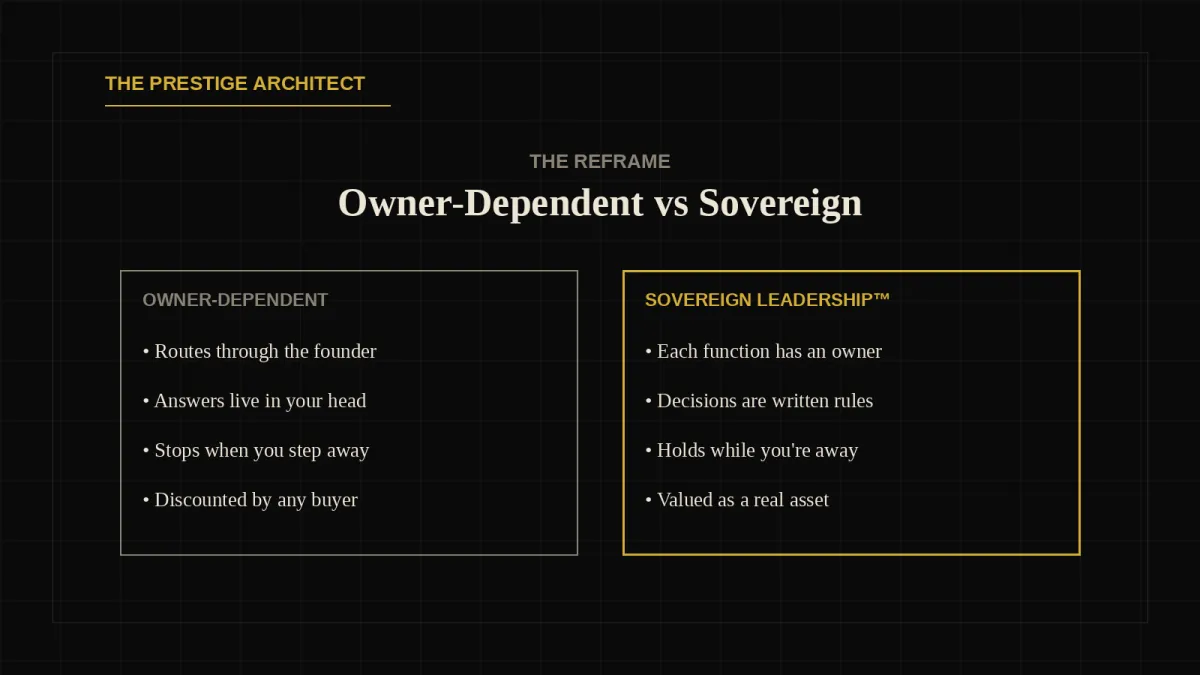
Here is the contrast I draw for leaders.
Collapsed: the only unclaimed hour is after midnight, taken in secret, paid for at dawn.
Sovereign: unclaimed hours are designed into the day, protected on the calendar, owned in the open.
Collapsed: rest is stolen from a depleted reserve.
Sovereign: rest is the reserve the reserve is drawn from.
Collapsed: you fight your own body for autonomy at night.
Sovereign: your body sleeps because the day already gave you what the night was reaching for.
Baz Porter does not motivate. He does not inspire. He architects. The nightly reach for your own time is not weakness. It is a blueprint pointing at what your day is missing.
If your nights have become the only place you feel free, that is worth reading closely. The Silent Collapse Diagnostic™ is a sixty-minute session with me to find where your day lost its autonomy and how to rebuild it.
A Case From the Room
A founder came to me sleeping five hours a night. She was not an insomniac. Waking at 3 AM was not her problem, and that is a different pattern with its own architecture. Her problem was the opposite end. She would not go to bed. Every night she sat with her phone until 1 AM. She did nothing that mattered. She guarded an hour that felt like hers.
We did not attack the habit. We audited the day. Her calendar held zero unclaimed time. Every block answered to someone. So we rebuilt the Systems pillar first. We designed two protected hours into her working week that answered to no one. Owned, visible, on the record. Within three weeks she was in bed by 11 PM. Not through discipline. Through architecture. The night stopped fighting once the day gave it nothing left to reclaim.
The Architecture of Your Return
You will not fix revenge bedtime procrastination at bedtime. The hour is the symptom. The day is the cause. The return is not a stricter evening routine or a colder, harder rule against your own phone. It is a day rebuilt so your time is yours before the sun goes down.
That is architecture, and it is what I do. If the night has become the only hour you own, I can show you where the day gave it away. Start with the Silent Collapse Diagnostic™. One session. We map the collapse, and we design the return.
Questions Leaders Ask Me
What is revenge bedtime procrastination?
It is the deliberate choice to delay sleep with no external reason. The aim is to reclaim personal time. The delay reduces your total sleep. You know it will cost you the next day. For high performers it is a nightly attempt to own an hour the day never gave them.
Why do high achievers stay up late even when exhausted?
Because the night is often the only time that answers to no one. Their days are full of decisions owned by other people. Staying up is a quiet reclaiming of autonomy. The exhaustion is real, but the need to feel ownership outweighs it in the moment.
Is revenge bedtime procrastination a sign of burnout?
It is often an early marker of Silent Collapse™, the stage before visible burnout. It signals that daytime autonomy has thinned to nothing. Left unread, it deepens. Chronic sleep loss lowers next-day capacity. The pattern hardens into something you cannot easily reverse.
How do I stop revenge bedtime procrastination?
Stop trying to fix it at night. The urge is a symptom of a day with no owned time. Build real autonomy into your daytime schedule, protected and visible, so the night no longer has to steal it. The evening settles once the day is sovereign.
Does poor sleep from bedtime procrastination affect leadership performance?
Directly. Lost sleep degrades judgment, emotional regulation, and decision quality the following day. For a leader those are the core assets. The nightly reclaiming that feels like freedom quietly taxes the exact capacities the role depends on.
About Baz Porter®
Baz Porter®, The Prestige Architect®, guides high-achieving leaders from Silent Collapse™ to Sovereign Leadership™. He is the architect of Sovereign Leadership Architecture™ and the RAMS™ method, host of the Rise From The Ashes podcast, and an international bestselling author. He works with founders and executives who hold power without collapse and success without self-betrayal.