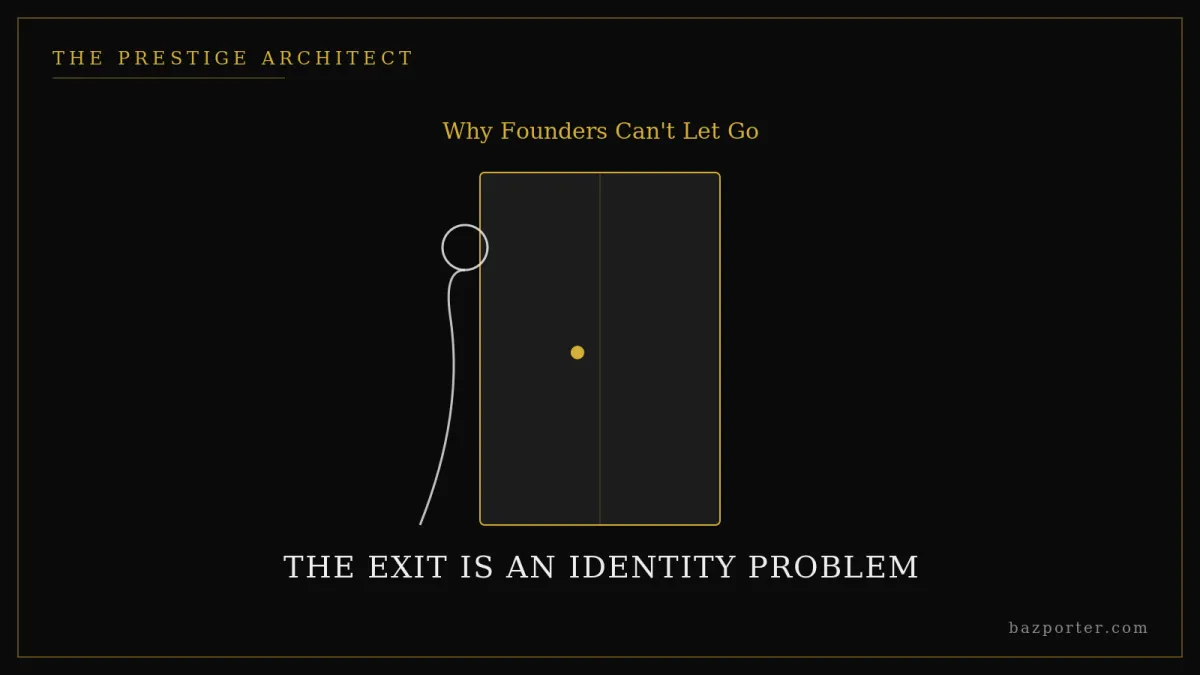
Responsible For Everything, In Control Of Nothing
You make the call. Nothing moves.
You are responsible for everything. You are in control of almost none of it.
People nod in the room. Then they do the old thing. Your decisions route around you. You chase grown adults to do what they already agreed to do.
You tell yourself to delegate better. To communicate more clearly. To stay patient. None of it lands. This is Silent Collapse™, the felt state Baz Porter®, The Sovereign Leadership Architect, names and corrects. It is the quiet erosion called responsibility without authority. You still hold the title. The pull went quiet. The way back is not a new tactic. It is a return to who you are.
On this page
- Key takeaways
- What responsibility without authority really means
- The hidden pattern underneath the stall
- The RAMS™ reframe, pillar by pillar
- What this looks like in the room
- The architecture of your return
- Questions leaders ask
Key takeaways
- Responsibility without authority is a state, not a skill gap.
- You can hold the title and still lose the pull.
- Real authority lives in who you are, not the seat you sit in.
- Better delegation does not restore a signal that went quiet.
- The return starts with one honest audit you can run this week.
What responsibility without authority really means
Responsibility without authority is the state where you carry every outcome and command almost none of them. The accountability sits on you. The power to move people does not. You decide, and the room stays still. People agree, then drift back to the old way. Inside Silent Collapse™, Baz Porter® reads this as a signal, not a failing. The seat still gives you tasks. It stopped giving you pull. That pull is not a title. It is a state of being, and it can be rebuilt.
The hidden pattern underneath the stall
Most leaders read the stall as their own weakness. They think they are too soft, too slow, too unclear. That read is wrong. The real pattern is structural.
Two forces are at work. The first is load. You hold high demand and low control at the same time. Research on the demand-control model (Karasek, 1979) found that this exact mix predicts strain better than workload alone. High responsibility with low command is the most draining seat there is. The study is documented through the American Psychological Association.
The second force is the source of your power. Work on the bases of social power (French and Raven, 1959) draws a hard line between two kinds. One comes from the position. The other comes from the person. Position power issues orders. Person power earns movement. Harvard Business Review has covered this split for decades at hbr.org.
Here is the pattern. Early in your career, the seat and the self rose together. People moved because of who you were becoming. Over years, you leaned harder on the seat and less on the self. The title grew. The signal thinned. Now the seat gives orders, and the person behind it has gone quiet. That is why nothing moves. Not a skill gap. A quiet self.
The RAMS™ reframe, pillar by pillar
RAMS™ is the framework Baz Porter® uses to rebuild authority at the level of state. Five pillars. No weights. Here is how each one meets responsibility without authority.
Results. Redefine the result. The result is not more decisions issued. The result is decisions that land. Count movement, not memos. One decision that sticks beats ten that scatter.
Attitude. Stop reading the stall as proof you are failing. Read it as data. The room is telling you the signal is faint. That is useful. A faint signal can be restored. Shame cannot restore anything.
Authenticity. This is the center. Your pull returns when your authority is yours, not borrowed from the seat. People move for a leader who is present and real. They route around a leader who is performing a role. Return to your own voice, and the room turns toward you again.
Mastery. Master the few moves that make a decision hold. Name the owner. Name the date. Name the cost of no movement. Say it once, plainly, and let it stand. Mastery here is less talk, not more.
Systems. Build the structure that carries agreements without you chasing. A decision log. A single owner per outcome. A standing check-in where drift gets named early. The system holds the weight so you stop holding all of it alone.
Collapsed vs sovereign
- Collapsed: you issue more decisions. Sovereign: you make fewer decisions land.
- Collapsed: you chase people to follow through. Sovereign: the structure carries the follow-through.
- Collapsed: you lean on the title for pull. Sovereign: your presence is the pull.
- Collapsed: you read the stall as your failure. Sovereign: you read it as a signal to restore.
- Collapsed: you are accountable and powerless. Sovereign: you are accountable and able to move the room.
You do not need more authority from the seat. You need your own authority back. Press for control and the room pushes away. Return to your real self and the room moves with you.
If you want to see where your signal went quiet, start here. Book the Fast Future Freedom Blueprint™, the free 60-minute identity audit. It shows you the exact point where the self and the seat came apart.
What this looks like in the room
The leaders who sit with me and have gone quiet almost always trace it to one shift. They stopped speaking as themselves. They started speaking as the role. The language got careful. The opinions got hedged. The presence got managed.
From the outside, nothing looked wrong. The calendar stayed full. The numbers held. The team still called them decisive. Inside, the signal was fading. Each careful word spent a little more of the real pull. By the time they noticed, the room had learned to wait them out.
This is a pattern, not a verdict. The same leaders who lose the pull can recover it. The self that earned movement is still there. It went quiet. It did not leave.
The architecture of your return
Start with one audit this week. It costs nothing and takes twenty minutes.
List your last ten decisions. Mark each one that moved and each one that stalled. Now look only at the stalls. For each, ask one question. Did I speak as myself, or as the role? Be honest. You will see a line form. The decisions that landed carried your real voice. The ones that stalled carried a managed one.
That audit solves the surface. It shows you where the signal drops. It hands you a first move you can make on your own.
It does not reach the deeper cause. The reason your voice went careful sits below the room. It lives in an identity you built to stay safe at the top. You cannot see the whole of it from inside it. That part is the work of the Fast Future Freedom Blueprint™, the free 60-minute identity audit. You can start the return yourself. The deepest layer gets done on the call.
Questions leaders ask
What is responsibility without authority?
It is the state where you are accountable for outcomes you cannot command. The weight sits on you. The power to move people does not. It is common in senior seats where the title grew faster than the real authority behind it. It is a state of being, and it responds to being rebuilt, not to more tactics.
Why do people nod and then ignore my decisions?
A nod is agreement in the room, not commitment to act. People act for presence they trust, not for a title alone. When your signal goes quiet, the nod becomes a way to end the meeting. The fix is not louder orders. It is a clearer owner, a named date, and a voice that is your own.
Is this just a delegation problem?
No. Delegation moves tasks. This is about movement, which is different. You can delegate perfectly and still watch the work drift back. The gap is in pull, not in process. Better handoffs will not restore a signal that has gone faint at the source.
How do I get real authority back?
You rebuild it at the level of state, not tactic. Return to speaking as yourself, not the role. Make fewer decisions land instead of issuing more. Let a simple system carry the follow-through. The RAMS™ framework walks each pillar, and the Fast Future Freedom Blueprint™ shows you where to begin.
What is Silent Collapse in leadership?
Silent Collapse™ is the felt state where you keep delivering while your inner command system erodes. The role stays intact. The person inside it narrows. You look strong on the outside and feel unseen on the inside. Baz Porter® named it to describe the leader who has quietly lost the pull while every outer marker still holds.
About the author
Baz Porter® is The Sovereign Leadership Architect. He rebuilds the identity beneath high performance, so leaders decide, lead, and live from a self that is genuinely their own. He works with accomplished people who look strong on the outside and feel unseen on the inside. His work begins underneath the visible problem, at the level of state of being.