How to Reclaim What You Traded to Get Here
You traded pieces of yourself to get here. A boundary here. A real opinion there. The part of you that used to say no.
Now the role fits you like a second skin. And underneath it, something you gave away keeps asking to come back.
This is not a character flaw. It is the slow arithmetic of a built life. The clinical name for it is Silent Collapse™, the quiet erosion of self that high achievers trade for the win. You can read the full account in The Prestige Architect™ manifesto.
The real question is not whether you traded yourself away. You did. The question is how you reclaim it, without torching the life the trade paid for.
What this article covers
Key takeaways
You did not lose yourself by accident. You traded specific parts of you for specific wins.
Reclaiming is not reinvention. It is return. The self you traded is still there.
You do not have to blow up your career to get it back. You change the system, not the life.
Reclamation runs on a sequence, not a mood. Name the trade, feel the cost, rebuild the rule.
The free Fast Future Freedom Blueprint maps your first three trades to reverse.
How to reclaim what you traded to get here
You reclaim what you traded by reversing the exchange on purpose, one trade at a time. First you name the exact part you gave away, and the win you got for it. Then you let the cost land, instead of explaining it away. Then you rebuild the daily rule that keeps the trade running. This is reclamation, not reinvention. The real self you set aside did not die. It went quiet. Silent Collapse™ is the name for that silence, and the return is the work of ending it, inside the life you already built.
The hidden pattern under the trade
Most leaders think the problem is the job. It is not the job. It is the rule you wrote to survive the job.
Every trade began as a smart move. You stopped voicing the unpopular view, and the room got easier. You stopped guarding your evenings, and the results came faster. Each win taught your nervous system one rule: this part of me is expensive, so retire it.
Research on self-concordance shows why this costs so much. Kennon Sheldon and Andrew Elliot found that goals pursued for internal, authentic reasons produce lasting wellbeing, while goals chased for approval or pressure do not, even when you hit them (Sheldon and Elliot, 1999, Journal of Personality and Social Psychology). You can win the whole game on borrowed motives and still feel robbed. The ache you carry is not weakness. It is accurate data.
Self-determination research adds the mechanism. Richard Ryan and Edward Deci show that when autonomy and authenticity are starved, motivation and vitality drain, no matter how high the status (Ryan and Deci, 2000, American Psychologist). The trade works on the scoreboard and fails in the body. That gap is the signal to reclaim.
The RAMS™ architecture of return
RAMS™ is the system I use to rebuild a leader from the inside. Five pillars. Results, Attitude, Authenticity, Mastery, Systems. Reclaiming what you traded runs through all five.
Results: measure what the trade actually cost
Start with the real ledger. For each win, name the part of you it bought. The promotion bought your candor. The scale bought your presence at home. Results stops being only the scoreboard. It becomes the full cost sheet, both columns.
Attitude: stop defending the trade
You have a story that keeps the trade safe. This is just what leadership takes. That story is the lock. Attitude is the choice to set the story down and let the cost be real. You do not reclaim a part of you that you are still busy justifying the loss of.
Authenticity: name the self you set aside
Here is the pillar the trade attacks first. Authenticity is not a vibe. It is the specific set of values, opinions, and limits that are actually yours. Reclaiming starts the moment you write down what you traded, in plain words. The blunt colleague. The parent who left at five. The one who said no.
Advice hands you tools. Counsel hands you back yourself.
Mastery: rebuild one rule, not your whole identity
You do not need a new personality. You need one reversed rule. If you traded your candor, mastery is saying the true thing in the next meeting, once. Small, repeatable, real. Mastery is reclamation at the scale your week can actually hold.
Systems: make the return automatic
Willpower will not hold a reclaimed self. A system will. This is the Systems pillar, and it is where the return gets built to last. You redesign the calendar, the boundaries, and the defaults, so the real you becomes the path of least resistance, not the exception. Change the system and the self stops needing a daily fight.
If you want the map of your own trades, start with the free entry audit. The Fast Future Freedom Blueprint shows the first three trades to reverse, and the order to reverse them.
Collapsed versus Sovereign
Collapsed: defends the trade as the price of success. Sovereign: names the trade and counts the cost.
Collapsed: waits for a clean break to feel real again. Sovereign: returns inside the life already built.
Collapsed: performs the version the role rewards. Sovereign: leads from the values that are actually theirs.
Collapsed: relies on willpower and resets every Monday. Sovereign: rebuilds the system so the real self holds.
Collapsed: calls the ache a weakness. Sovereign: reads the ache as data and acts on it.
What this looks like in a real life
A client ran a nine-figure division. On paper, untouchable. In person, a stranger to the self who built it.
Early on, they had traded one thing: the habit of disagreeing out loud. It made meetings smoother. It made promotions faster. Fifteen years later, they lost the ability to find their own opinion in a room, even alone.
We did not rebuild their life. We reversed one trade. Each week, they voiced one true disagreement, on purpose. That was the whole assignment. Within two months, the team started telling the truth again, because the leader did first. The reclaimed self did not arrive in a grand exit. It arrived one honest sentence at a time.
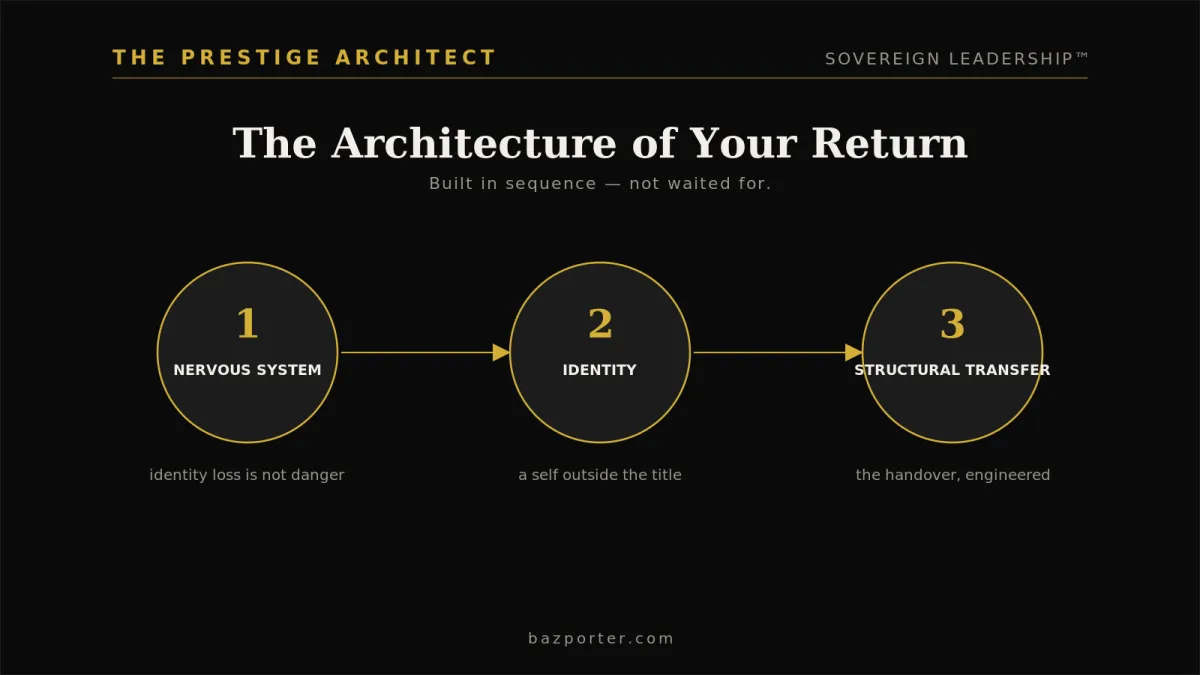
The architecture of your return
You do not come back by leaving. You come back by reversing the trades, one rule at a time, inside the life the trades paid for. That is the return, and it is a build, not a feeling.
This is the work of The Prestige Architect™. Not to hand you a new self, but to give you back the one you traded away, and to build the system that keeps it. If you are ready to map and reverse your own trades, apply through the free Fast Future Freedom Blueprint. It is the first step of the return.
Questions leaders ask
What does it mean to reclaim what you traded to get here?
It means reversing the quiet exchanges you made to succeed. You gave away parts of yourself, like candor, presence, or firm limits, for specific wins. Reclaiming is the deliberate work of taking those parts back, one at a time, without discarding the career you built.
Is it too late to reclaim myself after decades in the role?
No. The self you traded went quiet. It did not disappear. Self-determination research shows authenticity and vitality return once autonomy is restored, at any age. The decades are not lost. They are the evidence that the trade no longer pays.
Can I reclaim myself without quitting my job?
Yes, and quitting rarely fixes it. The trade lives in your daily rules, not your title. You reclaim by changing one rule inside your current role, then building a system that protects it. A clean break often just moves the same rules to a new office.
How is reclaiming different from reinventing myself?
It is the opposite. Reinvention builds someone new. Return brings back someone real. You are not becoming a different person. You are ending the performance and restoring the self you set aside to win.
Where do I start reclaiming what I traded?
Start by naming one trade in plain words, and the win it bought. Then reverse that one rule this week. The free Fast Future Freedom Blueprint maps your first three trades, and the order to reverse them, so the return has a sequence instead of a mood.
About the author
Baz Porter® is the founder of Baz Porter LLC and the creator of The Prestige Architect™ and the RAMS™ framework. He works with accomplished leaders who have built the life and lost themselves inside it, guiding the return to a sovereign self through counsel, not advice. Learn more in the manifesto.