How to Rebuild Self-Respect After Self-Betrayal
You caught it in a mirror you were not looking into. A meeting ended. The room emptied. For one second you saw the face you wear at work still sitting on yours. And you thought: I do not respect the person I have become.
Not hate. Something quieter and worse. The slow withdrawal of your own regard.
That withdrawal has a name. I call the state under it Silent Collapse™. It is the private erosion that happens when a capable leader keeps trading pieces of themselves for the role. One day you stop meeting your own eyes. This piece is the way back. It is how to rebuild self-respect after years of self-abandonment, without torching the life you built. The map for it lives in the manifesto.
What this covers
Why self-respect drained out so slowly you never saw it go.
The one definition of self-respect that actually rebuilds it.
The hidden pattern researchers found under lost regard.
The RAMS™ reframe across all five pillars.
A short case, and the architecture of your return.
Key takeaways
Self-respect is not a feeling. It is a ledger of promises you keep to yourself.
You did not lose it in one betrayal. You spent it in a thousand small ones.
You rebuild it the same way: small, specific promises, kept in daily operation.
The goal is return, not reinvention. You are not broken. You are overdrawn.
The built life stays. The self inside it comes home.
How do you rebuild self-respect after self-betrayal?
You rebuild self-respect by keeping small promises to yourself again, on purpose, until the ledger turns. Self-respect is not restored by a grand gesture or a new title. It is restored one kept word at a time. You name a standard you quietly abandoned. You make one commitment to it that is small enough to keep. You keep it. Then you keep it again. Each kept promise is a deposit. The feeling of respect follows the deposits. It never leads them.
This is slow on purpose. The erosion was slow. The return is too.
The hidden pattern: self-respect is a ledger, not a feeling
Here is what most leaders get wrong. They wait to feel worthy before they act worthy. So they wait forever.
Research on how we value ourselves points the other way. Crocker and Wolfe, writing in Psychological Review in 2001, showed that self-worth is not one fixed trait. It rises and falls with the specific domains we stake it on. Stake it only on output, and every miss is a withdrawal. Stake it on living by your own standards, and every kept standard is a deposit.
That is the hidden pattern. You did not lose respect for yourself in one dramatic act. You lost it in a slow run of small compromises. The email you sent against your gut. The value you did not defend in the room. The version of you that was easier to be. None of them felt like much. Together they emptied the account.
So the ledger is the real diagnosis. And a ledger can be refilled.
The RAMS™ reframe: five pillars that rebuild self-respect
RAMS™ is the operating frame I use with leaders in Silent Collapse. It moves you from a collapsed stance to a sovereign one across five pillars. Here is how each one rebuilds regard.
Results
Collapsed, you measure yourself only by what you produced today. Sovereign, you measure yourself by whether you acted like someone you respect. Output still matters. It is just no longer the only entry in the book. One self-honoring choice counts as a result.
Attitude
Collapsed, the inner voice is a prosecutor. It reads the list of your failures back to you at night. Sovereign, the voice becomes an architect. It asks one question instead: what is the next small promise I can keep? Contempt does not rebuild anything. Correction does.
Authenticity
This is the pillar under the ache. Collapsed, you perform a self you do not like because it is safer. Sovereign, you let your real standards show in one real decision at a time. Respect returns the moment your outside starts matching your inside. Not all at once. Just once, then again.
Here is the contrast, drawn plainly.
Collapsed: waits to feel worthy. Sovereign: acts worthy, then feels it follow.
Collapsed: keeps promises to everyone but themselves. Sovereign: puts one promise to self first.
Collapsed: calls self-abandonment maturity. Sovereign: calls it the slow cost it is.
Collapsed: wants a new life. Sovereign: wants the real self back inside this one.
Collapsed: measures the gap and despairs. Sovereign: measures the gap and closes it by an inch.
You do not rebuild self-respect by becoming someone new. You rebuild it by keeping your word to the person you already are.
If that line landed, the Fast Future Freedom Blueprint is the free first step. It is a quiet hour to map where your ledger went empty and name the first promise to refill it.
Mastery
Collapsed, you are expert at the role and a stranger to yourself. Sovereign, you turn the same discipline inward. You already know how to keep commitments to a board, a client, a number. Mastery here is pointing that exact skill at your own standards. You are not learning a new ability. You are aiming an old one home.
Systems
Willpower will not carry this. A system will. Sheldon and Elliot, in the Journal of Personality and Social Psychology in 1999, found that goals chosen from your own values, not borrowed from pressure, are the ones people actually sustain. So build the promise into the week. One recurring, self-chosen commitment, on the calendar, with no audience. The system keeps the promise when the feeling does not show up. And on the days you do not feel one ounce of respect, the kept promise still counts.
A short case: the leader who stopped flinching
A senior executive sat across from me and said a sentence I hear often. "I do not flinch anymore when I do things I used to find wrong." That was not pride. That was the alarm he had stopped hearing.
We did not blow up his life. We found one standard he had quietly abandoned, years back. He used to tell people the hard truth kindly. Somewhere in the climb he traded it for smooth. So we made one promise. One honest sentence, said out loud, in one meeting a week. Small enough to keep. Specific enough to notice.
Six weeks in, the flinch came back. Not the fear. The feeling. He told me he could hold his own gaze in the mirror again. The account had started to fill. Nothing about his title, pay, or team had changed. Only the ledger had.
The architecture of your return
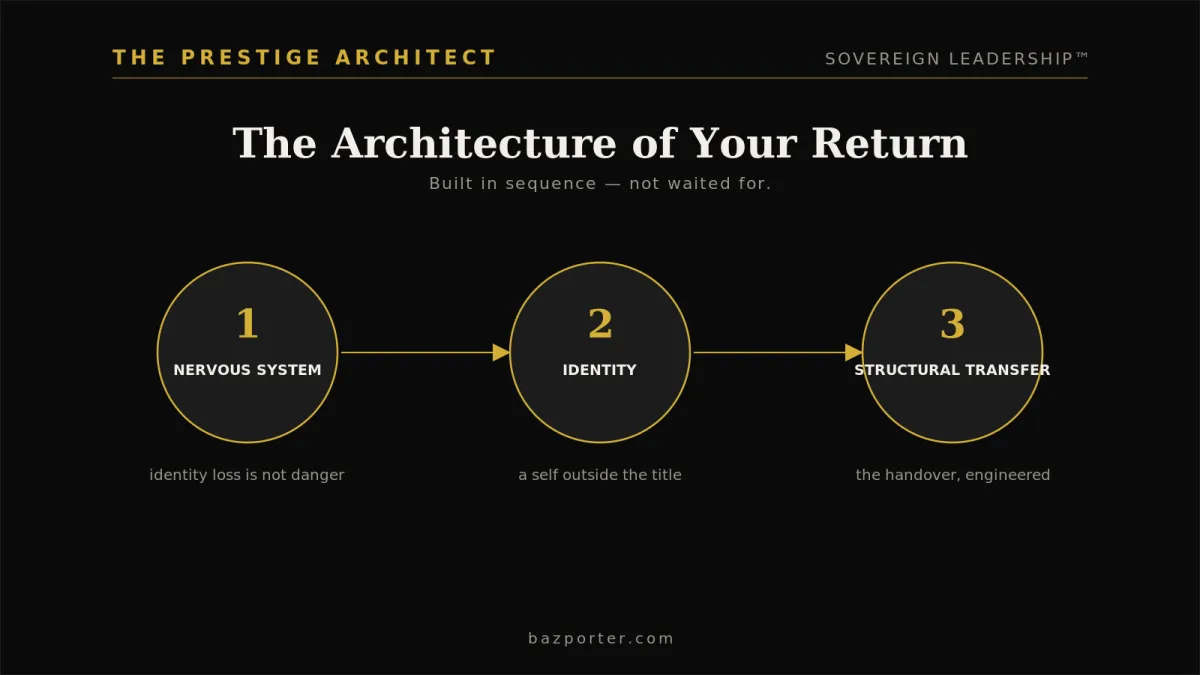
Return is not a feeling you wait for. It is a structure you build. The structure is simple, which is not the same as easy.
First, name one standard you abandoned. Not ten. One. Second, make one promise to it small enough that you cannot reasonably fail. Third, put it in the system, on the calendar, with no audience to perform for. Fourth, keep it, and mark the deposit. Fifth, when the ledger has turned even slightly, name the next standard. That is the whole architecture. Repeated, it is a returned self.
This is the work I do as The Prestige Architect™. Not a new you. The real one, brought back inside the life you already earned. If you want the first map drawn with you, start with the Fast Future Freedom Blueprint. One hour. No performance required.
Frequently asked questions
What is the difference between self-respect and self-esteem?
Self-esteem is how good you feel about yourself. Self-respect is whether you act in line with your own standards. Esteem can be propped up by praise and wins. Respect can only be earned by kept promises. That is why you can be widely admired and still not respect yourself. The fix is not more applause. It is one standard honored on purpose.
Why did I lose respect for myself even though I succeeded?
Because success and self-respect are measured on different ledgers. You can hit every external number while quietly betraying your own standards to do it. The wins fill the esteem account. The compromises drain the respect account. Silent Collapse is the name for that specific gap: outward success sitting on top of inward erosion.
How long does it take to rebuild self-respect?
Longer than a weekend and shorter than you fear. It moves at the speed of kept promises, not calendar time. Many leaders feel the first shift within weeks of keeping one small, self-chosen commitment. The deeper return is a season of work, not a single act. The point is that it starts the first time you keep your word to yourself.
Do I have to leave my job to respect myself again?
Usually not. The ache often says "escape," but the real need is "return." Most leaders rebuild self-respect inside the life they already built, by changing how they hold themselves in it, not by burning it down. Leaving is sometimes right. But it is a later question, and a calmer one, once the ledger is no longer empty.
What is the very first step to rebuild self-respect?
Name one standard you abandoned, and make one promise to it small enough to keep this week. Not a vow. A deposit. The Fast Future Freedom Blueprint exists to help you find that first standard and name that first promise, so the account starts filling instead of draining.
About the author
Baz Porter® is the founder of Baz Porter LLC and the architect behind The Prestige Architect™. He works with accomplished leaders in Silent Collapse™ to rebuild self-respect and return to their real selves, using the RAMS™ framework, without dismantling the lives they worked to build.