How to Put the Weight Down Without It All Falling Apart
You built a life that works. The team runs through you. The family leans on you. The business holds because you hold it. And somewhere in the middle of being that dependable, you stopped being able to put anything down. This is Silent Collapse™: the quiet state where being needed replaced being known, and the weight you carry has become the only proof you exist. You do not need another system for carrying more. You need to learn how to put the weight down without everything falling apart. That begins with seeing what you actually believe about the load, which is the work of the manifesto.
On this page
Key takeaways
The weight is not the work. It is the belief that everything depends on you.
Over-functioning is reciprocal. When you carry more, the people around you carry less.
A controlled handoff redistributes the load in stages, so nothing drops at once.
Your worth was never your usefulness. That belief is the thing to set down first.
The move is RETURN, not rescue: coming back to a self that is more than useful.
How do you put the weight down without everything falling apart?
You put the weight down in stages, not in one collapse. First you separate the real load from the imagined one. Most of what you carry is habit, not necessity. Then you name the belief underneath it: that if you stop being useful, you become no one. That belief is the weight. The tasks are light by comparison. A controlled handoff moves one piece at a time to a named person, with a clear line and a short review. Nothing falls apart because nothing is dropped. It is set down, on purpose, into waiting hands. This is the architecture of return that Baz Porter® builds with load-bearing leaders. It is slow on purpose. Speed is how things break.
The hidden pattern: the load is structural, not personal
You think the weight is yours because you are the capable one. The research says otherwise. In family systems theory, Bowen described over-functioning and under-functioning as a single reciprocal pair (Bowen, Family Therapy in Clinical Practice, 1978). When one person over-functions, the people near them under-function by exactly that much. You are not surrounded by people who cannot cope. You are surrounded by people who stopped needing to. The system adjusted to your carrying. It will adjust again when you stop.
There is a cost to the carrying itself. Hobfoll's conservation of resources theory shows that sustained giving drains a finite pool of energy and attention (Hobfoll, American Psychologist, 1989). You cannot out-will a depleted pool. Rest does not refill it if the demand never stops. The load-bearing leader does not burn out from effort. They burn out from a resource drain that has no off switch. The off switch is the handoff. It is structural, which means it is buildable.
The RAMS™ return: five shifts that move the weight
RAMS™ is the five-pillar frame I use to rebuild a leader who has become the load-bearing wall. Each pillar moves one part of the weight off you and into a structure that holds without you.
Results. Redefine the result. The goal is not that you handled it. The goal is that it got handled well, by whoever was closest to it. When your presence is the only measure of success, you have built a result that cannot scale past your own exhaustion.
Attitude. Drop the story that asking for help is failing. Asking is not weakness. It is the first move of a leader who plans to last. The strong one who never asks is not strong. They are isolated, and the isolation is the risk.
Authenticity. Here is the pillar that holds the others. You have to let yourself be more than useful. People came to depend on what you do. You began to believe that is all you are. Return means being known, not just needed. It means being carried sometimes, not only carrying.
Mastery. Mastery is not doing it all yourself. It is building people who can carry their own weight. A master does not hoard the load. They distribute it so the whole structure gets stronger. The piece you refuse to hand off is the piece no one else learns to hold.
Systems. A controlled handoff is a system, not a feeling. One task, one owner, one clear line, one short review window. You do not let go of control. You trade frantic control over everything for designed control over the handoff itself. That is how the weight moves without anything dropping.
The difference between the two states is stark. In collapse you hold it all, you ask for nothing, you call it dependability. In return the load is shared, help is designed in, and your worth stops living in your output.
Collapsed: you are the only one who can. Sovereign: you built others who can.
Collapsed: asking for help feels like failing. Sovereign: asking is how the structure holds.
Collapsed: your value is what you carry. Sovereign: your value is who you are when you set it down.
Collapsed: control means doing it yourself. Sovereign: control means designing the handoff.
The leaders who last are not the ones who carry the most. They are the ones who built something that carries without them.
If you cannot tell where the real load ends and the belief begins, start with the free entry audit. The Fast Future Freedom Blueprint maps what you are actually holding and what can be set down first.
A case from the room
A chief operating officer, in their early fifties, came to me unable to take a weekend. Every decision routed through them. They were proud of it and dying under it. We did not start with delegation. We started with the belief. They thought the company would stall without them in every room. So we tested it. One decision, one named owner, one week, one review. The decision got made. It got made well. Nothing stalled. The hard part was not the handoff. The hard part was what it meant: that they were not, in fact, the only load-bearing wall. Over the next quarter we moved the load in stages. They took the weekend. The company held. They described it as grief at first, then relief. That is the shape of return. It feels like loss before it feels like freedom.
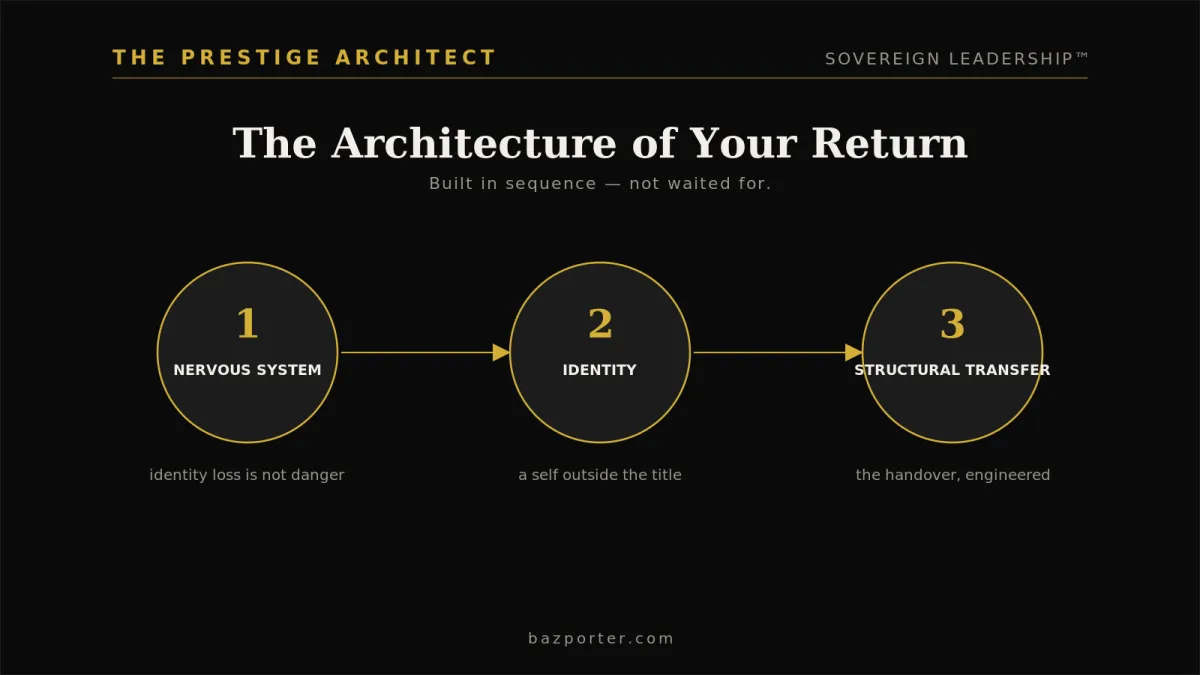
The architecture of your return
Your return is not a motivational decision. It is a build. It has stages, owners, and a sequence. You do not wake up one day and stop carrying. You design the handoff, test it small, widen it, and let the system prove it holds. The weight comes off in layers, and under the last layer is the thing you were protecting: a self that is worth something even when it is not useful. That self is the one worth returning to.
If you are ready to design the handoff instead of white-knuckling the load, apply through the Fast Future Freedom Blueprint. It is the entry audit where we map your real load and the first piece to set down.
Frequently asked questions
How do I put the weight down without everything falling apart?
You set it down in stages, never all at once. Move one responsibility to one named person with a clear line and a short review. Because the load is redistributed rather than dropped, nothing collapses. The controlled handoff is a designed sequence, not a leap of faith.
Why do I feel like everything depends on me?
Usually because the system quietly reorganized around your carrying. When you over-function, the people near you under-function by the same amount. The feeling that everything depends on you is partly true and fully built. You can rebuild it the other way.
Is it still burnout if I am not even that busy?
Yes. The load-bearing leader is not drained by hours. They are drained by a sense of responsibility that never switches off. Sustained carrying depletes a finite pool of energy whether or not the calendar looks full. The exhaustion is from being needed, not from being busy.
How do I let go of control without being reckless?
You do not give up control. You trade scattered control over everything for designed control over the handoff. One owner, one clear boundary, one review window. That structure is more responsible than carrying it all yourself, not less.
What if the people around me really cannot handle it?
Sometimes that is true, and sometimes it is the story that keeps the weight on you. Test it small before you believe it. Hand off one defined piece and watch what actually happens. Most leaders find the people rose to meet the space they were finally given.
About the author
Baz Porter® is the founder of Baz Porter LLC and the architect behind The Prestige Architect™. He works with accomplished leaders who have quietly become the load-bearing wall for everyone around them, and helps them put the weight down and return to a self that is more than useful. His work names the state of Silent Collapse™ and builds the structured return out of it.