Productivity Dysmorphia: Why Enough Never Feels Enough
You close the laptop near midnight. You did more today than most do in a week. Still a voice says it was not enough. That gap between what you achieve and what you feel has a name. It is productivity dysmorphia. It is an early signal of Silent Collapse™, the quiet erosion of a leader who looks unstoppable and feels unfinished. This is not a character flaw. It is a pattern. Patterns can be rebuilt. Start where every rebuild starts, with the Sovereign Manifesto.
On This Page
Key Takeaways
Productivity dysmorphia is the distorted sense that you never do enough, despite real results.
It is achievement blindness. Your output is high. Your ability to see it is low.
It is distinct from toxic productivity, which is the doing, and from imposter syndrome, which is competence doubt.
The root is a nervous system tuned to threat, not reward, welded to output.
The return is structural. You rebuild the system, then the striving quiets on its own.
What Is Productivity Dysmorphia?
Productivity dysmorphia is the distorted sense that you never do enough, no matter how much you achieve. Journalist Anna Codrea-Rado named it in 2021. It sits where burnout, anxiety, and imposter feeling overlap. Your output is high. Your ability to see that output is low. Praise arrives and slides off. Rest feels unearned. The scoreboard keeps moving, so you never win. For a high achiever, this is the private cost of a public climb. It is a core thread of Silent Collapse™.
The signs are quiet and consistent. You discount finished work the instant it is done. You feel behind on your best day. Compliments seem to land on someone else. Downtime brings guilt, not relief. The list never ends, because a new one starts before the last is closed. Women report this more than men, and the pressure climbs with the height of the role.
The Hidden Pattern Beneath The Doing
The problem is not your work rate. It is your reference point. A brain built for survival scans for threat, not reward. So a finished task drops off the radar. An unfinished one stays lit. You feel the gap, never the ground you gained.
Perfectionism pours fuel on this. A large meta-analysis by Curran and Hill, published by the American Psychological Association, found perfectionism has risen sharply since the late 1980s. Socially prescribed perfectionism, the sense that others demand you be flawless, rose the most. When worth is welded to output, enough becomes a moving target. Clinicians place this in the wider family of dysmorphia, a gap between what is real and what you perceive.
There is a second driver. The climb rewarded the striving, not the stopping. Every promotion came after a sprint. So the body learned one lesson. Push means safety. Rest means risk. That wiring served the ascent. It quietly taxes the summit.
Read that plainly. The feeling is not a report on your performance. It is a report on your nervous system.
The RAMS™ Reframe: From Never Enough To Sovereign
RAMS™ works at the business level and the nervous-system level at once. Here is the same leader, collapsed and sovereign, across all five pillars.
Results. Collapsed: results vanish the moment they arrive. Sovereign: results are logged, counted, and allowed to land.
Attitude. Collapsed: rest is a threat and stillness feels unsafe. Sovereign: rest is a strategy, not a reward you have to earn.
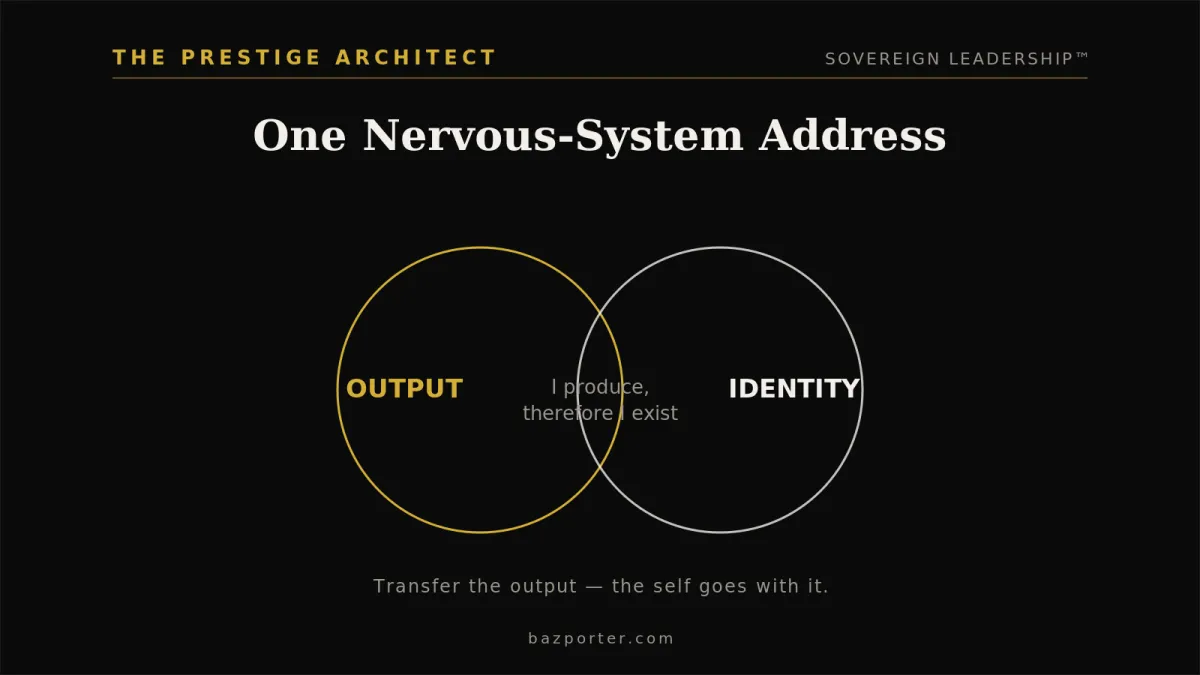
Authenticity. Collapsed: your worth is fused to your output. Sovereign: your worth is separate from your outbox, and steady when you stop.
Mastery. Collapsed: you chase more skill to feel safe. Sovereign: you already have enough, and you deploy it on purpose.
Systems. Collapsed: no line marks when the day is done. Sovereign: enough is defined in advance, so the work has an edge.
Baz Porter does not motivate. He does not inspire. He architects the system beneath the striving, so enough finally registers.
Naming the pattern is the first structural move. The Silent Collapse Diagnostic™ maps where the gap lives in your five pillars, in one hour, live.
One Leader Who Named It
A managing director came in after a record year. Her numbers were the best in the firm. She felt like she was falling behind. Every close ended in a blank scan for what she had missed. Rest made her anxious, so she filled it. We did not add a productivity tool. We rebuilt the Systems pillar first. She defined, on paper, what a finished day looked like. She logged wins where she could see them. Inside a month, the midnight scan stopped. The output did not drop. The dread did. She did not need more drive. She needed a place for the drive to rest.
The Architecture Of Your Return
You will not think your way out of this. You rebuild your way out. That means separating who you are from what you produce. It means defining enough before the day starts, not chasing it after. It means regulating the system that calls rest a risk. This is architecture, not advice. It holds because it is built, not because you tried harder.
Most leaders try to fix this with a better app or a harder push. Both feed the pattern. The app gives you more to track. The push proves rest is unsafe. Structure does the opposite. It draws the line the striving cannot. It lets a good day count as a good day.
Name the pattern precisely, then rebuild it. Begin with the Silent Collapse Diagnostic™, a single hour, live, that shows you exactly where enough went missing.
Frequently Asked Questions
What is productivity dysmorphia?
Productivity dysmorphia is the distorted belief that you never do enough, no matter how much you actually achieve. Journalist Anna Codrea-Rado named it in 2021. It sits where burnout, anxiety, and imposter feeling meet. Your output is high, but your ability to see it is low.
What are the symptoms of productivity dysmorphia?
The core sign is achievement blindness. Praise arrives and slides off. Rest feels unearned and stillness feels unsafe. You end a full day sure you did nothing that counts. The scoreboard keeps moving, so a win never lands.
Is productivity dysmorphia the same as imposter syndrome?
No. Imposter syndrome says you are not good enough and will be exposed. Productivity dysmorphia says you have not done enough, even when your results prove otherwise. One doubts your competence. The other erases your output.
What causes productivity dysmorphia?
It grows from socially prescribed perfectionism and a nervous system tuned to threat rather than reward. Research shows perfectionism has risen sharply across recent decades. When self-worth is welded to output, the brain logs danger, not achievement, so enough never registers.
How do you overcome productivity dysmorphia?
You rebuild the system underneath the striving, not the to-do list on top of it. That means separating identity from output, defining what enough looks like in advance, and regulating the nervous system that calls rest a risk. The first step is naming the pattern precisely, which is the work of the Silent Collapse Diagnostic.
About The Author
Baz Porter® is The Prestige Architect®, a nervous-system architect and leadership strategist who guides high-achieving leaders from Silent Collapse™ to Sovereign Leadership™. He is the creator of RAMS™ and the host of the Rise From The Ashes podcast. His work rebuilds power without collapse and success without self-betrayal.
Baz Porter® is the founder of Sovereign Leadership Architecture™. British military veteran. 2× international bestselling author. Baz works with high-achieving leaders to dismantle the structural patterns beneath Silent Collapse™ and return them to sovereign identity, relational wholeness, and gravitational power.