The Pieces of Yourself You Gave Away to Get Here
You can name the trade now. A piece of you for a promotion. Another piece for the respect. Another to keep the peace in a room. You told yourself it was temporary. Silent Collapse™ is the name for what happens when temporary becomes who you are. If that landed, read the manifesto before you read anything else.
This is not burnout. Burnout is about depletion. This is about subtraction. You are not empty from doing too much. You feel lighter because parts of you are missing.
What this covers
Key takeaways
Giving pieces of yourself away is a slow habit, not one loud betrayal.
The parts do not come back on their own. You go and get them.
The gap between who you were and who you became has a name in the research.
The return starts small. One reclaimed piece at a time.
Why you gave pieces of yourself away
You gave pieces of yourself away because each one bought something real. Standing was real. Money was real. Belonging was real. The exchange worked, so you kept making it. Over years, the small trades added up to a self you barely recognize. This is self-betrayal, and it is common in people who succeed. The way back is not a bigger sacrifice. The way back is a RETURN.
Notice the shape of it. No single trade felt like a betrayal at the time. Each one felt reasonable. That is what makes the pattern easy to run for decades. You were not weak. You were responsive. You gave each room what it rewarded, again and again, until the giving became your default setting. The cost stayed invisible because it never arrived as one bill. It arrived as a slow leak.
The hidden pattern under the trade
There is a measurable gap here. Psychologist E. Tory Higgins called it self-discrepancy. His 1987 paper in Psychological Review showed a simple thing. When your actual self drifts far from your real self, you feel it as a specific pain. Not sadness exactly. More like a disappointment that never lifts.
The research names two more selves. The self you think you should be. The self others expect. Every trade you made moved you toward those two. Every trade moved you away from the first one. The ache you carry is the distance you created.
There is a second study worth naming. Patricia Hewlin studied what she called facades of conformity. Her work in the Academy of Management Review found something quiet and costly. People at work hide their real values to fit the room. They perform agreement they do not feel. The better you are at it, the more the performance becomes the default. You stop noticing you left.
The RAMS™ reframe, pillar by pillar
Results. You measured yourself by output. The pieces you gave away did not show on any dashboard. So you kept trading them. A sovereign standard counts what the climb cost you, not only what it produced.
Attitude. You called the trades maturity. You called them being a professional. Rename them honestly. Some were wise. Some were slow self-abandonment dressed as discipline.
Authenticity. This is the pillar that broke. You learned to lead as a version of you. The version got promoted. Now the version runs your life, and you watch from somewhere behind your own eyes.
Mastery. You mastered the role so well that the mask fits like skin. Real mastery is different. It is being fully yourself and still excellent. Most leaders never reach it, because the mask kept working.
Systems. None of this was a single choice. It was a system you ran every day. Meetings, calls, decisions, all shaped to protect the built self. The return needs a new system, not more willpower.
Collapsed versus sovereign
Collapsed: you trade a piece of yourself and call it the cost of leadership. Sovereign: you name the trade and decide if it is worth it.
Collapsed: you perform the version that gets approval. Sovereign: you lead as the person you actually are.
Collapsed: you wait for a crisis to give you permission. Sovereign: you reclaim one piece this week, on purpose.
Collapsed: you think the parts are gone for good. Sovereign: you know they are waiting to be picked back up.
You did not lose yourself all at once. You handed yourself over in pieces, each one small enough to ignore. That is exactly why you can take yourself back the same way.
If you want to see which pieces to reclaim first, start with the Fast Future Freedom Blueprint. It is a free audit of where you gave yourself away and what to reclaim first.
One leader who counted the cost
A managing director came to me at fifty-one. On paper, she had everything. She also had a habit she could not name. In every meeting, she agreed with the loudest person. She had done it so long she forgot she held opinions of her own.
We did not talk about balance. We counted the trades. The opinions she swallowed. The friend she stopped calling. The version of her that used to laugh in meetings. Each one was a piece she had given away.
The return was not dramatic. She started saying one true thing per meeting. Small. Then she called the friend. Within a season, people said she seemed more like herself. She said it back to me. "I feel like me again." That is the whole goal.
The architecture of your return
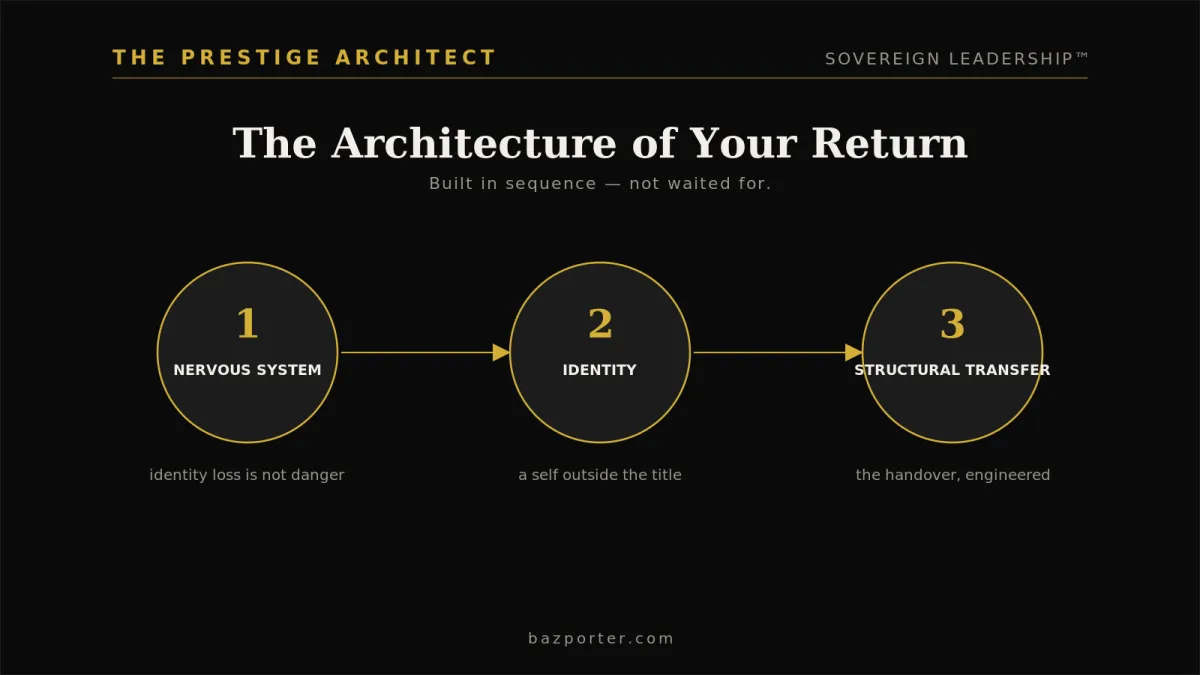
The return has a shape. First, you count what you traded, without flinching. Second, you pick one piece to reclaim. Not all of them. One. Third, you build a small daily practice that protects it. Then you repeat, piece by piece.
Most leaders want to skip to the end. They ask for the whole self back at once. That is not how it works. The self returns the way it left. In pieces. On a schedule you control. The slowness is not a flaw in the method. The slowness is the method. It is how the change holds when the pressure comes back, and it always comes back.
This is the work I do with leaders as The Prestige Architect™. Not a rescue. A rebuild. You keep the life you built. You come home to the person who built it.
When you are ready to begin, apply through the Fast Future Freedom Blueprint. We map the pieces and the first move.
Questions leaders ask
Is giving pieces of myself away the same as burnout?
No. Burnout is depletion from too much load. This is subtraction of self. You can rest a burnout and still feel like a stranger. The two can happen together, but they are not the same problem.
How do I know which pieces I gave away?
Look for things you used to do that you stopped without deciding to. A hobby. An opinion. A way of laughing. Those are the pieces. The Fast Future Freedom Blueprint helps you list them clearly.
Can I reclaim myself without quitting my job?
Yes, in most cases. The pieces you gave away are rarely about the job itself. They are about how you show up inside it. You can change that while you stay.
Why do the pieces not come back on their own?
Because the system that traded them is still running. Nothing changes until you change the daily pattern. The parts wait, but they do not return unless you go to get them.
What if I do not recognize myself at all anymore?
That is more common than you think, and it is reversible. The real you is not gone. It sits under the performance. Start with one true thing this week and build from there.
About the author
Baz Porter® is an executive counsel and the founder of the RAMS™ framework. He works with accomplished leaders who have everything the climb promised and no longer recognize the person who earned it. His work is a RETURN to the self, not another performance of it. Read the manifesto to begin.