Personal Board of Directors: The Sovereign Method
You run the company. You carry the family. You answer to a board. And still, you decide the hardest things alone. That is not strength. That is exposure. I name the slow cost of it Silent Collapse™: the high performer who looks in control and is running on empty. A personal board of directors is the structure that ends the isolation. It is not a friend group. It is not mentorship. It is a small, deliberate circle you build on purpose. This is the work behind my manifesto. Power without collapse. Success without self-betrayal.
What this covers
Key takeaways
A personal board of directors is a small, chosen circle of advisors who counsel one leader.
Isolation at the top is not a mood. It is a structural risk that erodes judgment.
The answer is design, not willpower. You build the circle on purpose.
Five seats carry the weight: the truth-teller, the strategist, the connector, the elder, the peer.
Built well, it is the difference between Silent Collapse™ and Sovereign Leadership™.
What is a personal board of directors?
A personal board of directors is a small, chosen group of trusted advisors who counsel one leader. Four to six people. Each holds a distinct seat. They are not your team. They are not your therapist. They meet you one to one, on a rhythm you set. You bring the real decisions. They challenge your thinking. They hold you to your word. For an executive inside Silent Collapse™, it is the structure that carries what you have been carrying alone. The company has a board for a reason. No serious enterprise lets one mind hold every risk. Yet most leaders run their own life with no such counsel. That gap is where the collapse begins.
The hidden pattern behind executive isolation
Here is the pattern I see in the room. The higher you climb, the fewer people tell you the truth. Your title filters your feedback. People manage up. They soften the news. So you learn to decide with less honest data, not more. Half of chief executives report feeling lonely in the role, and most say it hurts their performance, according to research published in Harvard Business Review (Saporito, 2012). Berkeley's California Management Review makes the case plainly: in an era of shifting careers, a deliberate personal board is now a core leadership discipline, not a nicety (2024). The science of stress agrees. Trusted human support buffers the nervous system and protects judgment under load. Isolation does the opposite. It narrows your thinking to your own loop. The pattern is not weakness. It is an unmanaged structure. And structure is something you can change.
The RAMS™ build: five seats, five pillars
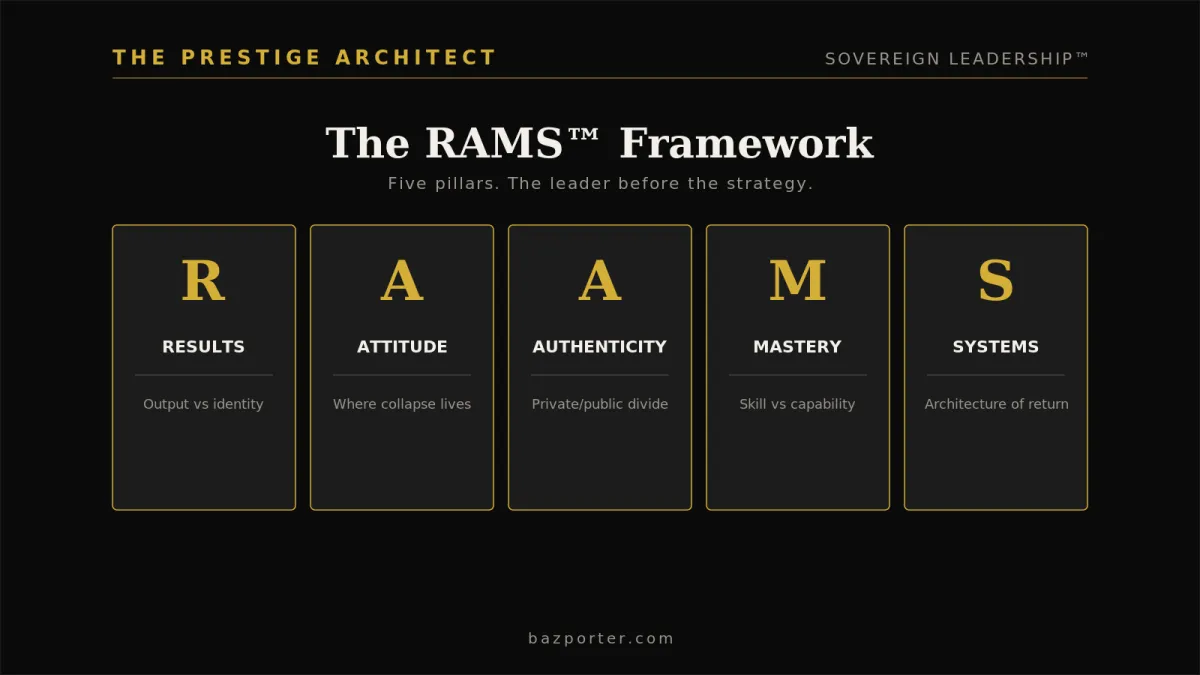
I build every system through RAMS™: Results, Attitude, Authenticity, Mastery, Systems. Here is how the five pillars design your board.
Results, the strategist seat
One seat exists to protect your outcomes. This is the strategist. Someone who sees your numbers clearly and asks the sharp question. They do not flatter the plan. They pressure test it. Their job is to keep your decisions tied to reality.
Attitude, the elder seat
The elder has walked the road ahead of you. They have carried scale and loss and come out standing. When you spiral, they steady you. They shorten the panic. They remind you that this season is a chapter, not the whole book.
Authenticity, the truth-teller seat
This is the seat most leaders never fill. The truth-teller owes you nothing but honesty. No stake in your image. No fear of your title. They tell you what your team will not. Without this seat, you decide inside an echo. With it, you stay honest with yourself.
Mastery, the peer seat
The peer sits at your altitude right now. Same weight. Same week. They understand the load without translation. You trade real problems, not headlines. This seat ends the myth that no one else gets it. Someone does. You just had not built the seat.
Systems, the connector seat
The connector widens your world. They open doors and route you to the right room. They keep you from solving a problem alone that a single introduction would solve. This seat turns your isolation into reach.
Collapsed and Sovereign are two ways to hold the same role. The list below shows the difference.
Collapsed: you decide alone and call it strength. Sovereign: you decide with counsel and call it design.
Collapsed: feedback reaches you filtered and late. Sovereign: the truth reaches you early and clean.
Collapsed: your circle happens by accident. Sovereign: your circle is built on purpose.
Collapsed: the weight sits on one nervous system. Sovereign: the weight sits on a structure.
Isolation is not the price of leadership. It is a design flaw you can correct.
If you cannot name your five seats right now, that is the signal. Do not push through it. The Silent Collapse Diagnostic™ shows you where the weight is landing and what your return requires. It is one hour, live with me.
One leader who stopped deciding alone
A founder came to me at forty. Company scaling. Home quiet. She had no one honest to call. Every hard call ran through her alone, at night, on repeat. We built her board in six weeks. A strategist for the numbers. An elder who had sold a company. A truth-teller from outside her industry. A peer at the same stage. A connector who opened three doors in a month. Nothing about her workload changed. Everything about the weight did. She told me the decisions got faster and the nights got quieter. She stopped confusing isolation with strength. That is the return.
The architecture of your return
You do not need more willpower. You need a structure that holds you. A personal board of directors is that structure. Five seats, built on purpose, meeting you on a rhythm. It is the practical face of Sovereign Leadership Architecture™: the design that lets you lead at full power without paying with yourself. The first move is not recruiting the board. The first move is seeing clearly where you are carrying too much alone. That is what I do with you in the Silent Collapse Diagnostic™. One hour. Live. Honest. Book the Silent Collapse Diagnostic™ and we map your five seats together.
Questions leaders ask
What is a personal board of directors?
It is a small circle of trusted advisors, usually four to six people, who counsel one leader. Each holds a distinct seat, from truth-teller to strategist. They meet you one to one, on a set rhythm, to sharpen your decisions and hold you accountable.
How is it different from a mentor?
A mentor is one relationship. A personal board of directors is a designed set of them. One person rarely covers strategy, hard truth, peer support, elder wisdom, and connection at once. The board spreads those roles across five seats on purpose.
How many people should be on it?
Four to six is the working range. Fewer than four leaves gaps in the counsel. More than six is hard to keep close. Start with the two seats you feel missing most, then build out over a few months.
How do I ask someone to join?
You do not need a formal title or a big ask. Invite one real conversation about a decision you are facing. Show up prepared and respect their time. The relationship deepens through use, not through a contract.
Can a personal board of directors prevent burnout?
It cannot erase the load, but it changes who carries it. Isolation is a driver of executive burnout and Silent Collapse™. A board moves the weight off one nervous system and onto a structure. That shift protects both your judgment and your health.
About the author
Baz Porter® is the founder of Baz Porter LLC® and The Prestige Architect®. He is a British Army veteran and an international bestselling author who guides high achieving leaders from Silent Collapse™ to Sovereign Leadership™. He is the host of the Rise From The Ashes podcast on the C-Suite Network. He does not motivate. He architects. His work is the return to power without collapse, and success without self-betrayal.