Why You Perform A Self You Don't Like
You walk into the meeting and something clicks on. A voice smoother than yours. A calm you do not feel. A certainty you stopped having years ago. You run the room. People nod. And on the drive home a quiet thought lands. I do not like the person I just played.
Not a stranger, exactly. Worse. A version of you that you built on purpose. Polished. Effective. And somehow not you. This is one of the clearest signals of Silent Collapse™, the felt state Baz Porter® named for the ache underneath a successful life. If this is landing, start with the manifesto. Then come back and read the rest.
What this covers
Key takeaways
Performing a self you dislike is a survival adaptation, not a character flaw.
The performed self was rewarded, so your nervous system kept it.
The mask feels more real than you do because you use it more.
The dislike is a signal, not a defect. It means the real self is still keeping score.
The move is RETURN to your real self, not another reinvention.
Why you perform a version of yourself you do not like
You perform a self you do not like because that self got results. Early in the climb, some part of you read the room. It saw what won approval, budget, and promotion. So you built a version that delivered those things. The performance worked. It kept working. And the reward loop wired it in.
Over years, the built self ran more often than the real one. Repetition made it fluent. Fluency made it feel true. Now the mask answers before you do. That is not weakness. It is a nervous system doing exactly what it was trained to do.
The discomfort is not the problem. It is the signal. It means the real self is still in there. It is still keeping score. Silent Collapse™ is what we call that gap between who you play and who you are. The gap does not close by trying harder at the performance. It closes by coming back.
The hidden pattern under the mask
Researcher Patricia Hewlin gave this a name. She called it the facade of conformity. In work published in the Academy of Management Review, she described how capable people suppress their real values and present a version that fits the organization. The facade is not lying. It is fitting in, at a cost that compounds quietly.
There is a second layer. Psychologist Mark Snyder studied what he called self-monitoring. High self-monitors read every room and adjust to fit it. They are often the ones who rise. They are also the ones most likely to lose the thread of who they are. The adjusting never stops.
A third strand ties it together. Sociologist Arlie Hochschild described surface acting, where you display an emotion you do not feel. Surface acting predicts exhaustion, because holding the gap open all day is work. Put the three together and you get the trap. The skill that made you effective is the same skill that made you a stranger to yourself. You did not fail. You over-succeeded at fitting in.
The RAMS™ reframe: from performed to real
RAMS™ is the five-part frame Baz Porter® uses to rebuild a leader from the self outward. The performed self shows up differently in each pillar. Here is the shift.
Results change meaning first. The performed self chases results to prove the mask was worth it. The real self lets results follow the work, not the performance. The output stays high. The desperation under it drops.
Attitude is the pillar this touches most, and this slot lives here. The performed self treats the mask as safety. The real self treats it as data. When you notice the dislike, you stop fighting it. You start reading it. The feeling becomes a compass rather than a verdict.
Authenticity is the return itself. Not confession. Not oversharing. Just closing the gap between what you feel and what you show, one honest degree at a time. Small and repeatable beats dramatic and rare.
Mastery stops being armor. The performed self hides behind competence. The real self uses competence as a tool it can put down. You keep the skill. You drop the hiding.
Systems hold the change. A real self with no boundaries collapses back into the mask by Friday. Structure keeps the return in place when the pressure returns, and it always returns.
Collapsed self versus sovereign self
Collapsed: the mask answers first. Sovereign: you answer, then choose the tone.
Collapsed: the dislike gets buried. Sovereign: the dislike gets read as a signal.
Collapsed: performance is identity. Sovereign: performance is a tool.
Collapsed: you brace for exposure. Sovereign: you have nothing to expose.
Collapsed: rest feels unsafe. Sovereign: rest is where the real self returns.
The mask did not betray you. You built it to survive a room. The work now is to stop needing it in every room.
If you want to see the exact gap between the self you play and the self you are, that is what the free entry audit maps. Start the Fast Future Freedom Blueprint.
One leader who lived it
A managing director came in saying one line. "I am good at my job and I cannot stand who I am at work." On paper, nothing was wrong. Strong numbers. A loyal team. A title most people would trade for.
We looked at the performed self honestly. It was warm in public and cold in private. Decisive on camera and frozen at home. The mask had a full-time job. The real self had gone part-time. That split, not the workload, was the thing draining them.
The work was not a personality overhaul. It was small returns. One meeting a week run as the real self. One honest sentence where a smooth one used to go. One hour a day the mask was allowed to stay off. Within two months the dislike softened. There was less to dislike, because the gap was closing.
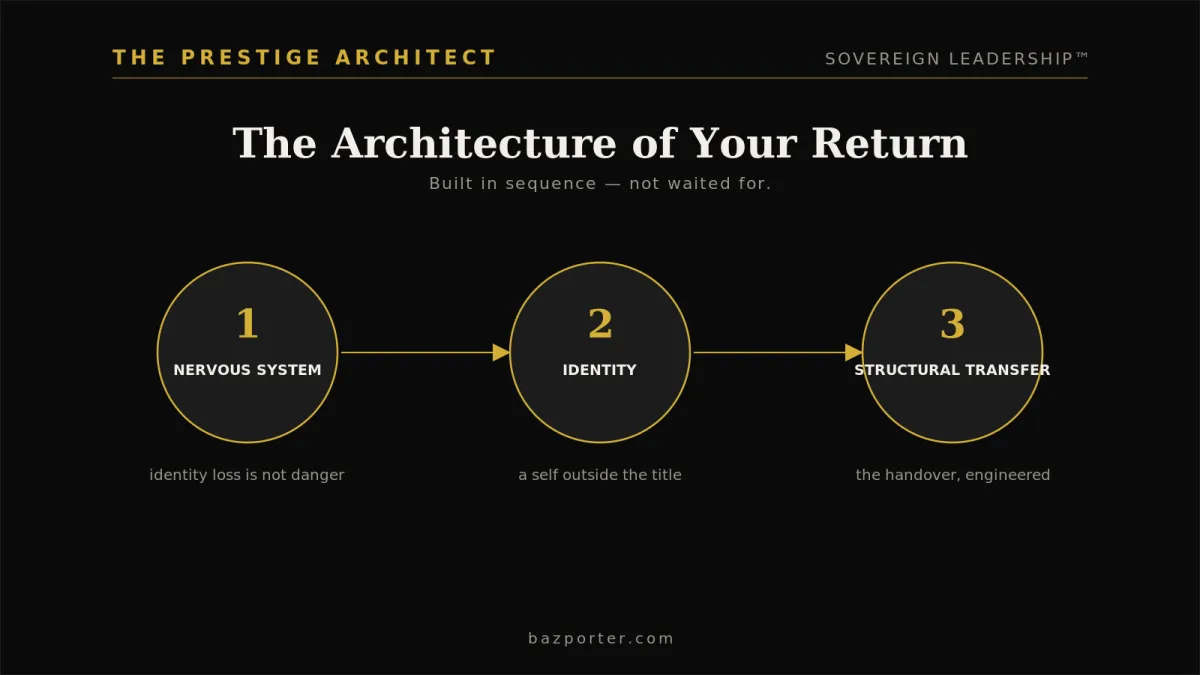
The architecture of your return
The return is not a leap. It is architecture. You do not tear down the built life. You bring the real self back into it, room by room, with structure that holds. That is the difference between a good week and a lasting change.
That is the work Baz Porter® does with leaders through The Prestige Architect™ approach. Not another reinvention. A return to the self that was there before the climb asked you to perform. The role can keep its edge. You do not have to keep paying for it with yourself.
If you are ready to map the first move, apply through the Fast Future Freedom Blueprint. It is the free entry audit, and it starts where you are.
Questions leaders ask
Why do I perform a version of myself I do not like?
Because that version was rewarded. Somewhere in the climb, a performed self won approval and results, so your nervous system kept using it. Repetition made it automatic. The dislike you feel is the real self noticing the gap it never agreed to.
Is performing at work the same as impostor syndrome?
No. Impostor syndrome is fearing you are not good enough. Performing a self you dislike is knowing you are good, and not liking who you had to become to prove it. The two can overlap, but the ache is different, and so is the fix.
Why does the performed self feel more real than I do?
Because you use it more. You run the mask in meetings, calls, and reviews for years. The real self gets less airtime. Fluency creates a false sense of truth. It feels real because it is practiced, not because it is you.
How do I know if I am performing or just being professional?
Professional is a register you choose and can drop. Performing is a self that runs without your consent and leaves you drained. If you cannot find your real self after work, that is the line. Being professional does not cost you yourself.
Can I stop performing without blowing up my career?
Yes. The return is gradual, not a dramatic reveal. You close the gap in small, safe increments, protected by structure. Most leaders find the real self is more effective than the mask, not less, because it costs less to run.
About the author
Baz Porter® is the founder of The Prestige Architect™ and the creator of the RAMS™ framework and the Silent Collapse™ body of work. He helps successful leaders return to the self they left behind on the climb. Learn more at the manifesto, or begin the Fast Future Freedom Blueprint.