People-Pleasing at Work: The High Achiever's Trap
You are the one who says yes. Yes to the extra board seat. Yes to the 9pm request. Yes to the thing no one else will hold. From the outside, it reads as leadership. Inside, it is the opening move of Silent Collapse™ — the quiet erosion of a high achiever who confused being needed with being sovereign. People-pleasing at work is not kindness. It is a survival strategy wearing a tailored suit. I wrote the Sovereign Leadership Manifesto for the woman who is done being indispensable.
In This Article
Key Takeaways
People-pleasing at work is not a character flaw. It is a learned survival pattern.
The cost is not counted in hours. It is counted in self-erasure.
Chronic yes breeds resentment, not respect. The room feels the difference.
Boundaries are not rejection. They are the architecture of trust.
The way out is structural, not motivational. You rebuild the system, not your willpower.
The Definitive Answer
People-pleasing at work is the habit of managing everyone else's comfort at the cost of your own truth. You say yes when you mean no. You over-explain. You absorb tension that was never yours to carry. You scan the room for approval, then edit yourself to earn it.
Here is the direct answer. You do not stop by trying harder. You stop by changing what you optimize for. The pleaser optimizes for approval. The sovereign leader optimizes for the decision. Those are two different operating systems. One drains you. One builds you.
The evidence is blunt. A 2026 analysis found that people-pleasing leaders read as dependable while running quietly toward exhaustion (Forbes, 2026). The yes is not free. You pay for it in yourself.
The pattern compounds. Each yes teaches the room to expect the next one. Your availability becomes the default setting. Requests route to you because you never route them back. Soon you are the bottleneck you built. The organization runs on your depletion. That is not durable leadership. It is a single point of failure wearing your name.
The Hidden Pattern Under the Yes
Psychology has a precise name for this. It is called unmitigated communion — overinvolvement in others to the exclusion of the self (Helgeson & Fritz, 1998). It is not generosity. It is self-silencing.
The research is unambiguous. Unmitigated communion predicts greater psychological distress and a slow decline in health, even after controlling for how much people care in a balanced way (Helgeson et al., 2007). People high in this trait attend to everyone else and neglect themselves. The body keeps that score.
Read that as an architect, not a critic. The pleaser is not weak. She is well-defended. Somewhere, being needed became the safest way to be valued. The pattern worked once. It is now the tax on her whole life.
There is a second cost, quieter than the first. When you silence your own needs, you also silence your own signal. The board loses your real read. The team loses your true no. A leader who only agrees is data-poor. Your dissent was always part of the value.
The RAMS™ Reframe
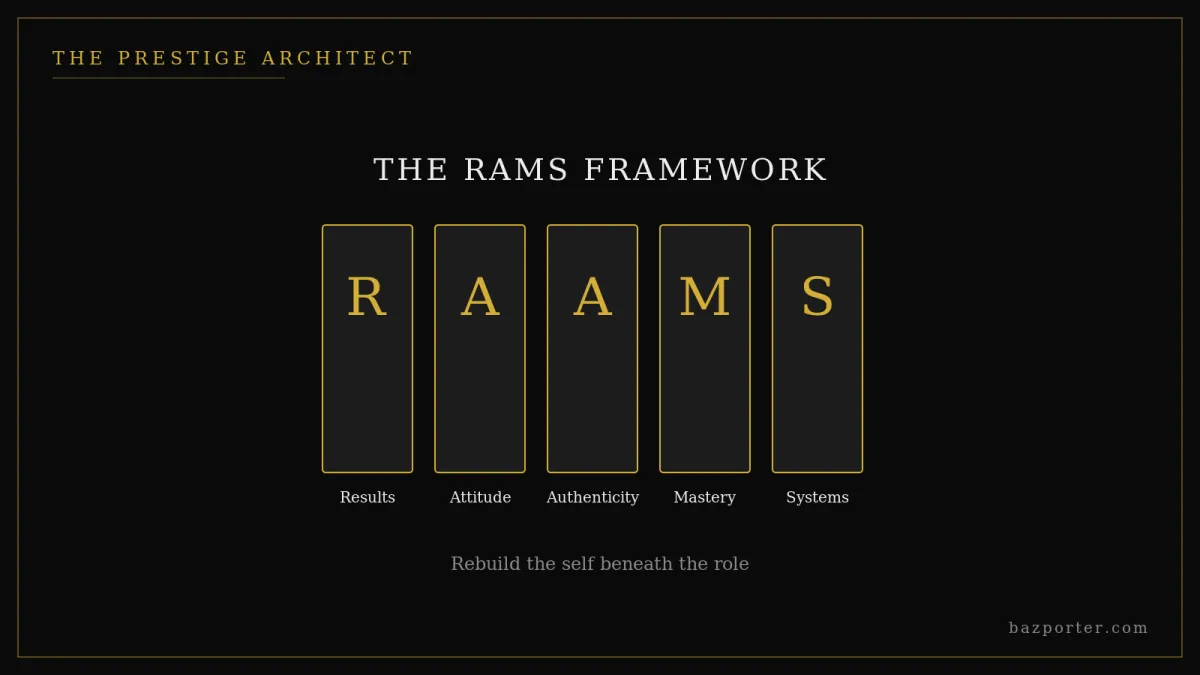
I do not counsel harder saying-no. I re-architect the operating system underneath it. RAMS™ is five load-bearing pillars: Results, Attitude, Authenticity, Mastery, Systems. People-pleasing corrupts each one. Here is the rebuild.
Results. Your yes inflates activity and starves outcome. Sovereign leaders protect the few decisions that move the number. Everything else is noise you are paid to decline.
Attitude. Approval-seeking is a posture of scarcity. You act as if belonging must be earned hourly. The sovereign stance assumes worth, then leads from it.
Authenticity. The pleaser performs a self the room will like. That self is exhausting to maintain. Authenticity is cheaper. It is also magnetic. People trust a leader who is the same person in every room.
Mastery. Saying no is a skill, not a mood. You train the pause. You train the clean sentence. You train the tolerance of another person's brief disappointment.
Systems. Willpower will lose. Structure will win. Default calendars, decision rules, and a standing no protect you when your nervous system wants to please. The system holds the line so you do not have to relitigate it daily.
Collapsed vs. Sovereign
Collapsed: Says yes to be safe. Sovereign: Says yes on purpose.
Collapsed: Absorbs everyone's tension. Sovereign: Returns tension to its owner.
Collapsed: Reads the room for approval. Sovereign: Reads the room for truth.
Collapsed: Over-functions, then resents. Sovereign: Delegates, then trusts.
Collapsed: Protects other people's comfort. Sovereign: Protects the decision.
You did not rise by pleasing everyone. You rose by deciding. Those are opposite skills.
If you recognize yourself in the left column, name it. The first move is not a rule. It is an honest read of the pattern. Take the Silent Collapse Diagnostic™ and see where the yes is costing you most.
A Case From the Room
A managing director came to me numb. On paper, she was untouchable. Inside, she was the person who fixed everything for everyone. Her calendar belonged to other people. Her evenings belonged to their emergencies. She called it service. I called it a slow disappearance.
We did not add motivation. We built structure. One standing no. One decision rule. One protected block that no one could book. The first week felt like withdrawal. By the sixth, her team had grown up around the boundary. Her results rose. Her resentment fell. She stopped being loved for her availability and started being respected for her judgment.
She told me the hardest part was the silence after the first no. No one applauded. No one collapsed. The request simply moved to the person who owned it. The catastrophe she feared never arrived. It rarely does.
Nothing about her changed. The architecture around her did.
The Architecture of Your Return
People-pleasing does not end with a pep talk. It ends with a rebuild. You install the boundaries, the rules, and the systems that make the sovereign choice the automatic one. This is the return to power without collapse, and success without self-betrayal.
Understand the sequence. Boundary first. Then the rule that enforces it. Then the system that makes it automatic. Motivation is the least durable layer, so we build it last, if at all. The sovereign leader is not more disciplined than you. She is better structured.
That rebuild is the work I do inside my highest container. If you carry a company on your yes and you are ready to set it down, you can apply to work with me directly. This is not for everyone. It is for the leader who is finished disappearing inside her own success.
Frequently Asked Questions
Is people-pleasing at work the same as being a team player?
No. A team player contributes from choice. A pleaser complies from fear. One is generous. The other is self-erasing. The tell is what happens inside you when you say yes. Relief is choice. Dread is fear.
How do I stop people-pleasing without becoming cold?
You do not swing to cold. You move to clear. Warmth and boundaries are not opposites. The clearest leaders are also the kindest, because people always know where they stand.
Why do high-achieving women people-please more?
Many were rewarded early for being agreeable and useful. That reward built a reflex. Under pressure, the reflex fires. Research links this overinvolvement in others to distress and poor health outcomes (Helgeson et al., 2007).
What is the first step to stop?
Name one recurring yes that drains you. Turn it into a standing no. Let the system hold the line so your nervous system does not have to. Structure beats willpower every time.
Where do I start with Baz Porter®?
Start with the Silent Collapse Diagnostic™. Sixty minutes, live, with me. We map where the yes is costing you and what the rebuild requires.
About the Author
Baz Porter® is the founder of Sovereign Leadership Architecture™. British Army veteran. Two-time international bestselling author and host of the Rise From The Ashes podcast. Baz works with high-achieving women to dismantle the structural patterns beneath Silent Collapse™ and return them to sovereign identity, relational wholeness, and gravitational power — power without collapse, success without self-betrayal.