How to Stop Being the Only Load-Bearing Wall
You became the one thing holding it all up. The team leans on you. The family leans on you. The business leans on you. Take one load off, and you fear the whole structure drops. This is not strength. It is a design flaw. A building with a single load-bearing wall is one bad day from collapse, and you have quietly become that wall. I named this felt state Silent Collapse™, the slow erosion of a leader who is still useful and no longer free. The way out is not more grit. It is better architecture. Start with the manifesto behind the return.
By Baz Porter®, architect of sovereign leadership.
In this article
Key takeaways
Being the only support is a structural risk, not a virtue.
A load spread across many points is safer than a load on one.
People grow stronger when you let them carry real weight.
Shared structure is built on purpose, not hoped for.
Your worth survives when you stop being the only wall.
The short answer
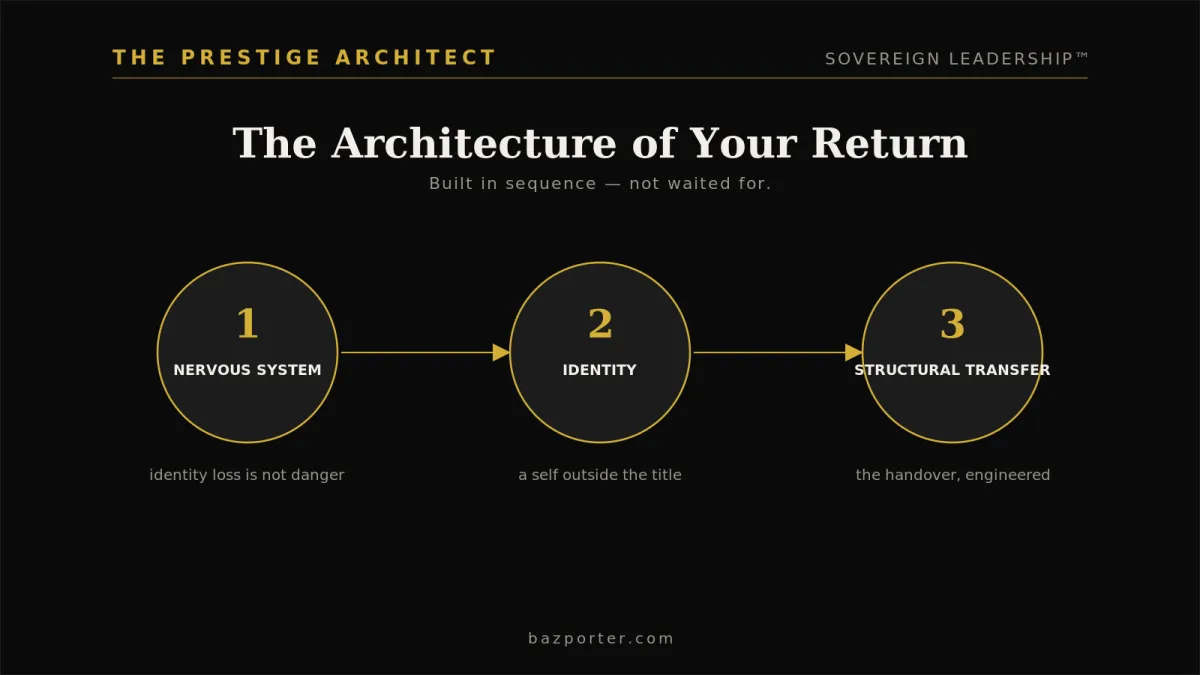
You stop being the only load-bearing wall by building a shared structure. A shared structure spreads weight across many people and systems. No single point holds the roof alone. You do this in three moves. First, you name every load that runs through you. Second, you assign each load a second owner. Third, you let that owner carry it, mistakes and all. The goal is not to drop the weight. The goal is to redistribute it. A sound building has many walls. So should your life. This is the work I call The Architecture of Your Return.
The hidden pattern
Here is the part most leaders miss. You did not become the only wall by accident. You built it, one rescue at a time. Each time you stepped in, you taught people to step back. Each save made the next save more likely. The structure learned to depend on you. Research on collective efficacy makes this plain. Bandura (2000, Current Directions in Psychological Science) found that a group's belief in its own shared capacity drives what it can do. When one person carries everything, that shared belief never forms. The group stays weak because you stay strong. Your reliability became their fragility. That is the quiet cost of being indispensable. You did not just carry the weight. You trained the walls around you to lean.
The RAMS™ reframe
RAMS™ is my operating model for the return. It moves you from a collapsed structure to a sovereign one. We run it across five pillars.
Results
Measure the right thing. A collapsed leader measures how much they personally carried. A sovereign leader measures how much the structure holds without them. Track that. Count the decisions made in your absence. Count the days off that did not cause a fire. Those are the real results. The output of a sound building is that no one notices the walls. Your absence should be a non-event, not a crisis.
Attitude
Drop the belief that help is failure. You were taught that asking is weakness. It is not. Asking is how a structure tests its other supports. A leader who never asks never learns who can hold weight. Change the inner line. Not "I must carry this." Instead, "who else can carry this with me." That single shift reopens the whole system. Pride keeps you the only wall. Humility builds the others.
Authenticity
You are more than your usefulness. That is the hard truth under all of this. You fear that if the weight moves, your value moves with it. It does not. The real you is not the wall. The real you is the architect who can design a better one. When you share the load, you stop performing strength. You start living it. People do not bond with a wall. They bond with a person. Let them meet the person.
You are not failing because you need support. You are failing to build the support you need.
If that line lands, start the free Silent Collapse Diagnostic™. It shows you exactly where your structure runs through a single point. Take the diagnostic here.
Mastery
Mastery is handing off without hovering. This is a skill. Most leaders delegate a task, then guard it. That teaches no one. Real handoff gives the owner the decision, not just the chore. Give them the why. Give them the room to do it their way. Give them permission to get it wrong once. A load you still inspect is a load you still carry. Mastery is trusting the other wall to hold. You built the capacity. Now let it bear weight.
Systems
This is the anchor pillar. A shared structure needs shared memory. Wegner (1987) described transactive memory, the way strong groups store knowledge across people, not in one head. When only you know how things run, only you can run them. Build the opposite. Write the process down. Name a second owner for every system. Make the knowledge live outside your skull. A system that depends on one person is not a system. It is a hostage. Design systems that hold when you are gone. That is how one wall becomes many.
The collapsed wall versus the sovereign structure
Collapsed: every decision waits for you. Sovereign: decisions happen at the edge.
Collapsed: your absence is a crisis. Sovereign: your absence is a Tuesday.
Collapsed: you guard every task. Sovereign: you grant real ownership.
Collapsed: the knowledge lives in you. Sovereign: the knowledge lives in the system.
Collapsed: you are needed. Sovereign: you are free.
A case from the room
A founder sat across from me last spring. She ran a company of ninety. She had not taken a clean week off in six years. Every escalation came to her. She called it dedication. I called it a single point of failure. We mapped every load that ran through her. There were forty-one. Forty-one threads, one wall. We assigned each a second owner over ninety days. The first month felt like betrayal to her. Things got done differently. Some got done worse. Then something shifted. By month three, her team made calls she used to make. She took a real week off. Nothing burned. She told me it was the first time in years she felt like a person, not a pillar. The structure held. She was no longer the only wall. She was the architect who built the rest.
The architecture of your return
Your return is not a rest. It is a rebuild. You do not come back by working less for a week. You come back by redesigning who holds the weight. Pick one load this week. Just one. Name a second owner. Hand them the decision, not the task. Then step back and let them hold it. Watch what happens. The roof does not fall. The wall beside you holds. You feel the first inch of freedom in years. That is the start of the return. I built the Fast Future Freedom Blueprint to walk you through the full redesign, step by step. Apply for the Blueprint here.
Questions leaders ask me
Why do I feel guilty when I let someone else carry the load?
Because you tied your worth to carrying it. Guilt is the old wiring firing. You trained yourself to believe that stepping back is letting people down. It is not. Letting someone carry weight is how they grow. The guilt fades once you see them succeed without you. Sit with the discomfort. It is the feeling of a structure getting stronger.
What if the people around me cannot handle the weight?
Often they can, and you never let them try. Capacity grows under real load, not under supervision. Start with a load that matters but will not sink the ship. Give them the decision and the room to use it. If they truly cannot hold it, you learn that fast and cheaply. More often, they rise. People meet the bar you set for them.
How is this different from delegating tasks?
Delegation hands off the chore and keeps the decision. A shared structure hands off both. When you delegate a task but guard the choice, you are still the wall. The load still runs through you. A shared structure gives the other person the authority to decide. That is the difference between a helper and a second owner. One lightens your day. The other rebuilds the building.
Will I still be valued if I am not the one holding everything?
Yes, and in a deeper way. Right now people value what you do for them. When you build a shared structure, they value who you are. You move from useful to known. That bond outlasts any task. Your value was never the weight you carried. It was the leader who could design a better load path. That is worth more, not less.
Where do I start if everything runs through me?
Start by naming every load on paper. You cannot redistribute what you cannot see. List each thread that ends with you. Then pick the single load with the lowest risk and the highest drain. Assign it a second owner this week. One load, one owner, one real handoff. Momentum builds from that first clean release. The Silent Collapse Diagnostic maps your single points for you.
About the author
Baz Porter® is the architect of sovereign leadership and the creator of the RAMS™ model and the Silent Collapse Diagnostic™. He counsels established leaders through the return from Silent Collapse™ to a self that is more than useful. His work helps capable people rebuild a life where they are no longer the only wall holding it up.