Why Staying Loyal To The Role Costs You Yourself
You tell yourself you cannot leave. Too many people count on you. Too much is riding on the version of you that got here. So you stay. You hold the line. You keep being the one who holds the line. And somewhere in that loyalty, a quieter cost starts to show.
Not to the company. To you. The role has your allegiance. The person underneath it has gone quiet. This is a signal of Silent Collapse™, the felt state Baz Porter® named for the ache underneath a built life. If this is landing, start with the manifesto. Then come back and read the rest.
What this covers
Key takeaways
Loyalty to the role is often loyalty to who you had to become, not to the work.
The longer you stay, the more leaving feels like a betrayal, so you keep paying.
Obligation can feel like duty while it quietly costs you yourself.
The loyalty is not a flaw. It is misdirected. It belongs to you first.
The move is RETURN to your real self, not a dramatic exit.
Why staying loyal to the role is costing you yourself
You stay loyal to the role because loyalty is how you were built to win. You showed up. You carried the weight. You became the person the role needed. That reliability earned trust, budget, and rank. So the loyalty got rewarded, again and again, until it became who you are.
But the loyalty drifted. It was meant for the work. Over time it bonded to the performance instead. Now you are loyal to a version of yourself that the role requires. That version does not get to rest, question, or change. It just has to keep showing up.
The cost is quiet. It does not show on the scorecard. It shows in the flatness, the dread on a Sunday night, the sense that you owe the role more than it ever owed you. Silent Collapse™ is the name for that gap. It does not close by being more loyal. It closes by coming back.
The hidden pattern under the loyalty
Researchers John Meyer and Natalie Allen mapped this. In the Human Resource Management Review, they described normative commitment, the pull to stay because you feel you ought to. It is loyalty built on obligation, not desire. The ought grows louder the longer you stay.
There is a second force. Psychologist Barry Staw called it escalation of commitment. In his study known as knee-deep in the big muddy, he showed how people pour more into a course of action because they already invested so much. The sunk cost becomes the reason to stay. Leaving would make the years feel wasted, so you double down.
A third strand closes the trap. In Self-Determination Theory, Edward Deci and Richard Ryan described introjected regulation, acting from guilt and internal pressure rather than real choice. You do not stay because you want to. You stay because not staying feels like letting everyone down. Put the three together and the loyalty looks noble from the outside. Inside, it is an obligation you never agreed to carry this far.
The RAMS™ reframe: from loyal to the role to loyal to yourself
RAMS™ is the five-part frame Baz Porter® uses to rebuild a leader from the self outward. Misdirected loyalty shows up in every pillar. Here is the shift.
Results stop being proof of your worth. The loyal self delivers to justify staying. The sovereign self lets results stand on their own. You keep the output. You drop the debt you think you owe.
Attitude is the pillar this slot lives in. The loyal self treats the obligation as duty. The sovereign self treats it as data. When staying feels like betrayal, you stop obeying the feeling. You start reading it. The guilt becomes information, not a command.
Authenticity is where the loyalty gets redirected. Not to the role. To the person who has carried it. You start keeping your own agreements, not just everyone else's. The allegiance comes home.
Mastery stops being the chain. The loyal self stays because it is good at the job and cannot imagine not being needed. The sovereign self keeps the skill and releases the grip. Being capable is not the same as being owned.
Systems hold the line. Loyalty with no boundaries collapses back into over-giving by Monday. Structure protects the return when the old pull comes back, and it always comes back.
Collapsed self versus sovereign self
Collapsed: loyal to the role. Sovereign: loyal to yourself first.
Collapsed: staying is a duty. Sovereign: staying is a choice you remake.
Collapsed: leaving would betray them. Sovereign: abandoning yourself already did.
Collapsed: the role owns you. Sovereign: you hold the role.
Collapsed: guilt runs the calendar. Sovereign: guilt is one more input.
Your loyalty was never the problem. You just gave it to the role before you gave it to yourself.
If you want to see exactly where your loyalty is costing you, that is what the free entry audit maps. Start the Fast Future Freedom Blueprint.
One leader who lived it
A senior partner came in with one sentence. "I cannot leave. They need me, and I built this." On paper it was a success story. Two decades in. A firm shaped by their hand. A reputation most people would envy.
We looked at the loyalty honestly. It was real. It was also one-directional. They kept every promise to the firm and almost none to themselves. The role had grown a claim on their health, their marriage, their mornings. The loyalty had no exit and no limit.
The work was not a resignation letter. It was redirection. One boundary held when guilt said give more. One promise to themselves kept before the firm's. One hour a day that belonged to the person, not the partner. Within weeks the dread eased. They stayed in the role. They stopped being owned by it.
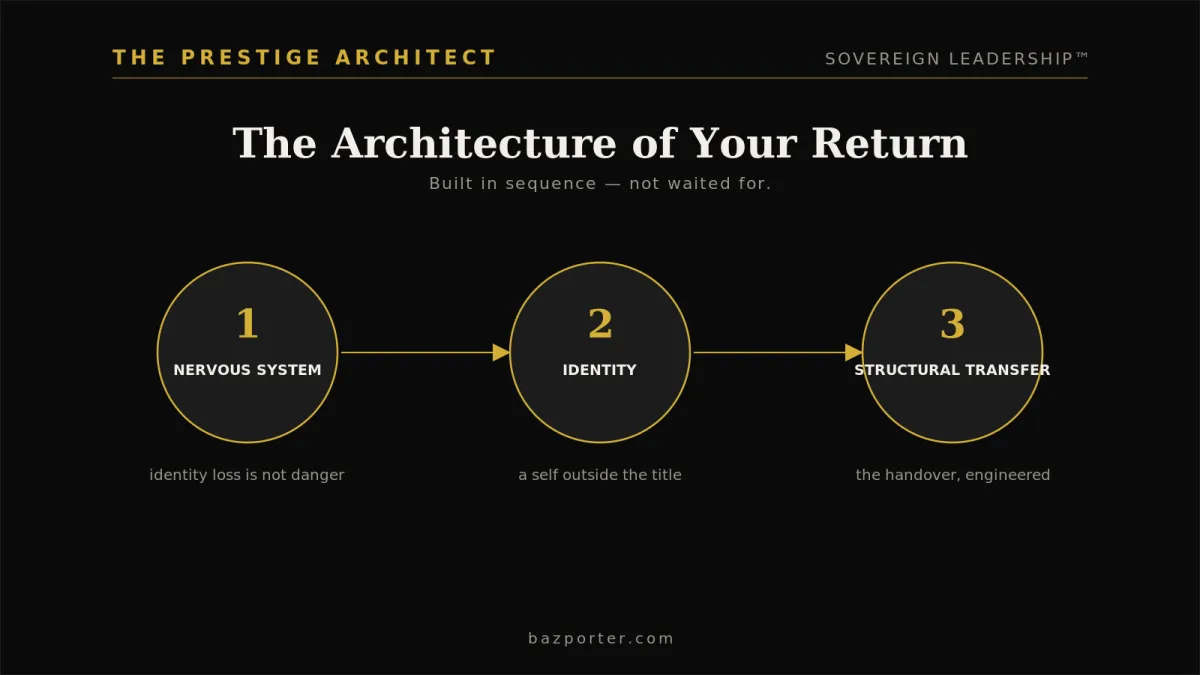
The architecture of your return
The return is not a resignation. It is architecture. You do not torch the firm, the title, or the team. You bring your loyalty home, one boundary at a time, with structure that holds under pressure. That is the difference between a good intention and a lasting change.
That is the work Baz Porter® does with leaders through The Prestige Architect™ approach. Not an exit. A return to the person the role has been borrowing for years. The role can keep its weight. You do not have to keep carrying it at the cost of yourself.
If you are ready to map the first move, apply through the Fast Future Freedom Blueprint. It is the free entry audit, and it starts where you are.
Questions leaders ask
Why does staying loyal to my role feel like it is costing me?
Because the loyalty bonded to the performance, not the work. You keep delivering for everyone else and stop keeping promises to yourself. The cost shows up as flatness and dread, not on any scorecard. That gap is the price of loyalty pointed in one direction.
Is this the same as just being committed to my job?
No. Commitment is a choice you can remake each day. This is obligation that runs without consent and leaves you drained. If staying feels less like a decision and more like a debt, that is the line. Healthy commitment does not cost you yourself.
Why do I feel guilty when I imagine stepping back?
Because years of investment make leaving feel like waste, and obligation makes it feel like betrayal. Researchers call this escalation of commitment and normative commitment. The guilt is real, but it is a signal about where your loyalty is pointed, not proof that you must keep over-giving.
Can I stay loyal to the role without losing myself?
Yes. The point is not to quit. It is to redirect the loyalty so it includes you. You keep your agreements to yourself alongside the ones to the role. Most leaders find they lead better from there, because the resentment drops.
How do I start coming back without blowing up my career?
You start small and protected. One boundary, one kept promise to yourself, one hour that is yours. Structure holds the change when the old pull returns. The return is gradual by design, so the built life stays intact while you come back to it.
About the author
Baz Porter® is the founder of The Prestige Architect™ and the creator of the RAMS™ framework and the Silent Collapse™ body of work. He helps successful leaders return to the self they left behind on the climb. Learn more at the manifesto, or begin the Fast Future Freedom Blueprint.