The True Legacy of a Leader Is More Than Achievement
You’ve built a career on hitting every target. You perform. It’s what you do. But in the quiet moments, a different feeling creeps in. A silent collapse. Instead of fulfillment, there is a deep, creeping exhaustion. There is a fear that all this relentless effort will end in burnout, not the meaningful legacy you actually crave.
Key Takeaways
Your Legacy Is Not a Monument: Discover why a "legacy" built on past achievements is a brittle trap that leads to burnout. Learn how to shift to building a "living ecosystem" that thrives without your constant effort.
The Neuroscience of Leadership: Understand the biological difference between leadership fueled by cortisol (stress) and leadership fueled by oxytocin (trust). This shift is the key to creating a team that innovates instead of fears.
The Four Pillars of Enduring Impact: Learn the four non-negotiable pillars—Embodied Values, Empowered People, Codified Culture, and Sustained Systems—that form the foundation of a legacy that lasts.
The RAMS™ Legacy Engine: See how the RAMS method transforms from a personal productivity tool into a powerful engine for building an ecosystem, empowering your team, and reclaiming your own nervous-system sovereignty.
That internal voice is relentless. "I've given everything, but what will actually last? Am I building something that matters, or just a monument to my own exhaustion?" This is the hidden cost of high achievement so many successful women face. You fought your way to the top only to find the air is thin. The view isn't what you expected.
The constant pressure to perform leaves zero room for reflection on your legacy of a leader.

This corrosive feeling of being "never enough" is a predictable side effect of a system that rewards unsustainable output. You can find out more about how high-achieving women can stop feeling never enough and reclaim their energy in our detailed guide.
To fight this ceaseless drive, learning how to manage multiple projects simultaneously without burnout is a non-negotiable skill.
A new model of leadership is taking hold. Recent data shows female founders are actively prioritizing "Founder Well-Being & Sustainable Leadership." They bake mental health into their core business strategies. This results in businesses that are 35% more likely to survive long-term economic downturns, a clear demonstration of building a resilient legacy.
What Is the True Legacy of a Leader?
A leader's true legacy is not a static monument built from past achievements for others to admire. It is the living, breathing ecosystem you cultivate every day through your values, actions, and the capabilities you build in your people. This ecosystem adapts, regenerates, and thrives long after you are gone, while a monument shatters under pressure.
When you hear ‘legacy,’ what comes to mind? A name on a building? A string of awards? A stock price that once touched the sky?
That’s a monument. And monuments are brittle. They must be constantly defended. They are built on the shaky ground of external validation. Your real legacy as a leader isn't a monument. It’s a living ecosystem you cultivate every single day.
A monument shatters. An ecosystem thrives.

The Hidden Pattern: Cortisol vs. Oxytocin
This isn't a feel-good metaphor. The difference is hardwired into our biology.
Monument-building is a threat-based game. It runs on cortisol and adrenaline. It floods your system and your organization with stress. It creates a culture of fear where everyone protects their turf, because you are so busy protecting yours. This is the fast-track to burnout. For you and your team.
In stark contrast, an ecosystem leader operates from deep trust. This style is fueled by oxytocin, the neurochemical responsible for social bonds and psychological safety. It fosters a generative environment where people feel empowered to grow, innovate, and take real ownership.
Monument Leadership vs. Ecosystem Leadership
The distinction is everything. It is the difference between fragile impact and sustainable impact. One model drains energy. The other creates it.
Look at this table. The first step to a legacy that lasts—one that nurtures instead of drains—is brutal honesty about where you operate right now.
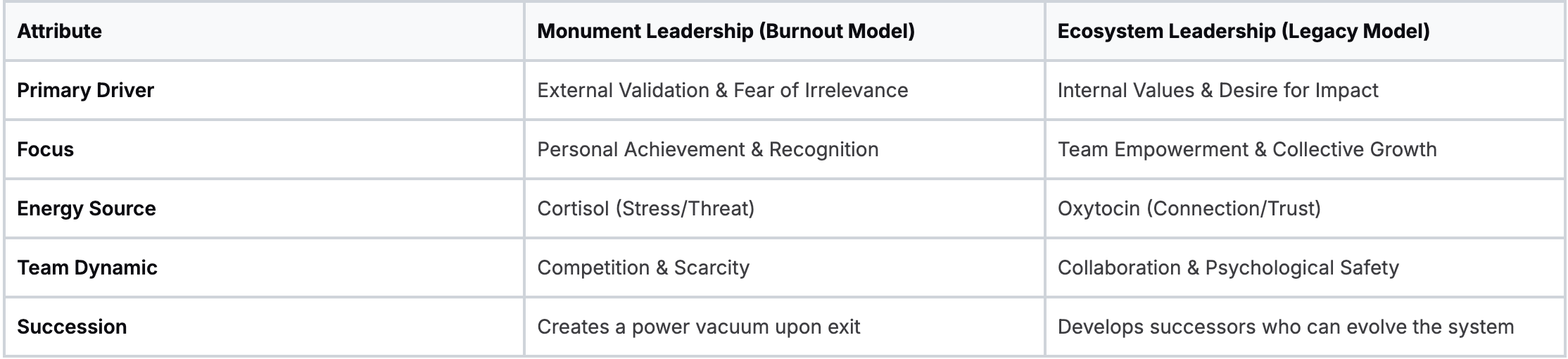
Do you see the shift? It’s moving from a "monument builder" to an "ecosystem architect." This is essential for any leader who wants her influence to outlast her time in the chair. An ecosystem thrives long after you’re gone. Its strength comes from the interconnected root system you cultivate—the people, values, and culture you nurtured.
This shift starts with understanding what authentic leadership truly means, not just in what you do, but in how you show up. Your legacy is what lives on inside of people.
The Four Pillars of an Enduring Leadership Legacy
An ecosystem isn’t built by accident. It is cultivated with brutal intention. Shifting from monument-builder to ecosystem-architect demands a clear roadmap. It transforms anxiety around your legacy into a concrete set of executable priorities.
This entire framework rests on four non-negotiable pillars.

These are not separate silos. They are deeply interconnected. Each one reinforces the others to forge a resilient, generative whole that will outlast any single leader.
1. Embodied Values
Values are not the words on a conference room wall. They are the principles you live and breathe. The absolute non-negotiables that guide your decisions when no one is watching. An enduring legacy is rooted in values that are embodied, not just stated.
Your team doesn’t listen to what you say. They watch what you do. Do you model the calm, regulated presence you demand during a crisis? Do your budget allocations reflect your commitment to integrity?
Your legacy is the sum of your daily actions. If your behavior contradicts your stated principles, then your true values—and your real legacy—are the actions themselves.
This is the bedrock. To build an authentic ecosystem, you must first become its most honest reflection. You can go deeper by understanding the core of your professional values.
2. Empowered People
A monument leader collects dependent followers. An ecosystem architect cultivates other leaders who can operate without them. The truest test of your legacy is the capability and autonomy of the people you develop.
Empowerment isn't delegating tasks. It's giving away authority. It's trusting your people to make critical decisions, fail, and learn from the wreckage. This requires you to hunt for successors from day one and train them to be better than you. This doesn’t diminish your role; it multiplies your impact exponentially.
3. Codified Culture
Culture is the invisible force dictating "how things are really done here." A strong legacy codifies a culture of psychological safety, where brutal candor is encouraged and real innovation can flourish.
This means building explicit rituals that reinforce desired behaviors. It's creating a feedback structure that is constructive, not punitive. It's fostering an environment where diverse perspectives are sought out, not silenced for comfort.
For high-achieving women, this is particularly potent. A landmark McKinsey study found that companies with the most gender-diverse executive teams were 21% more likely to have above-average profitability. Legacies built on true inclusivity don't just feel better; they perform better.
4. Sustained Systems
A legacy that lasts is built on systems that sustain excellence long after you're gone. These are the processes, playbooks, and operational cadences that ensure your ecosystem thrives in your absence.
Are your best practices locked inside your head? Or are they documented and repeatable? Is your organization dependent on your individual heroics? Or have you built scalable systems that empower everyone to execute at a high level?
These systems represent the ultimate act of letting go, ensuring the work not only continues but evolves.
The RAMS Reframe: Your Legacy Engine
Moving from "monument builder" to "ecosystem architect" demands a new way of operating. You need a system that turns your intention to build a lasting legacy of a leader into daily, measurable actions. This is where the RAMS™ Method becomes the engine driving your strategy.
Many see RAMS as a high-performance framework. They are not wrong. But its real power is as a legacy-creation tool—one that directly feeds the four pillars of your ecosystem.
Reframing RAMS for Lasting Impact
The RAMS Method—Results, Attitude, Mastery, and Systems—goes far beyond personal productivity. Through the eyes of an ecosystem architect, each component gains a profound new meaning.
Results are no longer just a number. They become the measurable health and vitality of your ecosystem.
Attitude is no longer just your mindset. It becomes the regulated nervous-system state you model, creating psychological safety for your people.
Mastery isn’t about your skills. It’s the deep competence you intentionally grow in others.
Systems aren’t just processes. They are the replicable structures that guarantee your ecosystem thrives without you.
This reframe shifts you from managing today's performance to architecting tomorrow's leaders.
Experiential Edge: From Burnt-Out Monument to Thriving Architect Sarah, a tech COO, was the hero. She personally drove every major win. She was indispensable. The cost? Utter burnout. Her team was a dependency engine, waiting for her next command. Her "legacy" was a culture of learned helplessness.
Using the RAMS reframe, her focus shifted. Results became the team's ability to hit targets without her direct involvement. Attitude became her practice of staying calm during a failed launch, which modeled resilience instead of fueling panic. She poured energy into Mastery, creating a mentorship program to build her own successors. Finally, she codified her unique frameworks into Systems—clear playbooks anyone could run with.
Within 18 months, team performance skyrocketed by 30%. Sarah took her first-ever three-week vacation without checking email once. She was no longer the monument; she was the architect of an ecosystem that could finally stand on its own.
How RAMS Maps to the Four Legacy Pillars
The connection between RAMS and the Four Pillars is a direct operational map. RAMS gives you the "how" for each "what."
This framework carves a clear path from abstract ideas to tangible, daily actions. For a deeper dive, learn more about Baz Porter's revolutionary RAMS Method and leadership framework explained.
Here’s exactly how the components align:
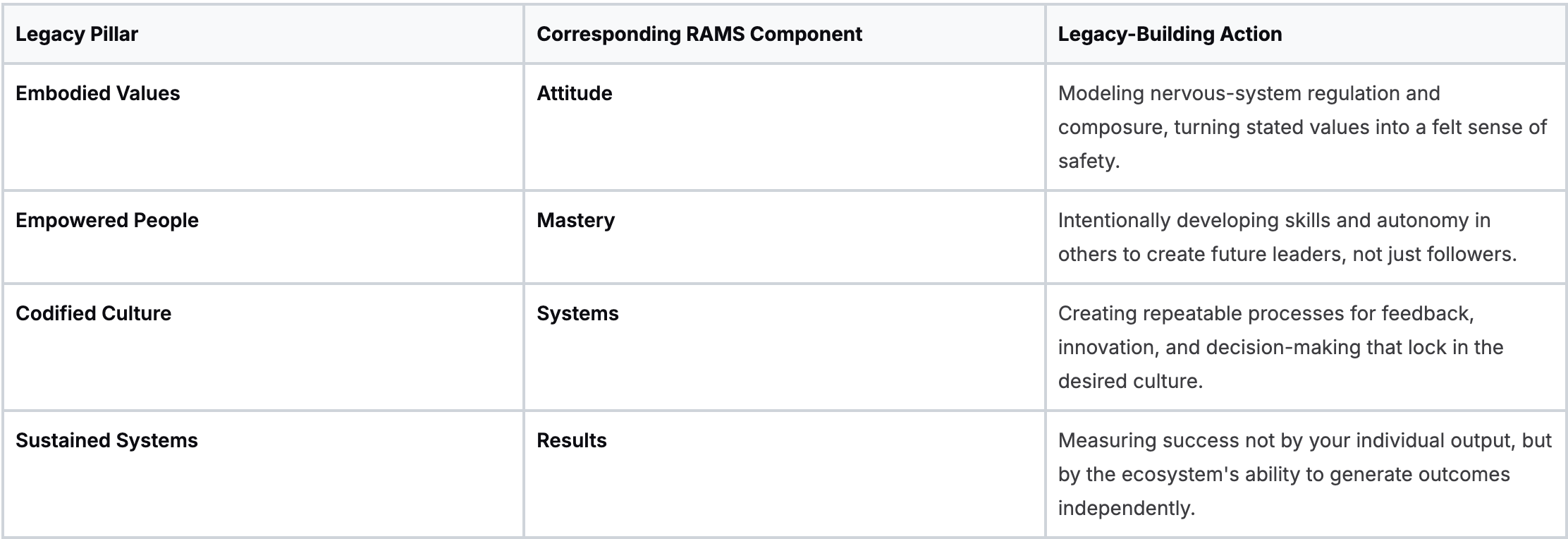
When you consistently apply this reframe, you stop chasing achievements and start cultivating an environment. This is the real, daily work of creating a legacy that matters.
The Return: Your Legacy Is Your Sovereignty
Let’s be clear. Building your legacy of a leader isn't another item to cram onto your overloaded schedule. It is an act of reclamation. A journey back to yourself—a return to a state of nervous-system sovereignty where your impact becomes a natural extension of who you truly are.
When you lead from this place of authentic alignment, your legacy stops being something you build brick by painful brick. It becomes the living outcome of your very presence.
This isn’t about adding more to your plate. It's about changing the plate itself—from one piled high with exhausting obligations to one that nourishes you. The anxiety of "what will I leave behind?" dissolves, replaced by the certainty of what you are creating right now.
Your greatest legacy is not the empire you build, but the sovereign leader you become in the process. This journey is about returning to that core power.
Are you ready to stop building monuments to your own exhaustion? It's time to cultivate a legacy that energizes you.
Your Questions About Building a Leadership Legacy Answered
You have questions. They run deeper than strategy. They touch on the core anxieties of high-achieving leadership: burnout, timing, and the true source of impact. Here are direct answers to help you reframe your approach to creating a meaningful legacy without sacrificing yourself.
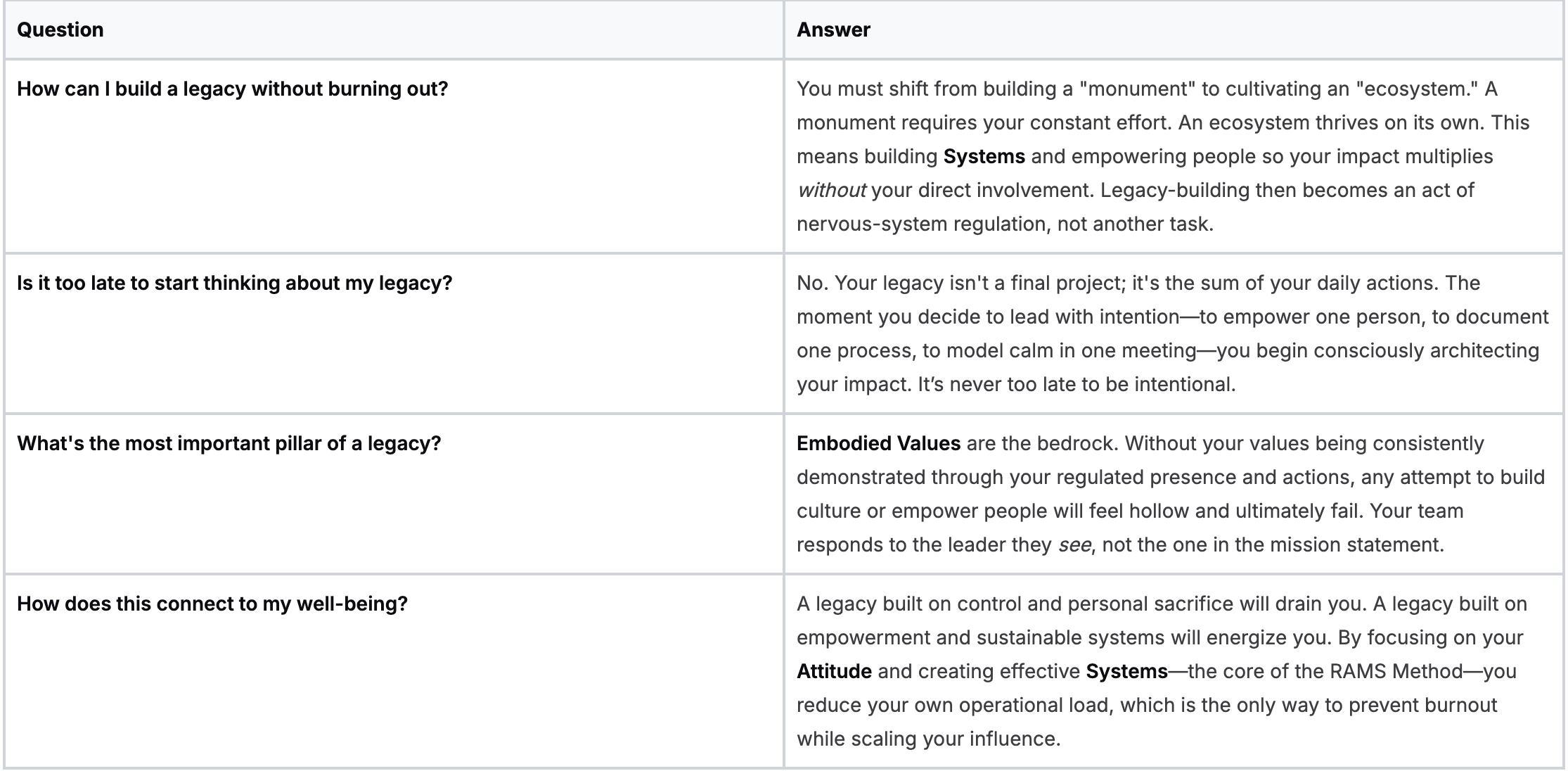
These are not just theoretical concepts. They are the practical foundations for a new kind of leadership. One where your greatest impact comes not from what you do, but from the environment you create for others to do their best work.
At Baz Porter, we guide accomplished women from a state of silent collapse to one of sovereign leadership. If you're ready to build a legacy that energizes you and elevates everyone around you, this is your next step.
Discover the path to building your enduring impact. Book your diagnostic call today.