How to Lead as Your Real Self
The mask goes on before the meeting starts. You feel it click into place. The voice gets a little smoother. The opinions get a little safer. By the time you sit down, the person in the chair is the one the room expects, not the one who drove in. And here is the quiet part. It feels safer that way. The mask has never cost you a promotion. Being fully yourself might.
This is the trap of Silent Collapse™. Not a breakdown anyone can see. A slow trade where you lead as a managed version of yourself because the managed version is what got rewarded. You are good at it now. That is the problem. You have proof that hiding works. So leading as your real self starts to feel reckless, like it would undo everything you built. If any of this lands, read the manifesto first. It names the thing you have been carrying alone.
On this page
Key takeaways
The mask feels safer because it has a track record. Hiding got rewarded, so your nervous system files it as survival.
Leading as your real self is not a personality change. It is a return to a self that was always there.
You do not drop the mask all at once. You lead unmasked in small, chosen, low-cost moments first.
Authenticity at work is a practiced skill, not a fixed trait. The research is clear on this.
The goal is not to be less of a leader. It is to stop paying yourself to disappear.
The short answer
You lead as your real self by treating the mask as a tool, not a home. Start where the stakes are low. Say the true thing in one meeting a week. Voice the real reservation instead of the polished one. Let your team see a decision cost you something. Each small act teaches your nervous system a new fact. Being yourself did not end the career. Over weeks, the safe zone widens. The mask becomes something you can set down, not a face fused to your own. This is a return, not a rebuild. The real self did not leave. It went quiet under years of being rewarded for the performance.
Why the mask feels safer than the truth
Here is the pattern under the fear. The mask is not a lie you chose. It is a habit your success trained into you. Early on, a smoothed-over version of you got the nod. It got the raise. It got the room. So your body learned a rule. Show the managed self, get rewarded. Show the real self, take a risk. That rule kept working. Now you have a decade of evidence that hiding is safe.
The cost stays invisible for a long time. Researchers call the daily effort of managing your true self at work emotional labor, and surface acting is its most draining form. Grandey's work in the Academy of Management Journal found that surface acting, showing feelings you do not hold, predicts exhaustion and lower performance over time. You are not tired because you work hard. You are tired because you spend energy every day being someone slightly other than yourself.
There is a second finding that matters more. Cha and colleagues, writing in the Academy of Management Annals in 2019, reviewed decades of research on being your true self at work. Their conclusion is direct. Authenticity is not a trait you either have or lack. It is a state you can build through specific choices. That is the whole hope of this. If the mask was learned, the real self can be led back into the room. Deliberately. In steps.
The five-part architecture for leading unmasked
My work runs on RAMS™, a five-pillar system for leading as yourself under load. Here is how each pillar takes the mask off, one layer at a time.
Results
Start by redefining the win. The mask optimizes for approval. Approval is not a result. It is a feeling other people have. Pick one hard outcome this quarter that matters to you, not to the room. Lead toward that. When the goal is real, the performance has less to hold onto.
Attitude
Watch the story you tell about honesty. The mask says candor is dangerous. Test that story in a low-stakes place. Say one true, uncomfortable thing in a meeting where the cost is small. Notice what actually happens. Usually the ceiling does not fall. Your attitude shifts from fear to evidence.
Authenticity
This is the center. Authenticity is not oversharing. It is congruence, when your inside and your outside match. Kernis, in Psychological Inquiry, described this as the core of healthy self-worth. You practice it in specifics. Voice the real reservation. Admit the thing you do not know. Let a value show in a decision. Small acts of congruence, repeated, become a way of leading.
Mastery
Treat leading unmasked as a skill, because it is one. You already mastered the performance. You can master the return. Pick one relationship, one meeting, one recurring moment. Practice being yourself there until it is stable. Then add the next. Mastery is not a leap. It is reps in chosen places.
Systems
Protect the change with structure. Willpower fades under pressure, and pressure is exactly when the mask snaps back on. So build a rule. One meeting a week where you say the true thing. A trusted person who names it when you disappear. A five-minute check after hard calls. The system holds the new behavior when your resolve is thin.
Leaders do not lose themselves in one dramatic moment. They lose themselves in a thousand small, rewarded compromises. The return works the same way, in reverse.
The difference between the collapsed pattern and the sovereign one is not effort. It is direction.
Collapsed: the mask is home, the real self is the risk. Sovereign: the real self is home, the mask is a tool you choose.
Collapsed: you manage what the room thinks. Sovereign: you lead toward what is true.
Collapsed: honesty feels reckless. Sovereign: honesty is a practiced skill with evidence behind it.
Collapsed: you are exhausted by a self you perform. Sovereign: you are steadied by a self you inhabit.
If you want the map for this return, the Fast Future Freedom Blueprint is the free entry point. It is a working session on where the mask costs you most, and the first pillar to move.
One leader's return
A managing director I worked with led two hundred people. Everyone trusted the calm, certain version she showed. She did not. On the drive home she felt like a fraud in her own success. The mask had never failed her at work. It was failing her everywhere else.
We did not stage a reveal. We picked one weekly meeting. In it, she practiced one thing. Saying the real reservation out loud. The first time, her voice shook. Nothing bad happened. The team leaned in. Over eight weeks the practice spread. She started naming what she did not know. She let a hard call cost her visibly. Her people did not respect her less. They trusted her more, because the calm was finally real. She did not become a new leader. She stopped paying herself to disappear.
The architecture of your return
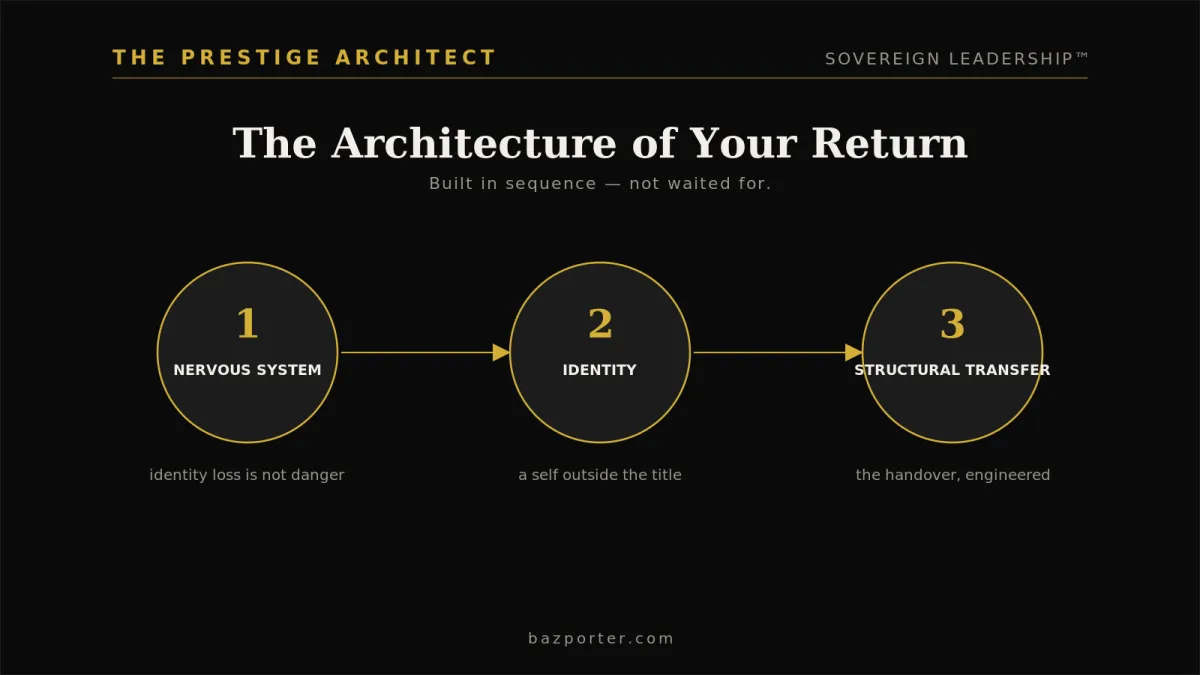
You do not have to choose between the life you built and the self you buried. That is the false trade the mask sells you. The real work is quieter. You lead unmasked in one place, then another, until the performed self is a thing you can put down. The standing stays. The exhaustion goes. What returns is you.
The Fast Future Freedom Blueprint is where this starts. It is a free, focused session, not a pitch. We find the moment the mask costs you most, and we design the first small act of leading as yourself. If you would rather sit with the whole picture first, the manifesto is here for that.
Questions leaders ask about this
Is leading as my real self the same as being unprofessional?
No. Congruence is not the absence of judgment. You still choose your timing and your words. Leading unmasked means your outside matches your inside, not that you say everything you think. It is honesty with discretion, not honesty without a filter.
Won't dropping the mask make me look weak in front of my team?
Usually the opposite. Teams read a performed calm as distance. They read chosen honesty as trust. When a leader names a real reservation or admits a gap, people lean in, not away. The mask protects your image and erodes their trust at the same time.
Why does the mask feel safer even when it exhausts me?
Because it has a track record. Your career rewarded the managed version, so your nervous system files hiding as survival. The exhaustion is real, but it is quiet and slow, while the fear of being yourself is loud and immediate. Safe and healthy are not the same thing here.
Can I really change this after leading one way for years?
Yes. The research is clear that authenticity is a state you build, not a trait you are stuck with. You learned the mask through repetition, and you return through repetition. The years of practice are not a wall. They are proof you can master a new pattern too.
Where do I start if the stakes feel too high everywhere?
Start smaller than feels significant. One sentence, in one low-stakes meeting, once a week. The point is not the size of the act. It is teaching your body a new fact through evidence. The safe zone widens from there. The Fast Future Freedom Blueprint helps you find the lowest-cost place to begin.
About Baz Porter
Baz Porter® is the founder of Baz Porter LLC and the creator of RAMS™, a system that helps accomplished leaders return to themselves without dismantling the life they built. He works with people in Silent Collapse™, the quiet, high-functioning ache of having become someone you no longer recognize. His work is about return, not reinvention. You were never the mask. You were the one wearing it.