Why "Is This It?" Won't Leave You Alone
Is this it.
You said it quietly. In the car. After the win. In a house that works.
On paper, the life is full. Inside, there is a flat, quiet nothing. You are not sad. You are not tired in the ordinary way. You just keep asking the same small question, and it will not leave you alone.
This feeling has a name. It is called Silent Collapse™. It is what happens when a capable person builds a whole life and quietly leaves themselves out of it. The good news is simple. The question is not a warning that something is wrong with you. It is your own self, asking to come home. If you want the short version of what that means, read the manifesto first.
What this article covers
Key takeaways
“Is this it” is not about your life. It is about your distance from yourself.
The question returns because the self you set aside is still waiting.
This is not clinical burnout. It is a quiet loss of contact with what is real in you.
The move is not another goal. The move is RETURN.
You can name the exact place the contact was lost, and you can walk back.
The short answer
“Is this it” keeps coming back for one reason. The feeling is not about the life. It is about you.
You built a life that works. Somewhere in the building, you left yourself out of it. The roles got louder. The real you got quieter. The question is the last honest signal still running. It is the part of you that never agreed to disappear, tapping on the glass.
So the fix is not a bigger win. A bigger win feeds the machine that made the silence. The move is to turn back toward the self you set down. That is what I mean by RETURN, not another climb.
Notice too that the question is not weakness. It takes a strong, honest mind to feel the gap and refuse to lie about it. Most people around you are pushing the same feeling down. You heard yours. That is the start, not the failure.
The hidden pattern under the question
Researchers have a name for the flat, empty middle. They call it languishing. It is the quiet space between distress and true wellbeing, where you function fine and feel almost nothing. The work of Corey Keyes shows that languishing is its own state, not simple sadness, and that high performers live in it often (Keyes, Journal of Health and Social Behavior, 2002).
There is a second piece. When reward stops landing, the brain keeps the ambition and drops the pleasure. Clinicians call the loss of pleasure anhedonia, and it can sit quietly inside a driven, working life (Anhedonia review, NCBI, 2020).
Put those together and the pattern is clear. You are not lazy. You are not ungrateful. You are a person whose wins stopped registering, because the one who was supposed to feel them went quiet years ago.
High performers hide this well. The output stays high. The calendar stays full. From the outside, nothing looks wrong, and that is the trap. The better you cope, the longer the quiet goes unnamed, and the deeper it settles.
The five places it shows up, and the return
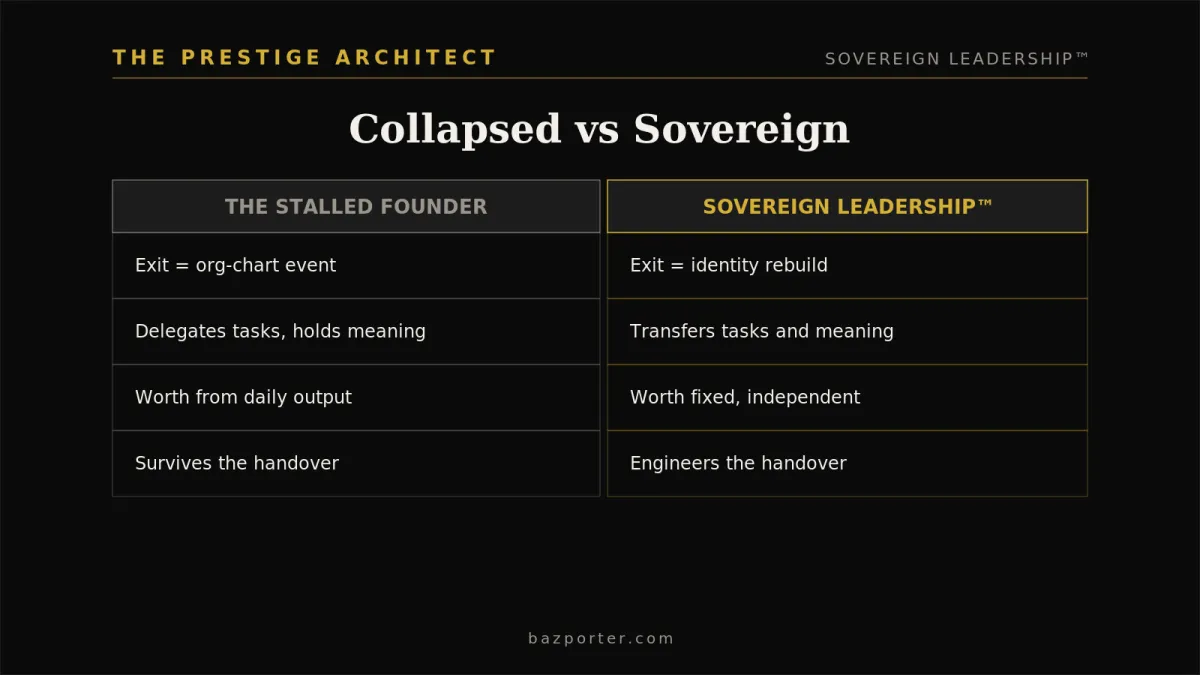
I read this through a simple frame called RAMS™. Five words. Results, Attitude, Authenticity, Mastery, Systems. The question “is this it” lives in each one. Here is the collapsed version, and the sovereign version, side by side.
Results. Collapsed: you hit the number and feel nothing. Sovereign: the win lands, because you were present for it.
Attitude. Collapsed: you call the flatness gratitude and push it down. Sovereign: you let the question be real, and you follow it.
Authenticity. Collapsed: you perform the person who is fine. Sovereign: you say the true thing out loud, to one safe person.
Mastery. Collapsed: you get better at the role and further from yourself. Sovereign: you build skill in feeling, not just doing.
Systems. Collapsed: your calendar protects the output and starves the self. Sovereign: your week has room for a real moment in it.
The question is not the problem. The silence you built around it is.
If you want to see which of these five is quietest in you right now, that is exactly what the free Silent Collapse Diagnostic™ is for. It shows you the place contact was lost, in plain words, in about ten minutes.
One person, one turn
A leader I worked with had every marker of a life that works. Title, home, family, a calendar people would envy. In our first hour, one line came out. “I keep waiting to feel it, and it never comes.”
We did not add a goal. We found the exact year the self went quiet. It was not dramatic. It was a slow trade, one yes at a time, until the real person was fully covered by the role.
The turn was small and it held. One honest sentence a day. One real moment on the calendar, defended. Within weeks the question changed. It stopped being a dread and became a door. That is the whole work. Not a new life. A way back into the one you have.
The architecture of your return
You do not need to burn the life down. You built something real. The task is to move back into it as yourself.
The return has an order. First, name the feeling in true words, not gratitude words. Second, find the place the self went quiet. Third, put one real moment back into the week and guard it. Fourth, build from there.
The order matters. People try to skip to step four and add a project. It does not hold, because the self is still absent from it. You cannot outbuild an inner absence. You have to be there first, then build. That is why the pace is slower at the start and faster later.
This is the work I do inside The Prestige Architect™. It is a return, not a rescue. If the question “is this it” has been following you, that is the signal it is time to answer it on purpose. You can start with the Silent Collapse Diagnostic™ and see your own map before you decide anything else.
Common questions
Why do I feel empty when my life looks full?
Because a full life and a felt life are not the same thing. You can build every outer marker and still lose contact with the self who was meant to feel them. The emptiness is that gap, not a flaw in the life.
Is “is this it” a sign of depression?
Not always. Often it is languishing, a flat middle state where you function well and feel little. It is worth naming with care. If the flatness comes with hopelessness or thoughts of harm, speak to a doctor or a licensed professional.
Why does another achievement not fix it?
Because the win is not the problem. The one who was supposed to feel the win went quiet. Adding a bigger win feeds the same silence. The answer is contact with yourself, not more output.
Is this just a midlife thing that passes?
It can arrive in the forties or fifties, but it is not a phase that fixes itself. Left unnamed, the quiet usually deepens. Named on purpose, it becomes the start of a return.
What is the first real step?
Name the feeling in honest words and find the place you went quiet. The free Silent Collapse Diagnostic™ walks you through that first step in about ten minutes.
About the author
Baz Porter® is the founder of The Prestige Architect™ and the creator of the RAMS™ framework and the Silent Collapse™ body of work. He guides capable, successful leaders out of quiet emptiness and back into a life that feels like their own. His work is a return to the self, not a rescue from the outside.