How to Rebuild an Identity Beyond Your Job
You keep waiting to feel like someone once the job is quiet. The meeting ends. The laptop closes. And the person underneath the title feels thin, almost absent. This is not a character flaw. It is a Silent Collapse™, the slow hollowing that happens when one role carries a whole self. If you want the frame behind everything here, start with the manifesto. Then come back, because this piece is about the build, not the wound.
On this page
Key takeaways
An identity beyond your job is built, not found. You assemble it in small, repeatable acts.
The job did not steal your self. It simply crowded out the other rooms.
You do not need to quit to rebuild. Most of the work happens in place.
Start with evidence, not affirmations. Note what is already true when no one is watching.
This is a return to who you are, not a reinvention of someone new.
The short answer
How do you rebuild an identity beyond your job? You give the non-work parts of yourself regular, protected practice until they carry weight again. Identity is not a fixed thing you locate. It is a pattern you keep. When the job is the only pattern you keep, it becomes the only self you can feel. The fix is not a personality overhaul. It is a set of small structures that let other parts of you exist on a schedule. You build the container first. The feeling of being someone follows the container. That order matters, and most people get it backwards.
The hidden pattern
Here is the part almost no one names. A demanding role does not erase your identity. It out-competes it. Every hour goes to the thing that pays, ranks, and applauds. The other selves, the maker, the friend, the beginner, the parent who is present, get whatever is left. Usually nothing is left.
Researchers call the repair work identity crafting. Amy Wrzesniewski and Jane Dutton, writing in the Academy of Management Review, showed that people actively shape the meaning and edges of their roles rather than passively receive them. The same muscle rebuilds a self outside work. You craft it. You do not wait for it.
Self-determination theory, the decades of work by Edward Deci and Richard Ryan documented through the American Psychological Association, points to why the job feels so total. It reliably feeds three needs: competence, autonomy, and relatedness. When only work feeds them, only work can hold your sense of self. The move is not to drain the job. The move is to feed those three needs somewhere else too. Then the job stops being load-bearing for your whole identity.
The RAMS reframe
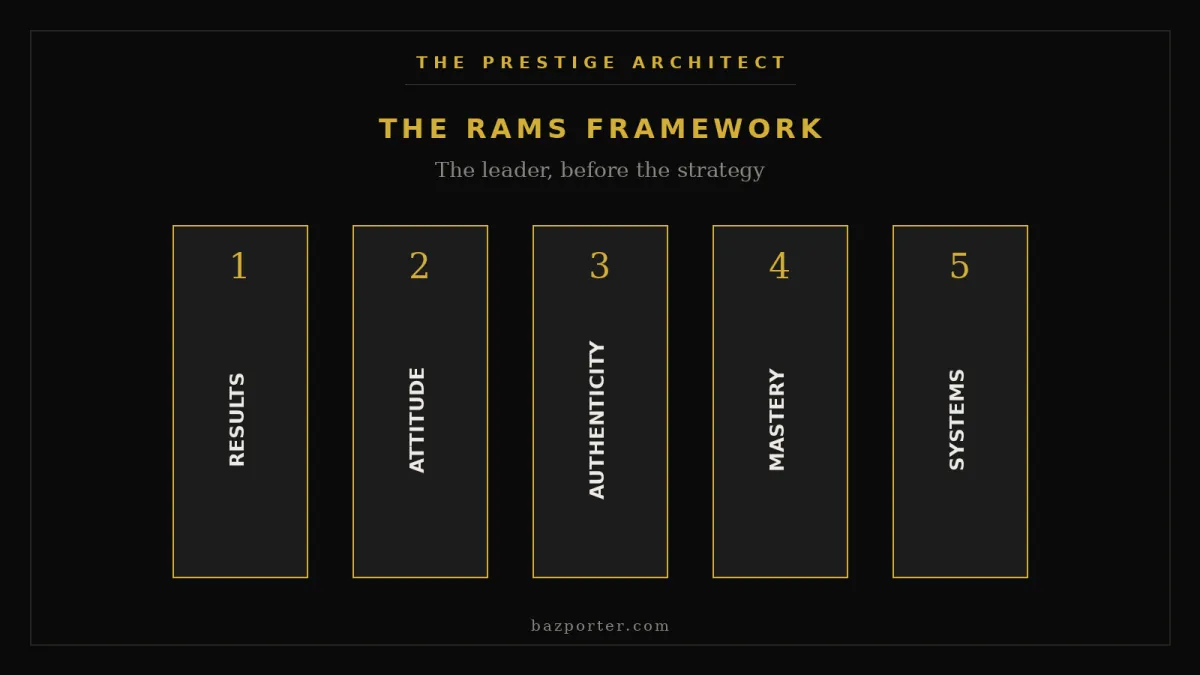
I rebuild identity through the five pillars of RAMS™. This post lives mostly in the Mastery pillar, because Mastery is where a self gets built by practice rather than by wish. But all five apply, so I will walk each one.
Results
Stop measuring yourself only in work output. Define one weekly result that has nothing to do with your title. A finished chapter. A repaired thing. A real hour with a person. A result you own that the company cannot claim. It is small on purpose. Small results, kept, become evidence of a self.
Attitude
Drop the belief that the non-work you is a hobby. It is not a hobby. It is a room in the house you forgot to live in. Treat it with the seriousness you give a client. You would not cancel on a client three weeks running. Do not cancel on yourself.
Authenticity
Notice who you are when nothing is being measured. What do you reach for on a free Saturday. What do you talk about when it will not advance your career. That reaching is data. It is the quiet signal of a self that predates the job. Follow the signal, not the resume.
Mastery
Pick one non-work skill and practice it on a schedule. Skill is the fastest route back to a self, because competence is felt, not argued. You do not have to be good yet. You have to be consistent. Consistency builds the identity. The identity does not arrive first and then produce consistency.
Systems
Protect the practice with a structure the job cannot override. A recurring block. A door that closes. A standing commitment with another person so it is not only up to your willpower. Willpower loses to a full inbox every time. A system does not.
Collapsed versus Sovereign
Collapsed waits to feel like someone before acting. Sovereign acts, then feels like someone.
Collapsed calls the non-work self a hobby. Sovereign calls it a room in the house.
Collapsed lets the job set the whole schedule. Sovereign protects one block the job cannot touch.
Collapsed measures worth in output alone. Sovereign keeps one result the company cannot claim.
Collapsed thinks quitting is the only door. Sovereign rebuilds the self in place first.
The leaders who last are not the ones who work the most. They are the ones who kept a self the work could not consume.
If you cannot yet feel where your identity ends and the job begins, that is the exact thing worth naming out loud. That is what the free entry audit is for. You can book the Fast Future Freedom Blueprint and we map it together, in plain terms, no pitch.
One leader, in real terms
A managing director came to me sure they wanted to walk away. On the call, the real problem surfaced fast. It was not the job. It was that the job was the only thing left. Fifteen years had gone to the title. Everything else had gone quiet.
We did not touch the job for six weeks. We built one block instead. Ninety minutes, Sunday morning, a piano they had not played since their twenties. Bad at first. Then less bad. Then something loosened. Within two months they told me the strangest thing. They still had the same job. But they no longer needed it to be their whole answer to who am I. The restlessness dropped. The exit fantasy dropped with it. They stayed, on purpose, as a fuller person. That is a return, not a reinvention.
The architecture of your return
Here is the build, in order. Do not skip the order.
First, name one non-work self you miss. Just one. The maker, the athlete, the friend, the student. Second, give it a fixed weekly block and a closed door. Third, set one small result inside that block, the kind you can finish. Fourth, tell one person, so it is witnessed and harder to cancel. Fifth, repeat it for eight weeks before you judge it. Identity is a pattern, and patterns need reps before they feel real.
You do not need permission to start, and you do not need to burn anything down. The life you built can stay. The self it crowded out can come back into it. That is the whole move. Return, not escape.
If you want help finding the first block and the first result, that is the work I do. Book the Fast Future Freedom Blueprint. We will find the one true thread and pull it.
FAQ
How do I build an identity outside of work when I have no time?
You do not add time. You protect a small block and defend it like a client meeting. Ninety minutes a week is enough to start. The point is consistency, not volume. A protected small block beats an unprotected large ambition every time.
Do I have to quit my job to rebuild my identity?
No. Most of this work happens in place, alongside the job you already have. Quitting rarely fixes an identity problem, because the empty feeling travels with you. Build the other self first. Then any decision about the job is made by a fuller person.
Why do I feel like nothing without my title?
Because one role has been feeding all of your needs for competence, autonomy, and connection. When only work feeds those needs, only work can hold your sense of self. Feed them somewhere else too, and the title stops carrying your whole identity.
How long does it take to feel like myself again?
Give any new practice eight weeks before you judge it. Identity is a pattern kept over time, not a switch you flip. Most people feel a shift within two months of one protected weekly block. The feeling follows the reps, not the other way around.
Is this reinvention or something else?
It is a return, not a reinvention. You are not becoming a stranger. You are giving room back to parts of yourself the job crowded out. The self was never gone. It was only starved of practice.
About Baz Porter
Baz Porter® is the founder of Baz Porter LLC and the architect behind RAMS™ and the Silent Collapse™ framework. He works with capable, accomplished leaders who have built the life and quietly lost themselves inside it, and helps them return to who they actually are without burning it all down. Start with the manifesto, or book the Fast Future Freedom Blueprint.