How to Stop Betraying Yourself in Small Daily Ways
How to Stop Betraying Yourself in Small Daily Ways
You did not sell yourself out in one big moment. You did it in a hundred small ones. A meeting where you swallowed the truth. A yes you meant as a no. A version of you that showed up so the room stayed comfortable. This is Silent Collapse™, the felt state Baz Porter®, The Prestige Architect™, has spent years naming. The daily self-betrayal is quiet. It is also the most expensive habit a successful leader keeps. If you feel it, start with the manifesto.
What this covers
Key takeaways
Self-betrayal is rarely dramatic. It is small, daily, and automatic.
Each small compromise trains your nervous system that your truth is unsafe.
You cannot think your way back. You have to act your way back.
The return is built one honored signal at a time, not one grand decision.
Mastery is keeping the promises you make to yourself first.
The short answer
You stop betraying yourself by catching the moment, not the mood. The daily self-betrayal happens in a two second window. Someone asks. You feel the true answer. Then you override it. The fix lives in that window. You learn to name the true signal before the override fires. Then you honor one small signal a day. That is the whole method. It sounds too simple. It is not easy, but it is simple. Small honored signals rebuild the self that the climb wore down. This is a RETURN to who you already are. It is not a project to become someone new.
The hidden pattern under the daily betrayal
Here is what almost no one tells capable leaders. Your competence is the trap. You became excellent at reading the room. You learned to give people the response they needed. That skill built your career. That same skill now overrides your own signal a dozen times a day. You are not weak. You are over-trained.
The research backs this. Studies on self-concordance show that people who chase goals misaligned with their real values report lower wellbeing even when they succeed (Sheldon and Elliot, University of Rochester). Success on the wrong terms does not fill you. It hollows you. Work on emotional labor points the same way. When you perform feelings you do not hold, day after day, the strain compounds (Grandey, Pennsylvania State University). The mask has a cost. You have been paying it in small daily installments.
So the pattern is this. A signal rises. You feel it in the body first. Then a faster, older program says the signal is unsafe. It says keep the peace, keep the pace, keep the image. You comply. The signal goes quiet. Repeat that a thousand times and you stop hearing the signal at all. That silence is what you call not recognizing yourself.
The RAMS™ method for returning to yourself
The RAMS™ framework works the leader before it works the strategy. Here is how each pillar rebuilds the self you traded away.
Results. Redefine the score. You measured results in output and applause. Start measuring the number of days you told the truth in a small way. That is a real result. It compounds faster than revenue does inside you.
Attitude. Drop the war with yourself. You did not fail. You adapted to survive rooms that rewarded the mask. Meet that with respect, not shame. Shame keeps the betrayal running. Respect ends it.
Authenticity. This is the center of the work. Authenticity is not oversharing. It is congruence. Your inner signal and your outer action match. You start small. One honest sentence in one meeting. One boundary you actually hold. Congruence is a muscle. You build it with reps.
Mastery. Mastery is keeping promises to yourself first. Most leaders keep every promise to others and break every promise to themselves by 9am. Reverse the order. The promise you keep to yourself is the foundation every other promise stands on.
Systems. Willpower fails under load. Design instead. Build a two second pause into your day. Before you answer, ask one question. Is this true, or is this the mask? The pause is the system. The system carries you when your resolve is thin.
Here is the contrast, drawn plainly:
Collapsed: you answer from the room. Sovereign: you answer from the signal.
Collapsed: you keep the image intact. Sovereign: you keep yourself intact.
Collapsed: you wait for a breaking point. Sovereign: you correct in the small moment.
Collapsed: you perform steadiness. Sovereign: you build it.
Sovereign leadership is not the absence of pressure. It is the refusal to abandon yourself under it.
If you want the map for your own week, the free entry audit is the Fast Future Freedom Blueprint. It shows you where the daily betrayals live in your specific life.
What this looks like in a real week
Consider a leader in their late forties. Title secured. Team performing. Home life intact on paper. They came in with one sentence. I do not like who I have to be at work. We did not rebuild their calendar. We watched three days of small moments. A yes that should have been a no. A joke that covered a real objection. A calm face over a clear concern. Then we ran one rule. One honored signal a day. Day one, they named a real reservation in a meeting. Day three, they held a boundary they usually folded on. Nothing exploded. The built life stayed. What changed was the person living inside it. They started recognizing themselves again. That is the return.
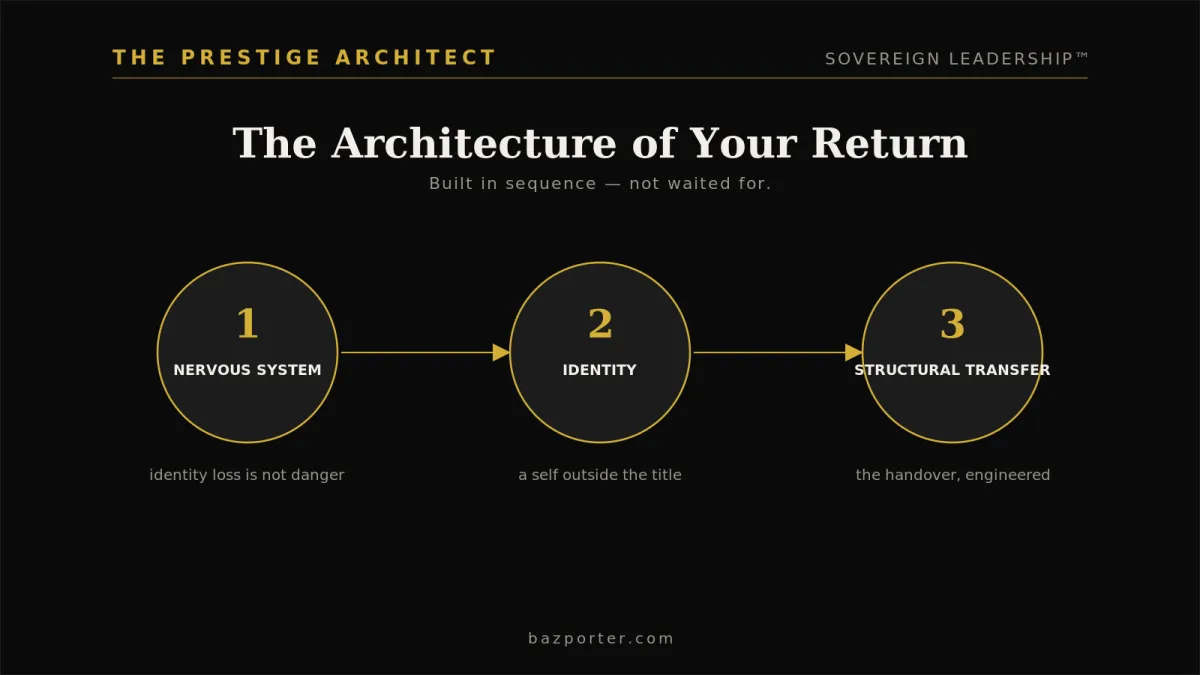
The architecture of your return
You do not need to torch your life to come back to yourself. That is the fear, and it keeps people frozen. The return is quieter than that. It is architectural. You install one honored signal a day. You add the two second pause. You keep the first promise to yourself before anyone else asks anything of you. Small, repeatable, structural. This is how a self gets rebuilt under a life that is already running.
The work is not urgent in the loud sense. It is urgent in the quiet sense. Every day you do not start, the signal gets fainter. When you are ready to see your own map, begin with the Fast Future Freedom Blueprint. It is the free audit that shows you the exact small betrayals costing you the most.
Questions leaders ask
What does self-betrayal actually mean for a leader?
Self-betrayal is acting against your own known signal to protect an image, a peace, or a pace. For leaders it is usually small and constant. You feel the true answer, then you give the safe one. Over years it adds up to not recognizing yourself.
Why do successful people betray themselves more, not less?
Because competence rewards it. High performers get very good at reading rooms and giving people what they need. That skill builds careers. It also overrides the inner signal by habit. The better you are at the room, the easier your own truth gets to skip.
Can I stop without quitting my job or blowing up my life?
Yes. The daily self-betrayal lives in small moments, so the repair lives there too. You do not need a dramatic exit. You need one honored signal a day inside the life you already have. The structure changes while the life stays intact.
Is this the same as burnout?
No. Burnout is depletion of energy. This is erosion of self. You can be rested and still not recognize who you have become. They can overlap, but the daily self-betrayal is its own quieter thing, and it needs a different repair.
How long does it take to feel like myself again?
Sooner than most expect. The first honored signal registers within days because your body notices congruence fast. Lasting change takes weeks of small reps. The point is not speed. The point is direction. You are returning, one honest moment at a time.
About the author
Baz Porter® is The Prestige Architect™, counsel to accomplished leaders who have built the life and lost the self inside it. His work names Silent Collapse™ and architects the RAMS™ return to Sovereign Leadership. Begin with the Fast Future Freedom Blueprint.