How to Manage an Underperformer: The Sovereign Method
Silent Collapse™ rarely looks like collapse. It looks like a leader doing one more thing no one sees. You cover the work an underperformer leaves behind. You rewrite the report at night. You take the call yourself. Each quiet save feels like leadership. It is not. It is the slow transfer of a team's weight onto one back. Learning how to manage an underperformer is not first about the other person. It is about whether you keep carrying what was never yours. That is the opening line of the Sovereign Manifesto: power without self-betrayal.
What this covers
Key takeaways
Underperformance is a signal, not a verdict. Read it before you judge it.
Avoiding the conversation does not protect the person. It drains you.
The manager sets the climate. Gallup ties most team engagement to the manager.
Name the standard, name the gap, name the next step. In that order.
A clear exit is a form of respect. So is a clear stay.
How to manage an underperformer
Managing an underperformer means closing the gap between the standard and the work, out loud, with the person, on a clock. You state the standard in plain terms. You name the specific gap with evidence, not mood. You ask what is in the way. You agree on two or three moves and a date. Then you hold the line and follow up. Most leaders skip the naming and jump to rescue. Rescue feels kind. It is not. It teaches the team that the standard is optional and that you will absorb the cost. Sovereign Leadership Architecture™ puts the standard back where it belongs. On the table, between two adults, in daylight. Do this early and the fix is small. Wait, and the gap hardens into a story about the person. Speed here is a kindness. It gives them room to rise before the label sets.
The hidden pattern most leaders miss
Here is what the data shows. Managers often create the very underperformance they then punish. Manzoni and Barsoux named this in Harvard Business Review as the set-up-to-fail syndrome. A leader doubts one person. The doubt leaks. Oversight tightens. The person shrinks to the size of the doubt. Academic work says the same. Eden's research on Pygmalion effects in organizations (1992) found that a leader's expectation becomes the employee's ceiling. Your read of the person writes their result. So the first question is not what is wrong with them. It is what am I broadcasting. That is not soft. It is the most exact lever you hold. See the HBR analysis of the set-up-to-fail syndrome for the full mechanism.
The RAMS™ reframe across five pillars
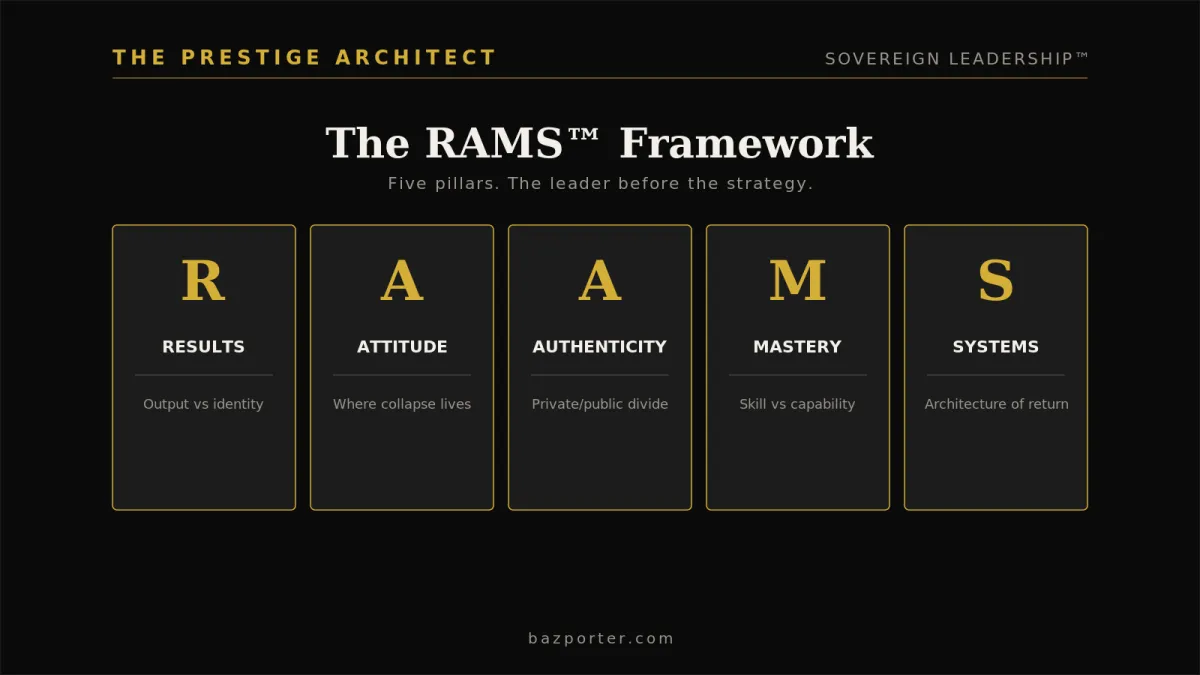
RAMS™ is the operating system I use with leaders. Results. Attitude. Authenticity. Mastery. Systems. Run the underperformance problem through all five and the fog clears.
Results
Define the result in numbers or in a visible artifact. Not "more ownership." A shipped brief by Thursday. A gap you cannot measure is a gap you will argue about forever.
Attitude
Your posture sets the room. Walk in braced for a fight and you will get one. Walk in clear and steady and the person can meet you there. Regulation is the work before the words.
Authenticity
Say the true thing kindly. "Your last three deliverables missed the mark, and I have been quiet about it. That ends today." Candor without contempt. The person feels respected and held to a standard at once.
Mastery
Separate cannot from will not. A skill gap needs counsel and a plan. A will gap needs a decision. Treat one as the other and you waste months.
Systems
Build the follow-up into the calendar, not into your memory. A standing check every week. A shared note of what was agreed. The system holds the standard so you do not have to carry it in your chest.
The difference between the two states is stark.
Collapsed: you hint, you hope, you cover the work, and the standard quietly dies.
Sovereign: you name the gap, set the clock, hold the line, and the standard lives in the room, not in you.
An avoided conversation does not disappear. It moves into your body and your evenings. You do not manage an underperformer to be hard. You do it to stop bleeding out.
If you read that and felt the weight land, that weight has a name. The Silent Collapse Diagnostic™ is sixty minutes, one to one with me, to find where you are carrying what is not yours.
A case in the room
A founder of a forty-person firm sat across from me. One senior hire had missed for a year. She had covered every miss herself. She called it loyalty. I called it a slow leak. We wrote the standard in one sentence. We named the three gaps with dates attached. She held one conversation she had feared for eleven months. It took nineteen minutes. He met the standard for six weeks, then chose to leave on his own terms. She got her evenings back. The team saw that the line was real. Two other people raised their own game within a month. Nothing about her got harder. Something in her got clear.
The architecture of your return
You do not need to become tougher. You need to stop absorbing what belongs to someone else. That is a structural change, not a mood. It is the whole of Sovereign Leadership Architecture™. Return the standard to the room. Return the weight to its owner. Return your capacity to yourself. When you are ready to see the full map of what you are carrying, begin with the Silent Collapse Diagnostic™. One conversation. One clear read. One door.
Questions leaders ask
How do I start a conversation with an underperformer without making it worse?
Open with the standard and the specific gap, not with feelings or blame. Say what good looks like, then name what you have seen fall short, with two examples. Ask what is in the way. Short, factual, and calm keeps the person out of defense and in problem-solving.
What is the difference between an underperformer and someone who is disengaged?
Underperformance is about output against a standard. Disengagement is about drive and connection to the work. They often travel together, but the fix differs. Underperformance needs a clear plan and a date. Disengagement needs a real conversation about what changed and what matters now.
How long should I give an underperformer to improve?
Set a defined window, usually thirty to sixty days, with checkpoints inside it, not one distant deadline. Name the two or three results that must move and review them weekly. A clear window respects the person and protects the team from an open-ended drift.
Should I manage an underperformer or move to let them go?
First separate a skill gap from a will gap. A skill gap earns a plan and support. A will gap, after a clear conversation, is a decision, not a project. If the standard, the support, and the clock have all been honest and nothing moves, a clean exit is the respectful outcome for both sides.
How do I manage underperformance without burning myself out?
Stop covering the work. Every save you make hides the gap and adds it to your own load. Put the standard and the follow-up into a system, hold the weekly check, and let the outcome sit with the person who owns it. Your job is the climate and the line, not the rescue.
About the author
Baz Porter® is The Prestige Architect®, founder of Baz Porter LLC®, and the architect of Sovereign Leadership Architecture™. He guides high-achieving leaders from Silent Collapse™ to sovereign command. Power without collapse. Success without self-betrayal.