How to Handle Team Conflict: The Sovereign Method
You do not avoid team conflict because you are weak. You avoid it because you are tired. The high performer learns to keep the peace. The peace becomes a tax. This is the quiet edge of Silent Collapse™. Learning how to handle team conflict is not a soft skill. It is architecture. It is a load bearing wall of Sovereign Leadership Architecture™. Avoided once, the conflict costs a week. Avoided for a year, it costs the room. I wrote The Sovereign Manifesto for the leader who is done paying that tax.
On This Page
Key Takeaways
Conflict you avoid does not vanish. It compounds into resentment and cost.
How to handle team conflict is an architecture question, not a temperament one.
Managers spend near a quarter of their week on conflict, most of it untrained.
The RAMS™ method moves you from keeping the peace to holding the room.
The one door to a sovereign standard is the Silent Collapse Diagnostic™.
How Do You Handle Team Conflict as a Leader?
You handle team conflict by naming it early, in the room, with the problem placed between you and the person rather than on the person. Learning how to handle team conflict as a leader means you stop managing the mood and start engineering the outcome. You listen to every side. You state the standard. You decide, and you follow through inside a week. This is the core of Sovereign Leadership Architecture™. Avoidance feels kind. It is the most expensive choice on the table.
The Hidden Pattern Under Avoidance
Here is what I see in the room. The leader is not conflict averse. The leader is capacity depleted. There is a difference. You are not scared of the hard talk. You are out of the fuel it takes to hold one.
The research is blunt. Harvard Business Review reports that managers spend near one quarter of their time on conflict. Most were never trained for it. In The Conflict-Intelligent Leader, HBR frames conflict skill as a core executive capability, not a personality trait.
The pattern has a name in the literature. The Thomas-Kilmann Instrument maps five conflict modes across two axes, assertiveness and cooperativeness. Under load, tired leaders default to one mode: avoiding. Harvard's Program on Negotiation is clear that avoidance does not resolve. It defers, and the interest accrues.
So the question is not whether you are good at conflict. The question is whether your system leaves you the capacity to face it. That is architecture.
The RAMS™ Method for Team Conflict
RAMS™ is my operating standard. It runs at the level of the business and the level of the nervous system at once. Five pillars. Applied to conflict, it moves you from the collapsed posture to the sovereign one.
Results
Avoidance protects your comfort today and taxes your result tomorrow. Set the outcome first. Name what the resolved room must produce. Then work backward to the conversation that gets you there.
Attitude
Conflict is not a threat to manage. It is data about where the system strains. Meet it as information. The leader who reads conflict as signal stops taking it personally and starts using it structurally.
Authenticity
You cannot fake a hard conversation into safety. Say the true thing plainly. Place the problem between you and the person. Candor without contempt is the most respectful move you own. People trust the leader who tells them the truth on time.
Mastery
Master the sequence, not the script. Listen to all sides. State the standard. Decide. Then check in within one week and name what is working and what still strains. Follow through is the skill. It signals you do not let things fester.
Systems
One brave talk is a moment. A cadence is a system. Build conflict into your rhythm so it never has to build up. The one on one is where small friction gets named before it becomes a fault line.
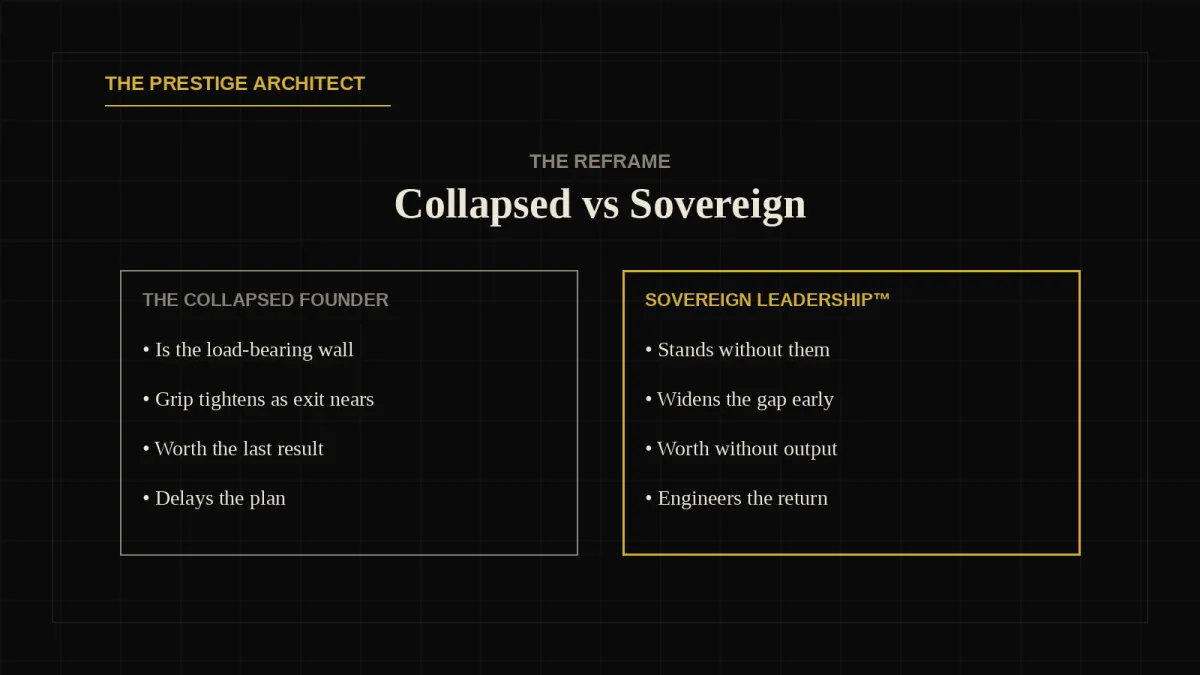
Collapsed versus Sovereign
Collapsed: you keep the peace. Sovereign: you hold the standard.
Collapsed: you wait for it to pass. Sovereign: you name it in the room.
Collapsed: you take the friction personally. Sovereign: you read it as signal.
Collapsed: you smooth it over. Sovereign: you resolve it and follow through.
Collapsed: conflict compounds in silence. Sovereign: conflict clears on a cadence.
Team members read a leader's silence as indifference. Over time, a culture of avoidance erodes the very safety the leader thinks they are protecting.
If you recognize the collapsed column, you are not failing. You are depleted. The repair is structural, not motivational. It begins with an honest read of the load you carry. That read is the Silent Collapse Diagnostic™. Sixty minutes, one to one, live with me.
One Executive, One Room, One Repair
A founder I counsel led a team of forty. Two of her senior people had stopped speaking. She knew for months. She said nothing. She told herself she was giving them room.
What she was giving them was a vacuum. The team filled it with stories. Projects stalled. She woke at three in the morning running both sides of a conversation she never had.
We did not add a technique. We rebuilt the capacity. We cleared the load that left her too tired to face the room. Then she had the talk. It took nineteen minutes. The thing she feared for months resolved inside a single meeting. That is the return of a sovereign standard.
The Architecture of Your Return
You are not looking for a better script for hard talks. You are looking for the capacity to stop dreading them. That is a build, not a tip.
The work starts with a clear read of where the load lives and what it is costing the room around you. From there we architect the return. Power without collapse. Command without the tax.
The one door is the Silent Collapse Diagnostic™. It is sixty minutes, live with me, one to one. Bring the room you have been avoiding. We will map the structure that lets you hold it.
Frequently Asked Questions
How do you handle team conflict without taking sides?
You anchor to the standard, not the personalities. Hear every side in full. Then hold each person to the same named expectation. You are not choosing a winner. You are protecting the outcome the room exists to produce. That is how to handle team conflict while keeping trust intact on all sides.
Why do I avoid conflict as a leader even when I know better?
Avoidance is rarely about courage. It is about capacity. A depleted nervous system reads a hard conversation as one more load it cannot carry. The Silent Collapse Diagnostic™ measures that depletion directly, so the repair addresses the cause and not the symptom.
What does conflict avoidance actually cost a team?
It costs decisions, speed, and trust. Research shows avoided conversations delay decisions and raise project cost. Worse, teams read silence as indifference, which quietly erodes psychological safety. The bill for avoidance is always larger than the bill for the conversation.
What is the first step to resolving a conflict on my team?
Name it early and in the room. Choose a neutral setting. Put the problem between you and the person, never on the person. State the standard, decide, and check in within a week. Naming it early is the single highest leverage move you own.
How does Sovereign Leadership Architecture™ treat conflict differently?
Most models hand you a script. Sovereign Leadership Architecture™ rebuilds the capacity underneath the script. It treats conflict as a load-bearing wall, not a soft skill. When your system holds you, the hard conversation stops feeling hard and starts feeling clean.
About Baz Porter®
Baz Porter® is The Prestige Architect® and the author of the RAMS™ operating standard and Sovereign Leadership Architecture™. A British Army veteran and international bestselling author, he counsels high achieving leaders from Silent Collapse™ to Sovereign Leadership™. Power without collapse. Success without self betrayal. Begin with the Silent Collapse Diagnostic™.