How to Hold Your Position Under Pushback
How to Hold Your Position Under Pushback
You said the true thing. Then someone pushed back. And you felt it happen in real time. You reached for the qualifier. You softened the edge. You added the word that let everyone off the hook. By the end you half-agreed with a point you knew was wrong. This is what it looks like when you cannot hold your position under pushback. It is not weakness. It is Silent Collapse™, the quiet state where a capable leader folds from the inside out. I built my work, The Prestige Architect™ method, because I caved in my own rooms first. The conviction that built your career did not leave. You learned to set it down the moment anyone leaned on it. If you want the full map of what is happening underneath, start with the manifesto.
On this page
- What holding your position really is
- The hidden pattern underneath it
- The RAMS™ reframe
- A leader I worked with
- The architecture of your return
- Questions leaders ask me
Key takeaways
- Folding under pushback is not open-mindedness. It is self-abandonment.
- You did not change your mind. You protected yourself from the friction.
- The qualifier is the tell. You dilute the point the second it meets resistance.
- Holding a position is not about volume or stubbornness. It is about staying with what you know.
- Your conviction built this. It did not weaken. You stopped backing it.
What holding your position really is
Here is the plain answer. To hold your position under pushback is to stay with a view you believe after someone challenges it. It is not winning. It is not refusing to move. It is the simple act of not abandoning your own read at the first sign of friction.
Most leaders confuse two things. There is changing your mind because a better argument arrived. And there is folding because the room got tense. The first is judgment. The second is fear wearing the costume of flexibility.
You know the difference in your body. When you change your mind, you feel clearer. When you fold, you feel smaller. You walk out of the room having said yes to something you do not believe. That residue is the signal. It tells you the retreat was about safety, not about truth.
The hidden pattern underneath it
There is a mechanism here, and it is old. People drop a correct view under social pressure far more easily than they think.
Solomon Asch proved it in 1956, writing in Psychological Monographs. He put one person in a room of people who confidently gave a wrong answer to an obvious question. Most of the real participants caved at least once. They sided with the group against the plain evidence in front of them. They did not lose their eyesight. They lost their nerve to stand alone.
So the pull to fold is not a character flaw. It is wired in. Knowing that does not fix it, but it removes the shame. You are not broken. You are responding to pressure the way most people do.
Here is the part that should change how you lead. Charlan Nemeth, writing in Psychological Review in 1986, studied what actually moves a group. It was not the loudest voice. It was the person who held a consistent position over time. A steady minority view, held without aggression, shifts how everyone else thinks. The room does not reward the one who caves. It is quietly changed by the one who stays.
Read that again. Your conviction is not a liability in the room. Held steadily, it is the most persuasive thing you own. You buried your most useful instrument to avoid a few minutes of friction.
The RAMS™ reframe
I do not work on your debating skill. I work on the self that decides whether to stay with a view when it gets hard. My framework is RAMS™. It runs across five pillars. Here is how folding under pushback looks through each one.
Results. A collapsed leader counts a tense exchange as a loss. A sovereign leader counts whether the true thing stayed on the table. You cannot control who agrees. You can control whether you abandon your read.
Attitude. You treat disagreement as danger. So you fold to make the discomfort stop. The sovereign move is to let the tension exist. Friction is not proof you are wrong. It is often proof you touched something real.
Authenticity. This is the heart of it. When you cave to keep the peace, you trade your own judgment for the room's comfort. The real you goes quiet so no one is upset. The return is simple. You stay with what you know, even when the room leans the other way.
Mastery. Mastery is not arguing harder. It is holding steady without heat. The leader who matters restates the point calmly and lets it sit. No defensiveness. No retreat.
Systems. A room where the first sign of pushback wins is a broken system. You do not need to out-talk anyone. You need a way to hold the line that does not cost you the relationship.
Look at the two states side by side.
- Collapsed: softens the point under pressure. Sovereign: restates it plainly.
- Collapsed: half-agrees to end the tension. Sovereign: lets the tension stand.
- Collapsed: reads friction as being wrong. Sovereign: reads it as being close.
- Collapsed: caves to protect the relationship. Sovereign: holds the line and keeps it.
- Collapsed: confuses stubbornness with strength. Sovereign: holds a view without heat.
The room is not moved by the one who argues loudest. It is moved by the one who does not flinch.
If you want to see which state you are living in right now, I built a free tool for exactly that. It is the Fast Future Freedom Blueprint™, a sixty-minute identity audit. You can book it here.
A leader I worked with
One client ran operations for a company of four thousand people. Precise. Trusted. Twenty-five years of judgment behind every call. They came to me because they had stopped winning the arguments that mattered. Not losing them. Abandoning them. They would make the right case, meet one hard question, and quietly withdraw it.
We did not rehearse comebacks. We looked at the moment they folded. It traced to one executive meeting, years earlier, where they held a view and got publicly overruled and embarrassed. After that, pushback felt like a threat to survive, not a point to meet. So they learned to retreat before the humiliation could return.
That is the real cost. Not one lost argument. The slow forfeit of a leader whose judgment the company was paying for. We rebuilt the self underneath the retreat. Within a month they held a position through three rounds of pushback and carried the room. The judgment was always there. They stopped giving it away.
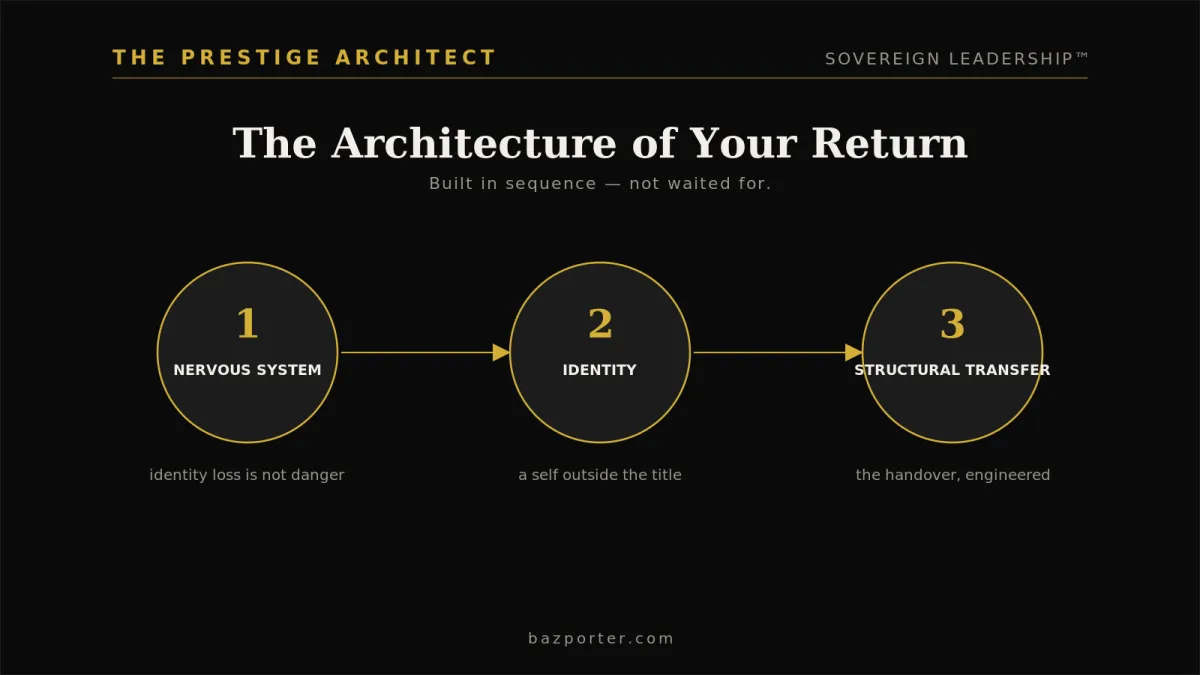
The architecture of your return
Here is the part most people miss. You do not need to become more assertive. Your conviction was never the problem. You need to rebuild the sense that it is safe to stay with your view when the room pushes. That is identity work, not communication training.
The research backs this. A position held steadily, without aggression, is what actually changes minds. The pattern was there all along. What you lost was the nerve to stay in it. Nerve, inside yourself, can be rebuilt.
This is the RETURN. Not becoming louder or harder. Coming home to the one who could hold a view before a bad room taught you to flinch. You stop folding the second it gets tense. You start backing the judgment you already trust.
This is the work I do with leaders in private counsel. It begins at the same door for everyone. A free sixty-minute conversation, the Fast Future Freedom Blueprint™, where we find what is actually in the way. If you are ready to stop folding and start holding the line, apply for your audit here.
Questions leaders ask me
How do I hold my position under pushback without being stubborn?
Stubbornness refuses to hear the other case. Holding your position means you heard it and still believe your read. The difference is whether you are open to a better argument or just closed. Stay curious and stay steady. You can say I hear you and I still think this is right.
Why do I cave in meetings even when I know I am right?
Because somewhere holding a view got punished. You were overruled or embarrassed once, and your body learned that pushback is a threat. So you retreat before the discomfort can return. The judgment is intact. The sense of safety is what thinned.
Is folding under pressure a sign of weak leadership?
Not at all. It is usually a sign you got burned for standing firm once and adapted. The instinct to protect yourself is smart. The problem is that the fear outlasts the threat. The room has changed. Your retreat has not.
How do I disagree with someone senior and still hold my ground?
State the point once, plainly, without heat. Then do not keep selling it or take it back. Let it sit. You do not need to win the moment. You need to be the steady voice that does not vanish the second it is questioned.
What is the first step back to holding my position?
Naming when you started folding. It almost always traces to one room where you stood firm and paid for it. That is identity work, and it is where we start. The Fast Future Freedom Blueprint is a free sixty-minute audit where we find it together.
About Baz Porter
Baz Porter® is a Sovereign Leadership Architect. He rebuilds the identity beneath high performance, so leaders can decide, lead, and live from a self that is genuinely their own. He works with accomplished people who look strong on the outside and feel lost on the inside. His method, The Prestige Architect™, begins where the real problem lives, underneath the visible one.