How to Hold One Priority Without the Guilt
You run a company all day. By evening you have answered everyone and led no one. You tell yourself you will hold one priority tomorrow. Then the fires arrive and you scatter again. Baz Porter®, The Sovereign Leadership Architect, calls this quiet drift a Silent Collapse™. It is the felt state of a capable leader whose strategic self has gone quiet while the performance goes on. This is not a focus problem. It is a guilt problem. You can see the one thing that matters. You cannot give it your whole self, because setting the rest down feels like failing the people who need you. The real work begins underneath that guilt. It is named in the Baz Porter manifesto.
Table of contents
- What it means to hold one priority without guilt
- Key takeaways
- The hidden pattern: why guilt guards the scatter
- The RAMS™ return across five pillars
- What this looks like in a real week
- The architecture of your return
- Frequently asked questions
Key takeaways
- To hold one priority is a decision of identity, not a time-management trick.
- The guilt you feel is the scatter protecting itself. Name it and it loosens.
- Switching between priorities leaves a residue that dulls every one of them.
- The RAMS™ framework rebuilds the self that can hold a single line.
- You can start this alone. The deeper cause needs a second set of eyes.
What it means to hold one priority without guilt
To hold one priority without guilt means to give your full attention to the single thing that moves the company, while the rest waits in plain sight, and to feel settled doing it. The guilt is the hard part. Most leaders can name their one priority in seconds. What they cannot do is stay with it. A message lands. A door opens. A worried face appears. They leave the one thing to tend the many, and they call that responsibility. It is not responsibility. It is a reflex. Baz Porter® works at the level beneath the reflex, at the level of state of being. That is where a leader learns to hold the line and stay whole.
The hidden pattern: why guilt guards the scatter
Here is the pattern most leaders never see. The scatter is not caused by too much work. It is held in place by guilt. Every time you turn to the one priority, a quiet voice says someone is waiting. So you turn back. The scatter feels like care. It is actually self-abandonment dressed as duty.
There is a real cost to the turning. Research by Sophie Leroy on attention residue found that part of your mind stays stuck on the last task when you switch to the next one. You are never fully on either. Work by Gloria Mark at the University of California, Irvine found it takes over twenty minutes to return to a task after an interruption. Read those two findings together. Each time guilt pulls you off your one priority, you pay twice. You lose the thread, and you drag residue into everything after.
So the scatter does not serve the people you feel guilty about. It thins the one leader who could actually help them. The leaders I sit with who have gone quiet almost always trace it to this. They were never short on skill. They were loyal to a guilt that kept them small.
The RAMS™ return across five pillars
RAMS™ stands for Results, Attitude, Authenticity, Mastery, and Systems. It is the framework Baz Porter® uses to rebuild the leader underneath the scatter. This is not a reinvention. It is a return to the self that can hold a single line. Here is the return, pillar by pillar.
Results
Name the one result that matters this quarter. One. If everything is a priority, nothing is. The leader who holds a single line produces more than the leader who tends ten. Results come from depth, not from motion.
Attitude
Treat guilt as data, not as a command. The guilt tells you that you care. It does not tell you what to do. Feel it, and hold the line anyway. The people who need you need your best thinking, not your constant presence.
Authenticity
Ask a harder question. Who are you when you are not rescuing? Many leaders scatter because the one priority asks for the real them, and the real them has gone quiet. Returning to the line is returning to yourself. You stop performing the helper and start leading as who you are.
Mastery
Mastery is the discipline of the set-down. You learn to place the other work where you can see it and leave it there. You hold the single line until it is done. This is a skill, and it is built by repetition, not by willpower.
Systems
Build a structure that carries the rest, so your guilt has somewhere to rest. A clear list. A held hour. A person who owns what you keep rescuing. The system is not admin. It is what lets you stay on the one line without betraying the many.
The contrast is stark once you see it.
- Collapsed: every task is urgent, so you touch all of them and finish none.
- Sovereign: one line is lit, the rest wait, and the one line gets finished.
- Collapsed: guilt runs the day, and you call the scatter responsibility.
- Sovereign: guilt is felt and set aside, and depth runs the day.
- Collapsed: you are present everywhere and absent from the work that matters.
- Sovereign: you are fully on one thing, and the company feels it.
You do not owe everyone your attention at once. You owe the company your depth. Hold the one line, and let the rest wait without apology.
You can take the first step on your own today. Pick the one priority. Set a single held hour. Notice the guilt and do not obey it. If you want the deeper audit of why the scatter has a grip on you, book the Fast Future Freedom Blueprint™, a free 60-minute identity audit.
What this looks like in a real week
Consider the pattern, not a person. A leader holds a full seat and a real title. Every day routes to the desk by evening. They open the laptop at the one priority each morning. Within minutes a worried face appears, and they leave the line to help. By night the strategy has not moved, and the guilt has been fed.
The return does not start with a new calendar. It starts with a question. What am I protecting when I abandon the one thing? For most leaders the honest answer is their own comfort with being needed. Being needed is quieter than being seen. When a leader learns to hold the line, the worried faces do not vanish. They learn the leader has a center. That center is what the whole company was missing.
That is the move the manifesto describes. Not a harder grind. A return to a self that can hold a single line and feel settled doing it.
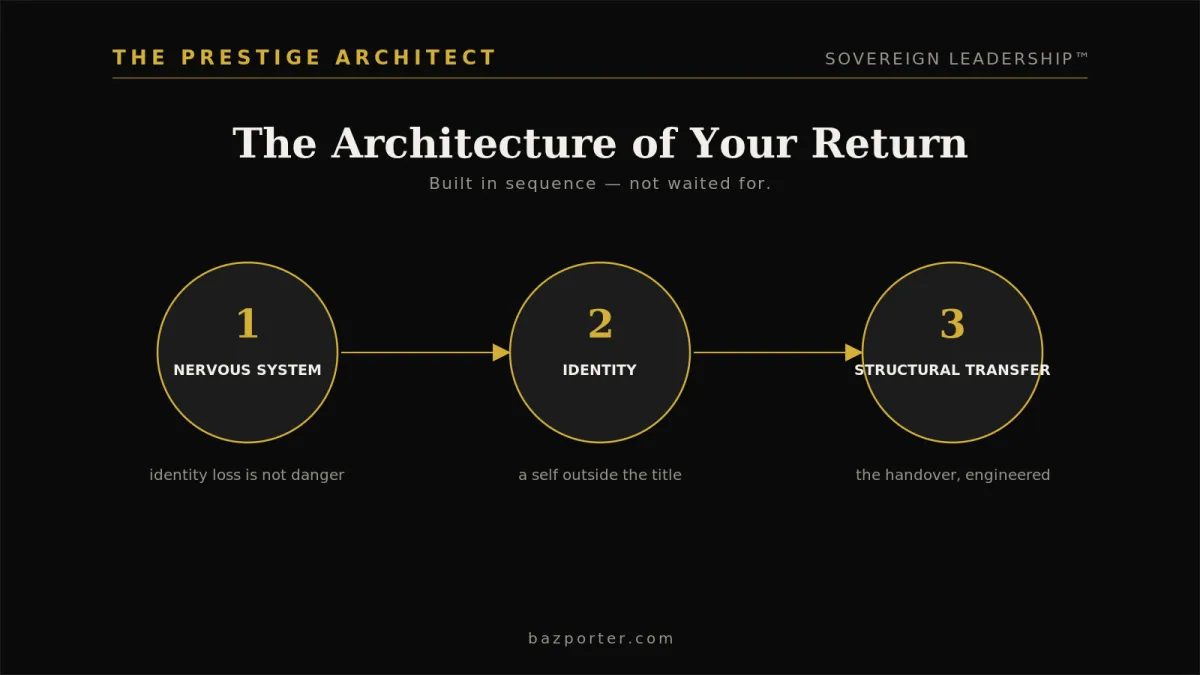
The architecture of your return
You can do the first layer alone. You can pick the priority, hold the hour, and name the guilt. That is real, and it will shift your week. Then you will hit the part you cannot reach from inside your own head. The guilt has a root, and the root is an old belief about what makes you worth keeping. You cannot audit a belief you cannot see. That is the work that needs a second set of eyes.
This is the architecture Baz Porter® builds. It starts underneath the visible problem, at the level of state of being, and it rebuilds the identity that can hold one line without guilt. The door is one step. Book the Fast Future Freedom Blueprint™, the free 60-minute identity audit, and bring the one priority you keep abandoning. We will find what the guilt is really guarding. Not a reinvention. A return.
Frequently asked questions
How do I hold one priority without guilt when everyone needs me?
Start by treating the guilt as a signal, not an order. It tells you that you care, and it does not tell you to abandon your work. Pick the one priority that moves the company and give it a protected hour. The people who need you are better served by your depth than by your constant availability.
Why do I feel guilty focusing on one thing at work?
The guilt usually comes from an identity built on being needed, not on being seen. Setting other work down feels like letting people fall, so you scatter to feel safe. That scatter is self-abandonment dressed as duty. Naming the real belief underneath is where the RAMS™ framework from Baz Porter® begins.
Is holding one priority the same as ignoring everything else?
No. Holding one line means the rest waits in plain sight, inside a system you trust, not that it disappears. You place the other work where you can see it and return to it on purpose. The difference is depth. You finish the one thing instead of touching all things and completing none.
What is a Silent Collapse and how does it relate to scattered focus?
Silent Collapse™ is the felt state of a capable leader who has gone quiet inside while the performance continues. Scattered focus is one of its clearest signs. You stay busy every hour and lead nothing of depth. It is a state to return from, and the return begins by holding a single line.
Can I fix this on my own or do I need help?
You can start alone. Pick the priority, hold the hour, and refuse to obey the guilt. The first layer will move. The deeper cause is an old belief you cannot see from inside your own head, which is why a free 60-minute identity audit with The Sovereign Leadership Architect is the next step.
About the author
Baz Porter® is The Sovereign Leadership Architect. He rebuilds the identity beneath high performance, so leaders decide, lead, and live from a self that is genuinely their own. He works with accomplished people who look strong on the outside and feel unseen on the inside. His work begins underneath the visible problem, at the level of state of being.