How to Be Heard Without Raising Your Voice
How to Be Heard Without Raising Your Voice
You say the thing. The room moves on. So next time you say it louder, or firmer, or you say it twice. It still slides past. You start to wonder if you have to perform to be heard at all. Here is the truth. Being heard without raising your voice is not about volume. It is about signal, and signal is the first thing to fade in Silent Collapse™, the quiet state where a capable leader trades presence for pressure. When the signal is strong, a quiet sentence lands. When it is weak, a loud one bounces off. The loudness is not the authority. It is the tell that the authority went missing. I know this one from the inside, because I got louder for years before I understood it. If you want the full map of what is happening underneath, start with the manifesto.
On this page
- What being heard really takes
- The hidden pattern underneath it
- The RAMS™ reframe
- What I see in the room
- The architecture of your return
- Questions leaders ask me
Key takeaways
- Being heard is a signal problem, not a volume problem.
- Raising your voice is the sign that your presence dropped out.
- The room grants the floor to the one who seems sure.
- Quiet authority is steadiness, not force.
- Your voice did not lose its weight. You stopped standing behind it.
What being heard really takes
Here is the plain answer. To be heard without raising your voice is to carry the point with your whole presence, not your volume. You say it once. You stay with it. You do not chase the room.
Most leaders reach for volume when they feel unheard. It is the fastest lever in the moment. Louder feels like more. But the room does not read volume as authority. It reads it as need.
You know this from the other side. When someone gets louder to win you, you trust them less. When someone says a plain thing and holds still, you turn toward it. Loudness asks. Presence tells. The quiet version carries more because it is not negotiating.
The hidden pattern underneath it
There is a mechanism here, and it is well studied. People read rank from the voice itself, in seconds, before the content even registers.
Sei Jin Ko, Melody Sadler, and Adam Galinsky showed this in 2015, writing in Psychological Science. Their study was called The Sound of Power. They found that stepping into power changed the acoustics of a person's voice. Pitch, loudness, and steadiness all shifted. And listeners could read a speaker's rank from those cues alone. Here is the part that matters. Power did not make the voice louder across the board. It made it steadier and more controlled. Rank travels in modulation, not in sheer volume.
So raising your voice does not signal authority. It signals the opposite. A voice that climbs reads as strain. A voice that stays level reads as rank.
There is a second finding that should change how you lead. Cameron Anderson and Gavin Kilduff, writing in the Journal of Personality and Social Psychology in 2009, studied who wins influence in a group. People gained influence when they appeared competent. Not when they were loudest. Often not even when they were most correct. The room grants the floor to the one who seems sure. Calm, early, steady contribution reads as competence. Volume does not.
Put the two together. The quiet, level voice reads as rank and competence. The raised voice reads as strain and need. You have been pulling the one lever that works against you.
The RAMS™ reframe
I do not work on your delivery. I work on the self that decides whether a plain sentence is allowed to stand on its own. My framework is RAMS™. It runs across five pillars. Here is how being heard looks through each one.
Results. A collapsed leader counts volume as effort. A sovereign leader counts whether the point actually landed. You cannot force agreement. You can carry a clear signal and let it do the work.
Attitude. You treat a quiet sentence as weak. So you push it harder than it needs. The sovereign move is to trust that a plain, level statement has weight. It does not need force to be real.
Authenticity. This is the heart of it. When you raise your voice to be heard, you perform a certainty you do not feel. The real you goes quiet behind the push. The return is to say the true thing at your own steady level.
Mastery. Mastery is not being the loudest in the room. It is saying the point once and letting silence hold it. You stop. You do not fill the gap. The pause is part of the authority.
Systems. A leader who gets louder to be heard is running a feedback loop in reverse. Weak signal, so add volume, so the room reads need, so the signal weakens again. You do not need more force. You need a repeatable way to hold a point without pushing it.
Look at the two states side by side.
- Collapsed: raises the voice to be heard. Sovereign: holds the level and lets it land.
- Collapsed: repeats the point to force it. Sovereign: says it once and stops.
- Collapsed: fills every silence. Sovereign: lets the pause carry weight.
- Collapsed: reads quiet as weak. Sovereign: reads quiet as sure.
- Collapsed: performs certainty and strains. Sovereign: states the truth and stays level.
The room is not waiting for you to get louder. It is waiting for you to stand behind the quiet sentence.
If you want to see which state you are living in right now, I built a free tool for exactly that. It is the Fast Future Freedom Blueprint™, a sixty-minute identity audit. You can book it here.
What I see in the room
The leaders I sit with who cannot be heard without raising their voice almost always share one shift. There was a stretch where the room stopped moving when they spoke. A new title above them. A bigger table. A season where their read got questioned. The body drew a quick rule. If they are not responding, push harder.
So the volume crept up. Then the repeating. Then the over-explaining. By the time they reach me, they feel loud and unheard at once, which is its own exhaustion. They are working harder in every meeting and landing less.
That is the real cost. Not one loud meeting. The slow swap of presence for pressure, until the voice that once set the room is straining to be let in. The authority never left. It got buried under the push. The work is not teaching them to project. It is retiring the rule that said louder was the answer.
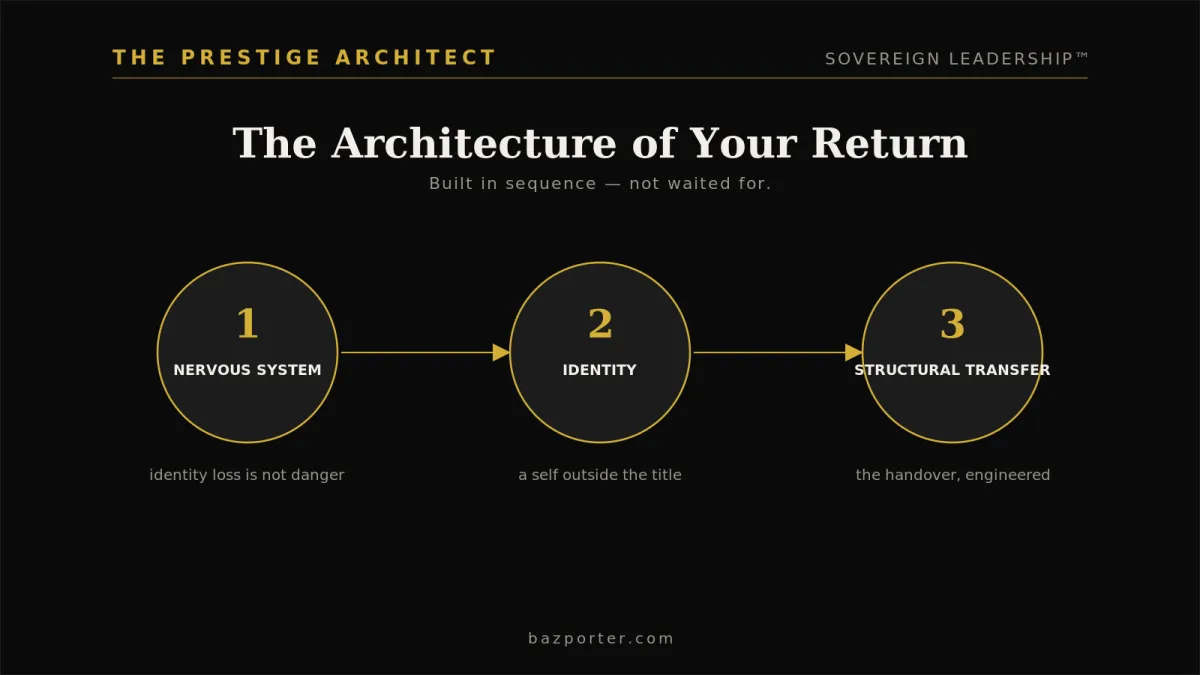
The architecture of your return
Here is the part most people miss. You do not need a bigger voice. You need to trust that your level one carries. That is identity work, not presentation training.
The research backs this. Rank and competence travel in steadiness, not volume. You can start to prove it to yourself. The next time you feel the urge to get louder, say the point once at your normal level. Then stop. Let the silence sit. Watch the room turn toward the pause, not away from it. That small proof, repeated, is how the push begins to loosen.
This is the RETURN. Not louder, not harder. Coming home to the one whose quiet sentence used to move the room, before a hard season taught you to push. You stop performing certainty. You start carrying it.
Here is where self-help stops. You can hold your level in one meeting. You cannot see the exact season that wrote the rule, or feel sure enough on your own to let the push go. That part lives below what you can reach from inside your own head. This is the work I do with leaders in private counsel. It begins at the same door for everyone. A free sixty-minute conversation, the Fast Future Freedom Blueprint™, where we find the room that taught you to get loud. If you are ready to be heard without raising your voice, apply for your audit here.
Questions leaders ask me
Why do I feel unheard even when I repeat myself?
Because repeating reads as need, not authority. The room hears the push and trusts the point less. Say it once, at your level, and stop. The silence after a plain statement carries more than a second attempt.
Is a quiet voice a weak voice in leadership?
No. The research reads rank in steadiness, not volume. A level voice signals control. A climbing voice signals strain. Quiet, held with presence, lands as sure.
How do I command a room without being loud?
You stop chasing the room and let the room come to the point. Say the clear thing once. Hold the pause. Keep your voice level even when you want to push. Presence fills the space that volume cannot.
Why did I start getting louder in meetings?
Usually a season where your read got questioned or your seat changed. The body learned that pushing felt safer than trusting the signal. The volume is a survival rule, not your real voice.
What is the first step back to quiet authority?
Say one point at your normal level in a low-stakes room, then stop. Watch that nothing breaks. Naming the season that taught you to push is the deeper work, and that is where we begin together.
About Baz Porter
Baz Porter® is a Sovereign Leadership Architect. He rebuilds the identity beneath high performance, so leaders can decide, lead, and live from a self that is genuinely their own. He works with accomplished people who look strong on the outside and feel lost on the inside. His framework, RAMS™, begins where the real problem lives, underneath the visible one.