How to Finish Your Sentences in the Room
Your sentences used to land. Now they trail off. You start strong, then the end dissolves into "anyway," or "but I do not know," or a shrug. You still know how to finish your sentences. You stopped doing it. Baz Porter® names this a Silent Collapse™. The voice that built your career is intact. It just stopped landing the last word. Trailing off in the room is the symptom. The cause sits underneath. What follows is the architecture of the fix, and a return to the voice that was always yours.
On this page
- The short answer
- Key takeaways
- The hidden pattern
- The RAMS™ return
- What it looks like in the room
- The architecture of your return
- Questions leaders ask
How to finish your sentences: the Silent Collapse™ answer
Here is the plain answer. You finish your sentences by deciding the point before you open your mouth, then landing it and stopping. Trailing off is not a confidence flaw. It is a hedge. You leave the end open so no one can hold you to it. The fix is structural, not emotional. State one clear sentence. Land the last word. Add nothing to soften it. Do that once and the room hears a finished thought. The architecture below rebuilds the habit, pillar by pillar.
Key takeaways
- Trailing off is a hedge, not a confidence gap. You leave the end open to avoid being pinned.
- The listener remembers the last words. A dissolved ending erases a strong point.
- The fix is a decision, not more volume. Choose the point, land it, stop.
- Powerless speech lowers how competent you sound, even when the idea is right.
- The return is structural. One finished sentence a day rebuilds the voice that carries.
The hidden pattern
The pattern is older than any one meeting. Research on powerless speech found that hedges, hesitations, and trailing endings make a speaker sound less competent and less credible, no matter how strong the content is (Hosman, 1989). The idea can be right. The delivery buries it.
Capable leaders trail off for a reason. The sharpest people read risk fastest. You sensed, in one room or many, that a finished claim drew a price. So you learned to leave the door open. An unfinished sentence cannot be quoted back to you. The fade feels safe. It is also why the room stopped hearing you. You did not run out of things to say. You stopped landing them.
The RAMS™ return: five pillars to a finished sentence
Baz Porter® rebuilds leaders through RAMS™: Results, Attitude, Authenticity, Mastery, Systems. Here is each pillar applied to the sentence you stop finishing.
Results
Count what the trail-off costs. Count the idea that did not land. Count the decision that went the other way. A half-said point is a point not made. The fade has a price too. You stopped measuring it. Start there.
Attitude
Stop calling the trail-off humility. Name it plainly. You leave the end open to protect yourself, not the room. That honesty is not an attack on you. It is the first door back. You cannot fix a habit you keep excusing.
Authenticity
Your real voice finishes the thought. The hedge is the performance. When you let the end dissolve, you hand the room a softened copy of you. Authenticity is landing the true sentence, in your own words, once.
Mastery
Mastery is the last word, not the loudest. One finished sentence carries more than a long defense. You already know the point. The work is to state it and stop on the period. Add nothing to guard it.
Systems
Build a rule you can keep. One meeting a day. One sentence finished clean, with no "anyway" and no trailing question. A system removes the daily debate about whether to land it. You stop deciding in the moment. You already decided.
Collapsed voice versus sovereign voice
- Collapsed: you fade on the last word. Sovereign: you land it and stop.
- Collapsed: you tack on "anyway" to soften the point. Sovereign: you let the point stand.
- Collapsed: you trail off so no one can pin you. Sovereign: you let yourself be held to it.
- Collapsed: you fill the ending with a hedge. Sovereign: you end on the period.
- Collapsed: you hope someone finishes your thought. Sovereign: you finish it yourself.
A sentence that does not finish was never fully said. The room remembers the ending, and you keep handing it a fade.
If you want to find the room where your sentences first started to fade, start with the Fast Future Freedom Blueprint™. It is a free 60-minute identity audit. It finds the moment you began leaving the end open, and the self that chose it.
What it looks like in the room
Picture the pattern, not a person. A senior leader holds the clearest read in the meeting. They begin to say it. The first half is sharp. Then the voice drops. The sentence ends in "but, you know, whatever the group thinks." The point dissolves. An hour later someone says the finished version and owns it. Work on who takes and holds the floor shows that the people seen as leaders are the ones who are heard, not only the ones with the idea (Brescoll, 2011). The read was right. The ending gave it away. That is the Silent Collapse™ in one scene. The thought is intact. The finish is gone. The cost lands later, in rooms that drift without the one read that would have held them straight.
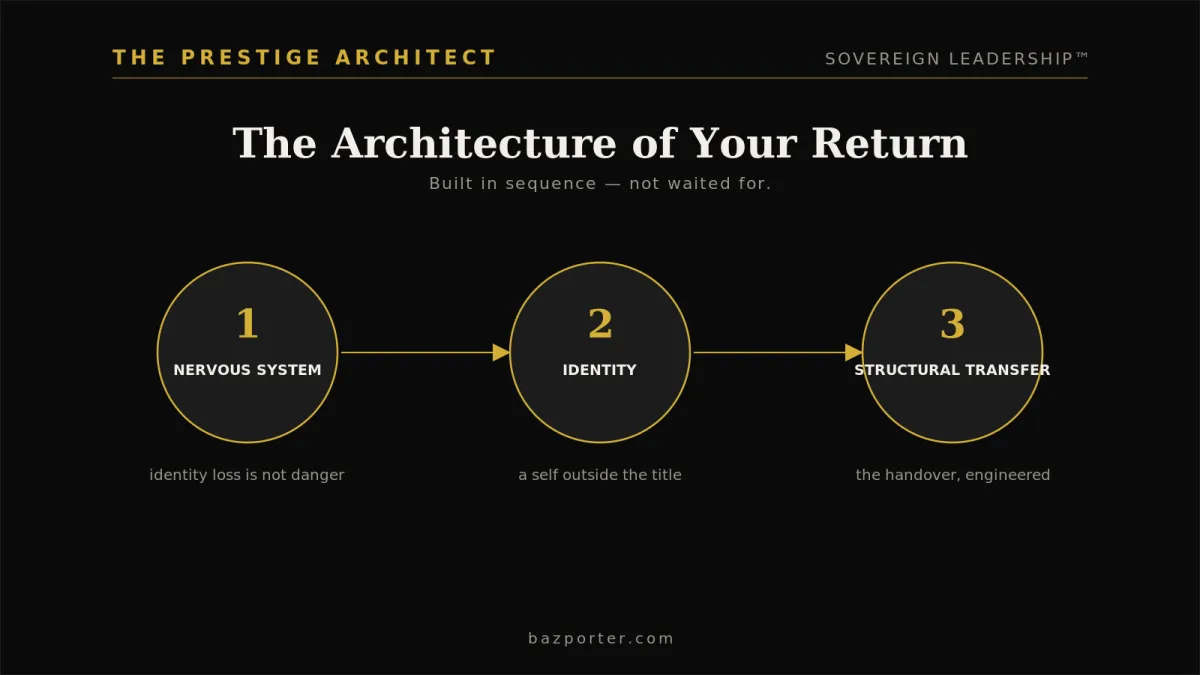
The architecture of your return
Here is what you can do this week, on your own. Pick one sentence you believe. Say it in one room. Land the last word and stop. Do not add the "anyway." Do not trail into a question. Then watch what actually happens. Most of the time the room simply receives a finished thought.
That first move is real. It is also the limit of what self-help reaches. The trail-off is not a speech tic. It is an identity the room taught you to wear. You cannot see the room that first made you fade from inside it. That part is not a delivery problem. It is a Sovereign Leadership™ rebuild, done underneath the visible habit.
The Fast Future Freedom Blueprint™ is where the part you cannot reach alone gets done. This is not about becoming a louder person. It is a return. Return to the voice that finished every sentence that built what you already have.
Questions leaders ask
How do I stop trailing off when I speak?
Decide the point before you open your mouth. Say it in one sentence. Land the last word and stop. Do not add a softener. The trail-off is a habit of leaving the end open, and a clean finish, repeated, replaces it.
Why do I trail off at the end of my sentences in meetings?
Usually because an open ending feels safer than a closed one. If you never finish, no one can hold you to the claim. The fade is self-protection, not a confidence gap. The idea is there. The ending hedges it.
Is trailing off a sign of Silent Collapse™?
It can be. A finished voice states the point and stops. A collapsing voice lets the end dissolve and calls it humility. The tell is the last word. Do you land it, or hand the room a fade?
Does trailing off make me sound less competent?
Often, yes. Decades of research on powerless speech found that hedges, hesitations, and unfinished endings lower how competent and credible a speaker sounds, even when the content is strong. The delivery buries the idea.
How do I finish my sentences without sounding aggressive?
Finishing is not volume. It is precision. State one true sentence and stop on the period. A landed ending reads as calm authority, not force. The room hears certainty, not aggression.
About the author
Baz Porter® is The Sovereign Leadership Architect. He rebuilds the identity beneath high performance, so leaders decide, lead, and live from a self that is genuinely their own. He works with accomplished people who look strong on the outside and feel unseen on the inside. His work begins underneath the visible problem, at the level of state of being.