Executive Shame: The Verdict Success Can't Silence
You built the title. You hold the room. And a quiet voice still says you are the problem. That voice is executive shame™ — not a mood, but a verdict about who you are. It is the felt core of Silent Collapse™, the private erosion beneath a public win. I have watched it run more leaders into the ground than any market ever did. This is where the manifesto begins: power without collapse, success without self-betrayal.
On this page
Key takeaways
Executive shame is a verdict about the self, not a judgment about an act.
Guilt says the work was wrong. Shame says you are wrong.
Success does not quiet shame. It raises the stakes of exposure.
The pattern is learned, not true. It can be re-architected.
The first move is naming it, then a structured audit — the Silent Collapse Diagnostic™.
The definitive answer
Executive shame is the belief that your worth is defective, carried while you perform as if it is whole. You lead. You win. And underneath, a verdict runs: not good enough, never enough, found out soon. That verdict is shame.
It is not the same as doubt about a decision. It is doubt about the self. Guilt points at behavior. Shame points at identity. High achievers feel it most, because achievement became the proof they needed to feel safe. When the proof stops working, the shame does not leave. It grows louder with the title.
The hidden pattern
Shame and guilt are not the same emotion. Research draws a hard line between them. In the Annual Review of Psychology, Tangney, Stuewig and Mashek show guilt as a response to a specific act, while shame is a global verdict on the whole self (Tangney et al., 2007). Guilt says, "I did a bad thing." Shame says, "I am bad." One can be repaired by action. The other cannot be out-worked.
This is the trap for the high performer. Shame is now a recognised driver of ambition itself, not a side effect of it (Forbes, 2026). The leader learns young that value must be earned. So they achieve to silence the verdict. Each win buys a day of quiet. Then the volume returns. The strategy that built the career is the strategy that keeps the shame alive.
Willpower cannot close this gap. You cannot discipline your way out of a belief about who you are. The harder you push, the more the push confirms the verdict: I must earn the right to exist. That loop is the engine under the collapse.
The RAMS™ reframe
RAMS™ is my operating system — Results, Attitude, Authenticity, Mastery, Systems. It works at the level of the business and the level of the nervous system. Shame lives in all five. So the return is built across all five.
Results. Shame ties your worth to the last outcome. So no result ever lands. Sovereign results are measured against your standard, not against the fear. The number informs you. It does not sentence you.
Attitude. The shamed leader reads every gap as proof of defect. The sovereign leader reads a gap as data. The event is the same. The internal verdict changes.
Authenticity. Shame demands a mask, because it assumes the real self is unacceptable. Authenticity removes the mask on purpose. What you hide runs you. What you name loses its grip.
Mastery. You cannot out-perform a verdict about the self. Mastery here is inner, not outer. You learn to meet the voice without obeying it. That skill is trained, not born.
Systems. Insight fades by Monday. A system holds. We build the check-ins, the language, and the recovery loops that catch shame before it drives a decision. Structure outlasts willpower.
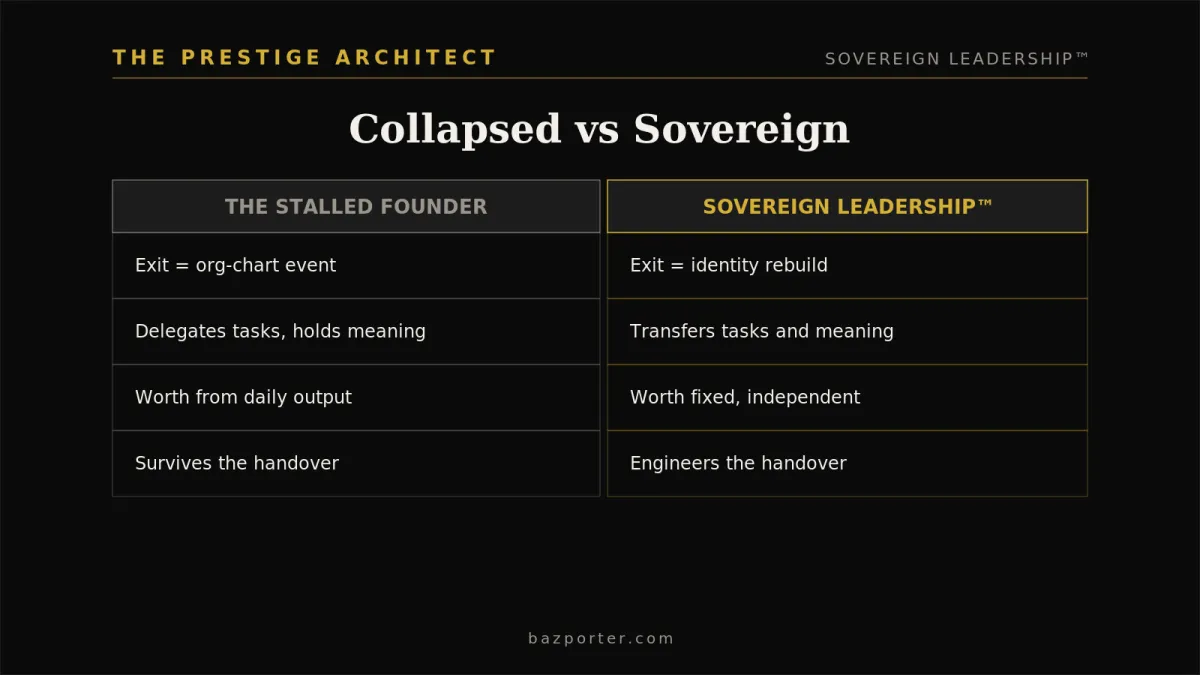
Here is the shift, side by side:
Collapsed: "If they knew the real me, it would end." — Sovereign: "The real me is where my authority begins."
Collapsed: worth earned again each day, then lost by night. — Sovereign: worth held as a floor, not a prize.
Collapsed: achievement to silence the verdict. — Sovereign: achievement as expression, not defence.
Collapsed: the mask protects me. — Sovereign: the mask exhausts me, so I set it down.
Shame is not the truth about you. It is an old verdict you never got to appeal. — Baz Porter®
If any of this reads like your own inner room, do not diagnose it alone. The Silent Collapse Diagnostic™ is sixty minutes, live with me, to locate the exact verdict driving your collapse.
A case from the room
A founder came to me at the top of her sector. Nine figures built. And she could not name one win as hers. Every board win, she credited to luck. Every miss, she filed as evidence. "They will work out I am hollow," she said. That is shame speaking, not judgment.
We did not add willpower. We named the verdict out loud. We traced it to a childhood room where love was a wage. Then we built the five-pillar structure to hold her worth without a fresh win to prove it. The shame did not vanish in a week. Its authority did. She stopped auditioning for a safety she already had. Her decisions slowed and sharpened. She stopped crediting every win to luck. She now leads from a floor, not from a fear. That is the return.
The architecture of your return
Executive shame is not a flaw in your character. It is a structure you learned. Anything learned can be re-built. You do not need more output. You need the verdict surfaced, then a system that holds your worth without the next result.
That is architecture, not motivation. I do not hand you a slogan. I map the exact belief running your collapse and build the return around it. The starting point is one honest hour. Begin with the Silent Collapse Diagnostic™ and we find the root before we build.
Questions leaders ask
What is executive shame?
Executive shame is a hidden belief that your worth is defective, held while you lead as if it is whole. It attaches to identity, not to any single act. High achievers carry it most, because achievement became the proof they used to feel safe.
Is executive shame the same as imposter syndrome?
They overlap, but they are not identical. Imposter syndrome is the fear of being exposed as a fraud. Shame is the deeper verdict that you are the fraud. Imposter fear is one voice shame uses.
How is shame different from guilt?
Guilt is about a behavior: "I did a bad thing." Shame is about the self: "I am bad." Guilt can be resolved by repair. Shame cannot be out-worked, because there is no single act to fix.
Why does success make my shame louder, not quieter?
Because success raises the stakes of exposure. The bigger the title, the further the fall if the verdict is true. Each win buys a short quiet, then the shame returns and asks for the next proof.
Can I work through executive shame without anyone knowing?
Yes. This work is private by design. The Silent Collapse Diagnostic™ is one confidential hour, live with me. Nothing is disclosed and no one on your team needs to know.
What is the first step to release executive shame?
Name it, then audit it. Shame loses power the moment it is spoken and located. The structured first step is the Silent Collapse Diagnostic™, which surfaces the exact verdict driving your collapse.
About the author
I am Baz Porter®, founder of Baz Porter LLC® and The Prestige Architect®. I guide leaders from Silent Collapse™ to Sovereign Leadership™ — power without collapse, success without self-betrayal. I do not motivate, and I do not counsel from theory. I architect the return.