Executive Resentment: The Silent Collapse™ Undertow
You carry more than anyone sees. A quiet current has started to pull. Silent Collapse™ rarely arrives as a crash. It arrives as resentment. It is the slow tax on a leader who gives everything and feels little of it returned. I am Baz Porter®. I do not motivate. I architect the return. Below is the pattern beneath executive resentment, and the way back. It starts where most leaders will not look — the manifesto.
On this page
The definitive answer
Executive resentment is the accumulated cost of unreturned effort. You lead. You deliver. You hold weight others set down. And the recognition never matches the load. Over time, the mind keeps score. That score is resentment.
It is not bitterness of character. It is a nervous-system verdict. The body has measured what it gives against what it receives. The books do not balance. Resentment is the felt result of that gap.
Most leaders hide it well. They smile in the meeting. They send the calm reply. They praise the team that leaned on them again. Inside, a colder question forms. Why do I keep carrying this? That question is the undertow. Named, it becomes data. Unnamed, it pulls a career under.
The people around you rarely see it coming. Resentment is quiet by design. It does not shout. It withdraws. First the extra energy goes. Then the warmth. Then the belief that effort is worth it. By the time it shows, the leader is already half gone.
Resentment is not the same as anger. Anger flares and clears. Resentment settles and stays. It is anger that lost its voice. Each unspoken grievance does not vanish. It is filed. The file grows quietly, until a small ask lands like an insult.
Watch for three forms. The first is comparison — you weigh your load against those who carry less. The second is withdrawal — you give the minimum and call it a boundary. The third is contempt — the people you serve begin to grate on you. Each is the same signal in a different coat.
The hidden pattern
The pattern has a name in the research. It is effort–reward imbalance. The sociologist Johannes Siegrist described it in 1996, in the Journal of Occupational Health Psychology. High effort paired with low reward produces sustained strain.
Reward is not only money. Siegrist defined it across three parts: pay, status security, and esteem. Esteem is recognition. Most executives do not lack pay. They starve on esteem.
This is why a raise does not settle it. The imbalance is not financial. It is relational. The exchange has gone one way for too long, and the body has noticed.
The strain is not abstract. A systematic review indexed by the U.S. National Library of Medicine ties effort–reward imbalance to measurable physical outcomes. Harvard Business Review has named the workplace form of it: performance punishment. The reliable leader is handed more, as a reward for being reliable. The load rises. The esteem does not. Resentment is the arithmetic that follows.
There is a cruel logic to it. Competence invites more demand. The better you cope, the more you are handed. Reliability becomes a trap. The person least likely to complain absorbs the most. High performers rarely raise a hand. So the system loads them until they quietly disengage.
The RAMS™ reframe
I read resentment through RAMS™ — Results, Attitude, Authenticity, Mastery, Systems. Each pillar exposes one part of the pattern, and one move out of it.
Results. You are measured on output alone. Effort and private cost go uncounted. Name the full ledger, not the visible half. What is counted can be corrected.
Attitude. Resentment reads to you as a fault. It is not. It is a reading. Treat it as instrument data, never as a verdict on your worth.
Authenticity. You perform a calm you do not feel. The gap between the mask and the truth widens the strain. Truth, spoken cleanly, closes it.
Mastery. You have mastered the work. You have not yet mastered the boundary. That is the next skill, and it is learnable.
Systems. Resentment is structural. Repair the structure — the roles, the asks, the recognition — and the feeling recedes on its own.
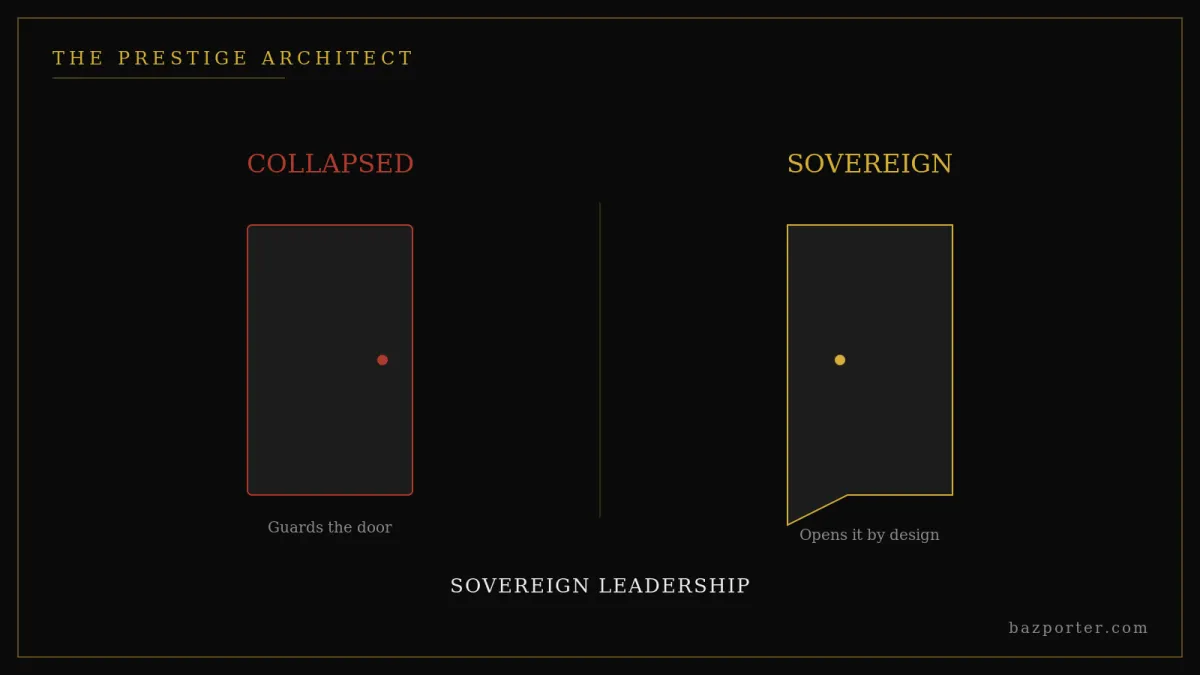
The Collapsed LeaderThe Sovereign LeaderAbsorbs every extra askAssigns the ask to its right ownerWaits to be noticedStates the value plainlyKeeps the score in silenceRenegotiates in the openCalls resentment a weaknessReads resentment as a signalCarries the system aloneRedesigns the system
Resentment is not a character defect. It is the body’s audit of an unfair exchange. — Baz Porter®
You cannot reason your way out of a structural problem. You map it, then you rebuild it. That begins with one honest hour: the Silent Collapse Diagnostic™.
A case from the room
A founder came to me last year. Details are changed for confidentiality. She ran a company at eight figures. On paper, she had won. In private, she resented her own board.
She had carried three roles for two years. No one had asked what it cost her. She had never said. She believed that naming it would look weak. So she held it, and the resentment turned to numbness.
Her body had kept the account even when she would not. She slept badly. She snapped at small things. She felt guilt for feeling any of it. That guilt is common. High achievers judge their own resentment harshly. The judgment adds a second weight on top of the first.
By the time we met, she had a plan to leave. She thought the exit was the answer. It was not. The role was not the problem. The exchange was.
We mapped it together. We named the three unpaid roles. We rebuilt the asks and the recognition around them. The resentment did not need more willpower. It needed a new design. Within a quarter, she led from choice again, and stayed.
The architecture of your return
Return is built, not felt into being. Four moves start it.
One. Name the ledger. Write what you give and what returns. See the imbalance in ink, not in feeling.
Two. Reclaim the boundary. Decide which asks are truly yours. Reassign the rest to their owners.
Three. State your value. Recognition you never request rarely arrives. Ask for the esteem the exchange owes you.
Four. Redesign the system. A structure that produced resentment will produce it again. Change the structure, not only the mood.
The change is not slow to begin. The first honest ledger shifts something the same day. What takes a quarter is the redesign — the roles renamed, the asks rerouted, the recognition made routine. You are not starting from weakness. You are starting from proof. You already carried the impossible. Now you build a structure worthy of that capacity.
You do not need more endurance. You need a new design. This is the work of Sovereign Leadership™ — power without collapse, success without self-betrayal. Apply for the Silent Collapse Diagnostic™, and we build it together.
Questions leaders ask
Is executive resentment a sign I should quit?
Rarely. Resentment marks an imbalance, not a wrong role. Correct the exchange before you change the seat. Most leaders stay once the structure changes.
How is resentment different from burnout?
Burnout is depletion. Resentment is grievance. Burnout says I am empty. Resentment says this is unfair. They often travel together, and both are signals worth reading.
Can I resolve this without anyone noticing?
Only in part. You can name your ledger in private today. The lasting change is relational. Value stated aloud is value returned.
Why does willpower fail here?
Because the cause is structural. You cannot out-discipline an unfair design. Change the design, and the feeling settles.
What is the first step?
One honest hour with me. The Silent Collapse Diagnostic™ maps the exchange and names the rebuild.
About the author
I am Baz Porter®, founder of Baz Porter LLC® and The Prestige Architect®. I guide leaders from Silent Collapse™ to Sovereign Leadership™ — power without collapse, success without self-betrayal. I do not motivate, and I do not counsel from theory. I architect the return.