Executive Hypervigilance: Why You Can't Switch Off
You closed every deal today. You answered every message. And your body never once believed you were safe. This is Silent Collapse™, and its most missed signal is a nervous system that will not stand down. You call it drive. Your physiology calls it a threat. High performers rarely name executive hypervigilance, because the name sounds weak and their whole identity stands on strength. So the alarm keeps running under the suit. It is the reason you cannot switch off in a room where nothing is wrong. I wrote The Sovereign Manifesto for the leader who reads that line and goes very quiet.
On this page:
Key Takeaways
Executive hypervigilance is a nervous system stuck in threat mode while your life looks calm.
It is not weakness. It is an adaptation that once kept you safe and now taxes you.
The cost is physical. Chronic alertness wears the body down over years.
Willpower cannot fix it. The alarm sits below thought, in physiology.
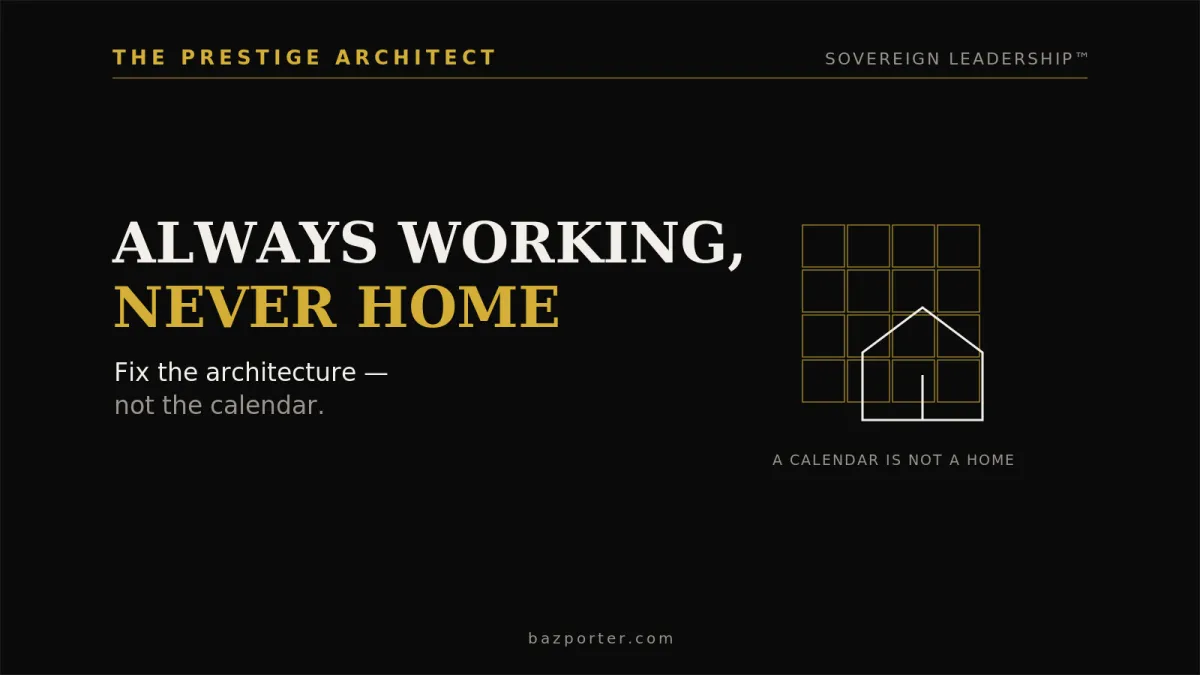
Sovereign Leadership™ rebuilds safety at the nervous system, not the calendar.
What Is Executive Hypervigilance?
Executive hypervigilance is a state where a high performer stays on alert long after any real danger has passed. The Silent Collapse™ version hides in plain sight. Your work is excellent. Your nervous system is exhausted. You scan every room, every email, every tone of voice for a problem to solve. You brace before meetings that hold no bad news. You lie down and your mind keeps working. Clinically, this is the fight or flight response left switched on. The American Psychological Association describes chronic stress as a state the body was built to survive briefly, not to hold for years (APA, Stress Effects on the Body). You were built to sprint from danger. You have been sprinting for a decade. This is why the word rest can feel foreign to you. Your body has forgotten the setting. It reads stillness as a gap where the next threat will arrive. That is not a character flaw. That is a nervous system doing its job on old orders.
The Hidden Pattern Nobody Names
Here is the mechanism under the symptom. Your brain reads safety before you do. The psychologist Stephen Porges called this neuroception, the nervous system scanning for danger below conscious awareness (Porges, The Polyvagal Theory, 2011). For a leader shaped by high stakes, that scanner never recalibrates. Calm starts to read as danger. Rest starts to read as risk. The body then pays a running bill. Bruce McEwen named this cost allostatic load, the wear and tear of a stress system that never fully powers down (McEwen, New England Journal of Medicine, 1998). This is why you can be successful and depleted at the same time. Mayo Clinic links this sustained activation to disrupted sleep, tension, and burnout across the body (Mayo Clinic, Chronic Stress). The pattern is not a flaw in you. It is a survival setting that outlived its use.
The RAMS™ Reframe Across Five Pillars
I do not treat hypervigilance as a mindset problem. I treat it as a systems problem inside the leader. RAMS™ reads the whole person across five pillars.
Results. Your output is real. It is also masking the cost. The scoreboard says you are winning. The body keeps a second ledger. We read both.
Attitude. You believe the vigilance is what makes you good. That belief is the trap. The edge you protect is the thing draining you.
Authenticity. The public leader is composed. The private one is braced. Sovereign Leadership™ closes that gap so the two become one person.
Mastery. Real mastery is not more control. It is the capacity to stay steady without gripping. You learn to read a threat and choose your response.
Systems. A regulated nervous system is your first system. Build that, and strategy, sleep, and judgment recover on top of it.
Here is the shift, stated plainly.
Collapsed: reads calm as danger. Sovereign: reads calm as data.
Collapsed: scans to feel safe. Sovereign: discerns, then rests.
Collapsed: treats rest as risk. Sovereign: treats rest as a system input.
Collapsed: controls to stay safe. Sovereign: trusts, then delegates.
Collapsed: calls exhaustion drive. Sovereign: calls energy a choice.
You were never fragile. Your alarm is just louder than your life. My work is to turn the volume back down at the source.
If you read that list and recognised yourself, that is the signal. The Silent Collapse Diagnostic™ is sixty minutes, one to one with me, to locate exactly where your system is stuck.
A Case From The Room
A founder came to me at the top of her market. Her company was thriving. Her sleep was gone. She described lying awake rehearsing conversations that had gone fine. In our first session she said she could not remember the last time her shoulders dropped. She was not anxious about failure. She was braced against a danger that had already passed years ago. We did not add discipline. She had enough of that. We rebuilt the signal of safety inside her body first. Within weeks she reported the quiet returning. Her judgment sharpened because her system was no longer screaming under it. She led the same company with the same drive. She simply stopped paying for it with her body. Her team noticed she listened longer. She made fewer reactive calls. Nothing about her ambition changed. Only the cost did.
The Architecture of Your Return
You do not need to become less driven. You need your body to stop treating your own life as a threat. That is architecture, not advice. We map where the alarm fires, why it holds, and what safety your system never received. Then we rebuild it in sequence, so rest, focus, and command return without you forcing them. This is the return at the centre of Sovereign Leadership™. It is precise, and it holds. Start where every return starts. Book the Silent Collapse Diagnostic™ and we find the source together.
Frequently Asked Questions
What are the signs of executive hypervigilance?
Common signs are scanning for problems that are not there, bracing before neutral meetings, and a mind that will not switch off at night. You may feel wired and tired at once. Rest can feel unsafe rather than restful. The tell is that your life is calm while your body acts as if it is under attack.
Is hypervigilance the same as anxiety?
They overlap but are not identical. Anxiety is often future worry about what could go wrong. Hypervigilance is a present state of scanning your surroundings for threat. In high performers the two feed each other. Both trace back to a nervous system that reads danger where there is none.
Why do successful leaders stay on high alert?
Because vigilance once worked. It helped you survive early pressure and win under stakes. The nervous system kept the setting long after the danger passed. Success does not switch it off. It often rewards the very state that is draining you, which is why the pattern hides so well.
Can you recover from chronic hypervigilance?
Yes. Recovery works when it targets the nervous system, not just the schedule. You rebuild the signal of safety in the body so the alarm no longer runs by default. Willpower alone will not do it, because the response sits below conscious thought. Structured work at the physiological level is what holds.
How is this different from ordinary stress management?
Stress management treats symptoms after the alarm fires. This work changes when the alarm fires at all. Through RAMS™ and Sovereign Leadership™, we rebuild the leader from the nervous system up. The aim is a system that reads safety correctly, so calm returns as your baseline rather than a rare reward.
About the Author
Baz Porter® is The Prestige Architect®, a British Army veteran and international bestselling author who guides high-achieving leaders from Silent Collapse™ to Sovereign Leadership™. His work rebuilds power without collapse and success without self-betrayal. He is the creator of RAMS™ and host of the Rise From The Ashes podcast on the C-Suite Network. Begin with the Silent Collapse Diagnostic™.