Executive Depersonalization: Watching Your Own Life
By Baz Porter®
You are in the meeting. You are talking. You are deciding. And some part of you is standing three feet back, watching it happen to a person who looks like you. That gap has a name. It is called executive depersonalization. It is the quiet sense that your own life is playing on a screen. This is not weakness. It is a known dissociative state. It is often the felt edge of Silent Collapse™, the slow shutdown that hides behind a working, winning exterior. If you have felt it, read the manifesto first. It will name what you already carry.
What this page covers
Key takeaways
Executive depersonalization is feeling detached from your own life, as if you are watching it from outside.
It is a dissociative state, not a character flaw, and it is common under long, high stakes strain.
The wins go quiet first. Then the flat feeling spreads to ordinary hours.
The mechanism is protective. Your nervous system dims the signal to survive the load.
The return is built, not forced. It runs through all five pillars of RAMS™.
What executive depersonalization is
Executive depersonalization is a felt state where a high performing leader feels detached from their own thoughts, body, and actions, as if watching their life from the outside. The work still gets done. The decisions still land. But the person doing them feels unreal, at a distance, behind glass. It is a dissociative response to sustained pressure, and in leaders it is a core signal of Silent Collapse™. The name matters. Once you can name it, you can start the return.
The signs leaders miss
The signs are quiet. They read as focus, not distress. That is why they get missed for years.
You narrate your day as if it belongs to someone else.
Your own voice sounds far away in a meeting.
Praise arrives and lands on nothing.
You feel like an actor playing your role well.
Mirrors, photos, and your own name feel oddly foreign.
You are calm on the outside and absent on the inside.
None of these stop you from performing. That is the trap. The engine runs while the driver is gone.
The hidden pattern behind the glass
There is a mechanism under this, and it is not a mystery. The brain has a way to keep you working when feeling too much would stop you. It turns the volume down on emotion.
Sierra and Berrios, in Biological Psychiatry, described depersonalization as the prefrontal cortex clamping down on the limbic system. The thinking brain suppresses the feeling brain. Emotion gets held at arm's length. You keep function. You lose presence. Cleveland Clinic notes the same detachment from self and surroundings in its account of the disorder. Psychology Today frames it as a survival response to overload, not a fault in you.
So the glass wall is not damage. It is a switch. And a switch can be turned back.
Why capable leaders feel unreal
High performers are prime candidates for this. The reasons are structural, not personal.
You carry stakes that never fully drop.
You learned early to perform through feeling, not with it.
Your identity fused with the role, so the self went quiet.
You get rewarded for composure, so the mask stays on.
The very traits that built the career also built the distance. The stronger the performance, the thicker the glass. This is why executive depersonalization hits the most capable leaders hardest.
The RAMS™ return
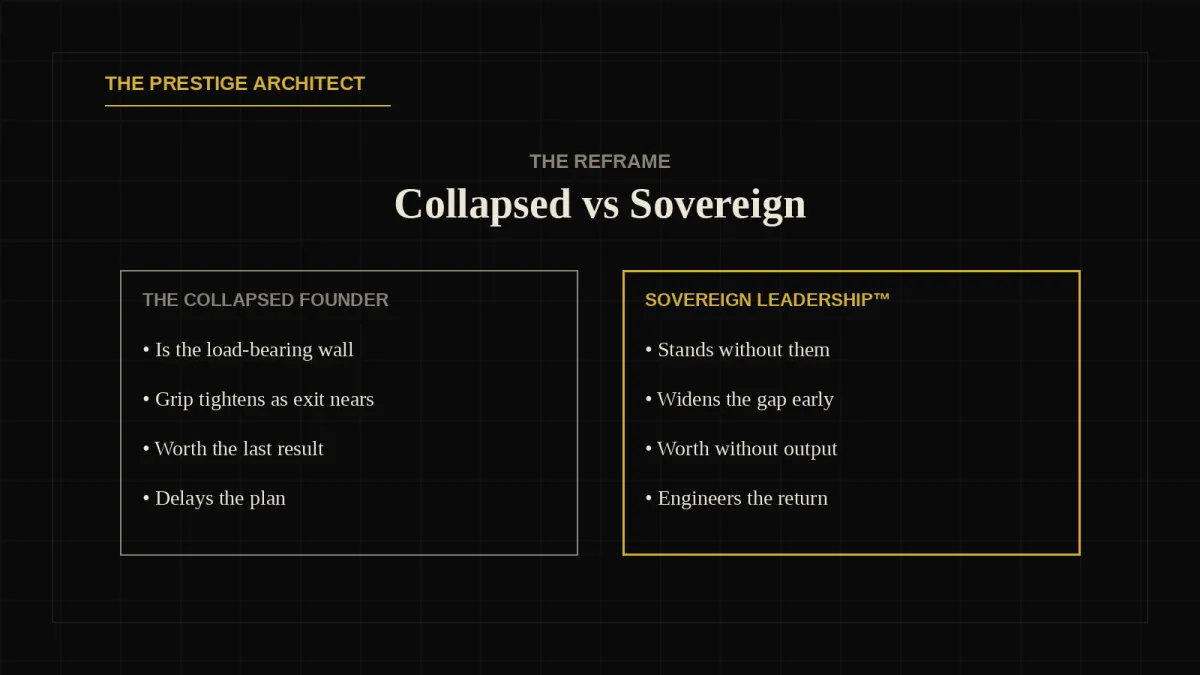
The return is not a bigger goal. It is a rebuilt relationship with your own life. RAMS™ moves it across five pillars, in order. Here is the contrast between the collapsed pattern and the sovereign one.
Results. Collapsed, you hit the number and feel nothing. Sovereign, the win lands in your body again.
Attitude. Collapsed, you watch your day from behind glass. Sovereign, you are inside the hour you are living.
Authenticity. Collapsed, you perform the person they expect. Sovereign, the face and the felt self are one.
Mastery. Collapsed, you manage the detachment and call it focus. Sovereign, you can feel and function at once.
Systems. Collapsed, your calendar runs you like a stranger. Sovereign, your days are built around a self that is present.
Depersonalization is not you leaving your life. It is your nervous system trying to survive it. The way back is to make the load safe to feel again.
You do not think your way out of this. You rebuild the ground under it. The Silent Collapse Diagnostic™ is a 60 minute session, live with Baz. It reads where the detachment started and names the first move back.
A leader who came back
A founder, six years into a company she built, described it plainly. She said she felt like a guest at her own life. Board wins came and went. She watched them from the ceiling. Her team saw poise. She felt like a rumor of herself.
We did not chase a new goal. We read the load first. We found the year the glass went up. Then we rebuilt the days around a self that was allowed to be present. The detachment did not vanish overnight. It thinned. She started to feel the room she was standing in. That is the return. Not a high. A homecoming.
The architecture of your return
You are not too far gone. You are too well defended. That is a different problem, and it has a build. The return is architecture, not effort. It starts by naming where you left, and it moves one pillar at a time.
If any of this reads like your inner life, start where it is safe to be honest. Book the Silent Collapse Diagnostic™. One hour, live with Baz, no mask required. It is the first room built for the self you set down. You can also read the related pattern of high functioning burnout if the wins have gone silent.
Questions leaders ask
What is executive depersonalization?
Executive depersonalization is a dissociative state where a high performing leader feels detached from their own thoughts, body, and actions. It feels like watching your life from the outside while still doing the work. It is common under long, high stakes pressure, and it is one of the clearest signals of Silent Collapse™.
Is depersonalization the same as burnout?
No. Burnout is depletion, the tank running dry. Depersonalization is detachment, the sense of standing outside your own life. They can travel together, but they are different states with different roots. Burnout is about energy. Depersonalization is about presence.
Why do successful people feel detached from their own lives?
Success often rewards composure over feeling. Leaders learn to perform through emotion, not with it, and the self goes quiet. Over years, the nervous system keeps the volume low to protect you from constant strain. The result is a capable person who feels unreal inside a life that looks complete.
Can depersonalization go away on its own?
Brief episodes often lift when the stress that triggered them settles. A longer, steady pattern usually needs a real intervention, because the detachment has become the way you cope. The return is built by making the load safe to feel again, one pillar at a time. It responds well to structured work.
How do I stop feeling like I am watching my life from the outside?
Start by naming it without shame, because the state is protective, not shameful. Then rebuild your days around presence instead of pure output. The Silent Collapse Diagnostic™ maps where the detachment began and names your first concrete move back into your own life.
About Baz Porter®
Baz Porter® is the founder of Baz Porter LLC® and The Prestige Architect®. He is a British Army veteran, an international bestselling author, and the host of the Rise From The Ashes podcast on the C-Suite Network. He does not motivate. He does not inspire. He architects the return from Silent Collapse™ to Sovereign Leadership™. Power without collapse. Success without self-betrayal.