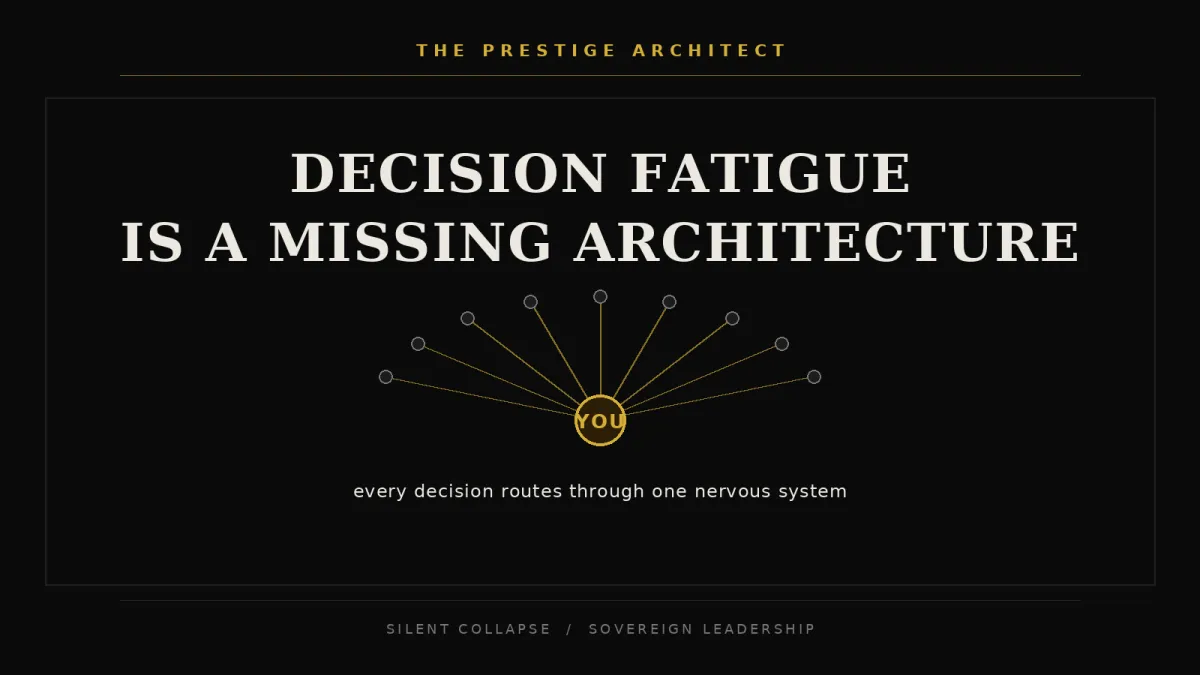
Executive Decision Fatigue: When More Choices Mean Less Command
You end the day drained, and you cannot name why. The output was normal. The volume was normal. Yet judgment feels thin, patience is gone, and small choices now cost what large ones used to. This is not tiredness. This is Silent Collapse™—the quiet erosion at the top that no one around you can see. The symptom has a name, and it is not weakness. It is architecture. Before you push harder, Read The Manifesto.
Table of Contents
Key Takeaways
Decision fatigue is a capability drain, not a workload problem. The issue is the number of choices, not the size of the job.
More decisions do not build mastery. They spend it. Command is finite. Every micro-choice withdraws from the same account.
The exhaustion is a symptom of missing architecture. A leader absorbing decisions a system should hold is running Silent Collapse™.
The return is structural, not motivational. You rebuild the system beneath the choices, not the willpower on top of them.
The Definitive Answer
Executive decision fatigue is the erosion of judgment quality caused by decision volume, not job size. It reads as exhaustion. It is a Mastery collapse—command spent on choices a system should have absorbed. The fix is not rest. The fix is architecture that removes the decisions before they reach you.
The Hidden Pattern Beneath the Fatigue
Judgment runs on a finite fuel supply. Every choice draws from it. By late morning, the tank is low, and the brain does what tired brains do—it defaults, delays, or defers. This is not a character flaw. It is measured neuroscience.
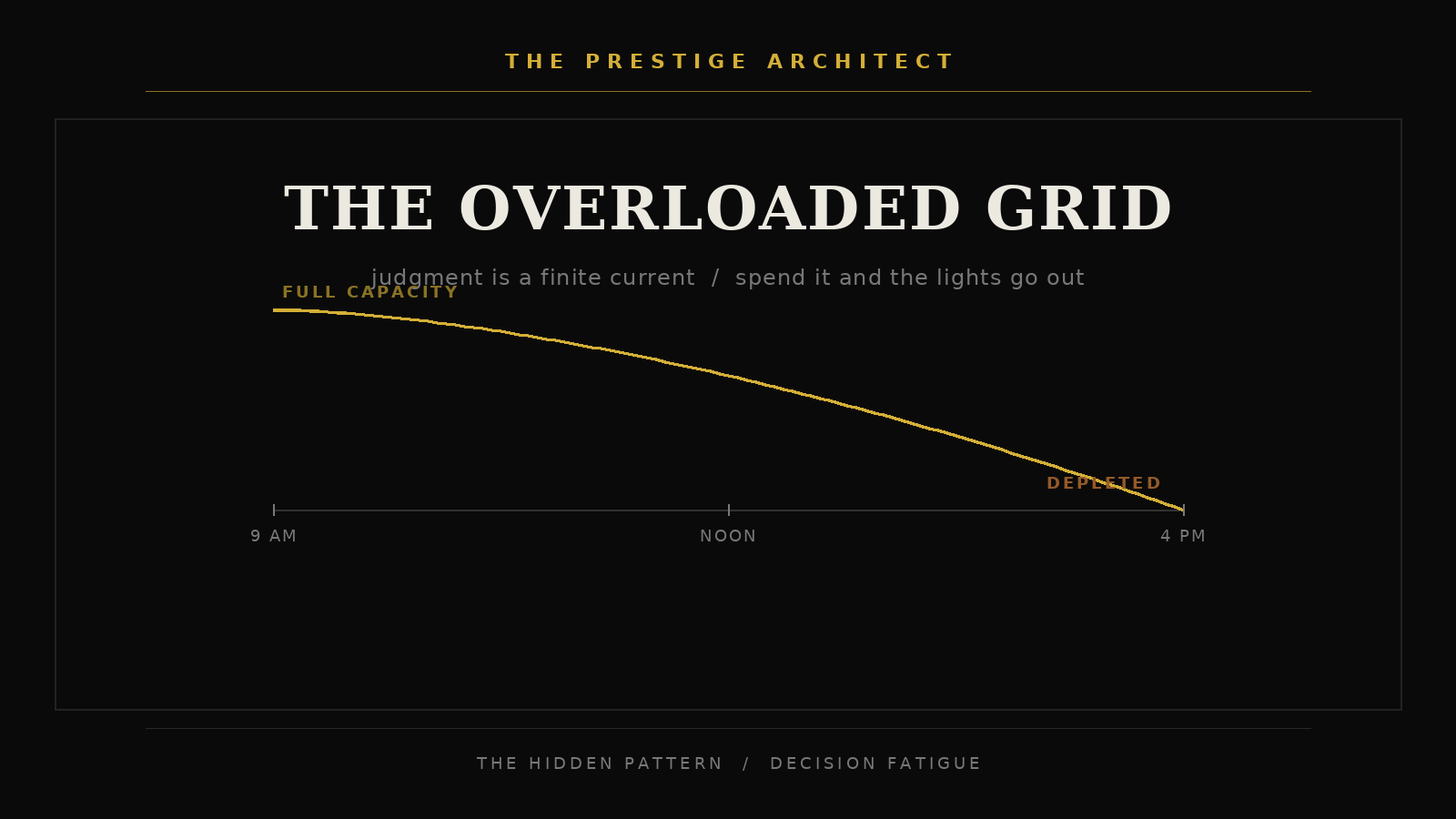
In a study of over 1,100 parole rulings, researchers found favorable decisions dropped toward zero as each session wore on, then recovered sharply after a break (Danziger et al., PNAS, 2011). Expert judges. High stakes. Same erosion. The decision itself was sound. The reserve behind it was gone.
More decisions do not build capability. They spend it.
Now map that onto a founder's day. The average adult makes tens of thousands of small choices daily, and roughly half are work (Korn Ferry). Each one is a withdrawal. The account is the same account you lead from. When it empties, the numbers still look fine. The person running them does not. That gap is Silent Collapse™: high function on the surface, a spent nervous system underneath.
The trap is the story you tell about it. You call it discipline. You call it commitment. So you add more decisions to prove you still have command. The additions are the drain. Want the clean overview of the pattern first? Start at the Sovereign Leadership Resource Hub.
The RAMS™ Reframe: Five Pillars of Command
RAMS™ is the operating system beneath the leader—Results, Attitude, Authenticity, Mastery, and Systems. It treats the body and the business as one architecture. When one is dysregulated, both are. Decision fatigue is where that shows first.
Results — The Output-Identity Gap
You measure yourself by throughput. Decisions made. Fires handled. The gap opens when output stays high while the self behind it thins. Operational rule: output is not proof of capacity. It is often proof of a leader spending reserves they are not tracking.
Attitude — Where the Collapse Lives
Attitude is the internal operating system. Under fatigue it hardens. Irritation replaces judgment. Speed replaces thought. Command decision: when your default answer becomes "just decide and move," the collapse has already reached the controls.
Authenticity — The Private-Public Divide
In the room, you are decisive. Alone, you are hollowed out. That divide between the performed self and the lived one is the engine of Silent Collapse™. The wider the gap, the faster the fuel burns—because performance itself is a decision, made all day, without rest.
Mastery — Skill Versus Sovereign Capability
Skill makes good decisions. Sovereign capability removes the need to make most of them. This is the reframe. A master does not out-decide the fatigue. A master builds so fewer decisions ever arrive.
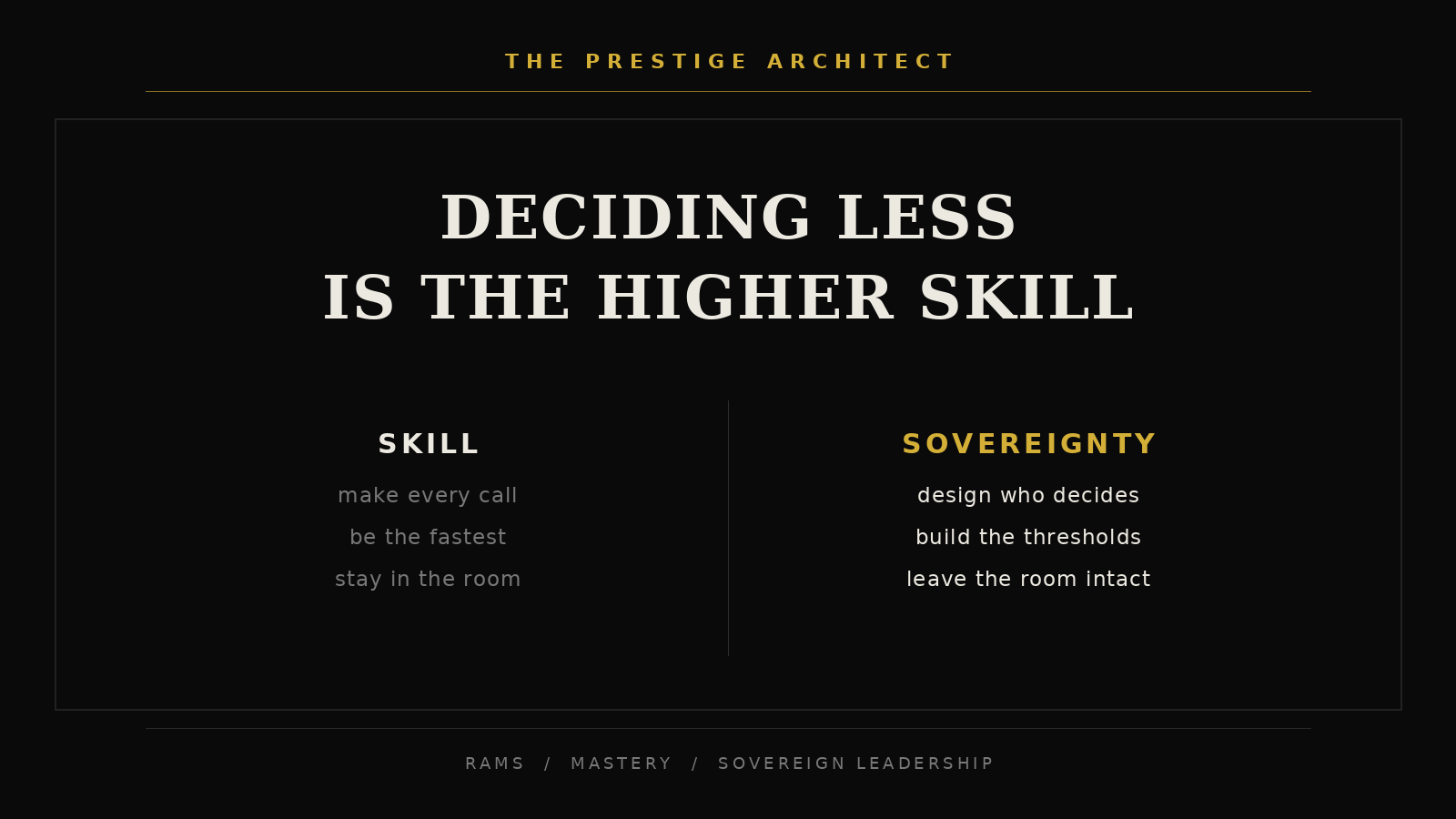
Decision fatigue is not the price of leadership. It is evidence the architecture underneath the leader has failed.
Here is the collapsed pattern against Sovereign Leadership™, pillar by pillar.
Results. Collapsed: throughput as identity. Sovereign: output as evidence of a working system.
Attitude. Collapsed: decide fast to feel in control. Sovereign: decide rarely, from a full reserve.
Authenticity. Collapsed: perform command all day. Sovereign: hold command without the performance.
Mastery. Collapsed: out-work the decision load. Sovereign: remove the decision load at the source.
Systems. Collapsed: the leader is the bottleneck. Sovereign: the architecture absorbs the choices.
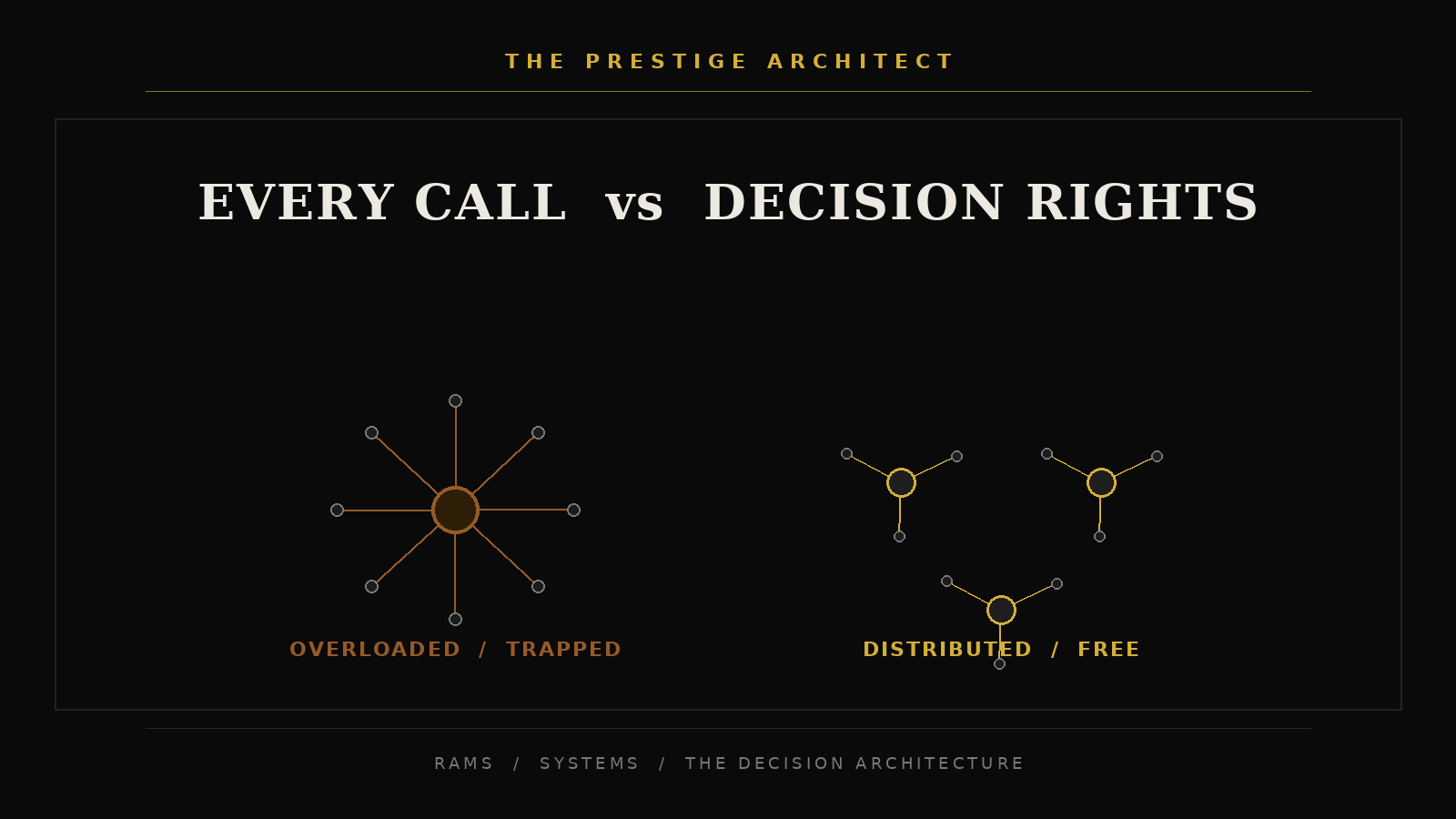
If you recognize the left column, name it precisely. Take the Silent Collapse Diagnostic—it locates where your command is leaking before you spend another quarter guessing.
Systems — The Architecture of the Return
Systems decide the ambient load. A leader without them personally metabolizes every choice. Operational rule: if a decision reaches you that a rule, a threshold, or a trusted owner would have handled, that is not delegation you missed. That is architecture you never built.
A Case of Return
One founder came in certain the problem was hours. Revenue was record. Sleep was not. We did not touch the calendar first. We mapped the decisions. Forty per day were his that a threshold would hold—spend limits, approval bands, hiring gates. We built the thresholds. Within six weeks, his decision count fell by half. The exhaustion followed it down. Nothing about his ambition changed. The architecture beneath it did.
The Architecture of Your Return
The return is not a break. A break refills a tank you will empty again by Thursday. The return is nervous-system sovereignty: a system that stops the leak, so command is held, not summoned. You stop being the organism that absorbs every choice. You become the architect who decided which choices exist.
This is not motivation. It is engineering. You audit the decision load. You set the thresholds. You build the owners. Then judgment returns—because it is no longer spent before noon. The work is precise, and it is done with counsel, not slogans. When you are ready to build it, Apply to Work With Baz.
You do not need more discipline. You need fewer decisions reaching you—by design.
Frequently Asked Questions
Why am I exhausted when my workload has not changed?
Because exhaustion tracks decision volume, not workload. Mental fatigue and decision friction now outrank raw workload as burnout drivers. You are spending command on choices a system should absorb, and the drain is invisible until judgment thins.
Is executive decision fatigue the same as burnout?
They are close but distinct. Decision fatigue is cognitive depletion from repeated choices. Burnout is the prolonged state that follows when the depletion is never structurally addressed. Untreated decision fatigue is a direct on-ramp to Silent Collapse™.
Will making decisions faster fix it?
No. Speed spends the same reserve faster. The fix is not deciding better or quicker. It is removing decisions at the source through thresholds, rules, and trusted ownership—so fewer ever reach you.
How do I know if this is me and not ordinary stress?
Ordinary stress lifts with rest. This does not. If output stays high while the self behind it feels hollow, and if small choices now cost more than large ones, that is the pattern. Locate it precisely with the Silent Collapse Diagnostic.
About the Author
British military veteran. Two-time international bestselling author. Founder, The Prestige Architect®. Host, Rise From The Ashes podcast, C-Suite Network. Boulder, Colorado.