Executive Apathy: The Sovereign Return
Executive apathy is not laziness. It is a late signal of Silent Collapse™. You used to care. The work moved you. Now it does not. You still perform. You still deliver. Inside, the caring has gone quiet. I am Baz Porter®, and I architect the return from that quiet. What follows is the pattern beneath it, named in the Sovereign Leadership™ manifesto.
In this article
Key takeaways
Executive apathy is diminished drive, not weak character.
It is a signal on the Silent Collapse™ arc, read early.
Forcing motivation deepens the flatness. Architecture reverses it.
The return is built at five levels, through RAMS™.
The definitive answer
Executive apathy is a state of diminished drive in a high performer. You still function. You have stopped caring. It is not depression on its own. It is not simple tiredness.
Clinically, apathy is a reduction in goal-directed effort. The psychiatrist Robert Marin defined it in 1991 as a syndrome of lost motivation. In a leader, it wears a mask. The mask looks like composure.
That is why it hides. Numbness means you cannot feel. Overwhelm means there is too much. Apathy means the effort no longer seems worth it. The drive is present. It has nowhere sovereign to go.
Read it as data, not as a verdict. It marks the point where output has outrun meaning.
Low motivation on a task is common. Apathy is wider. It flattens the things that once lit you up. That is why leaders miss it. They test themselves against the calendar and find they still deliver. Delivery is the disguise. The signal sits under it, waiting to be read.
The hidden pattern
Drive is not willpower. Drive is valuation. Your brain runs a constant cost-benefit read on effort.
Salamone and Correa mapped this in Neuron in 2012. Mesolimbic dopamine sets how much effort a goal is worth. When the reward signal thins, effort feels expensive. You do not choose to withdraw. The system withdraws for you.
For a leader, the reward signal thins for a reason. The wins stopped meaning anything. The role kept demanding output while the payoff went abstract. The American Psychological Association names this detachment as a core face of workplace burnout: cynicism and depersonalization, not only exhaustion.
There is a second driver. Chronic load. When the body carries stress for years, it starts to conserve. Effort becomes a resource it will not spend freely. The withdrawal is protective. It is the system defending itself from a demand that never eased.
The 2026 data confirms it at the top. Harvard Business Review reports that leaders now feel their agency eroding and are starting to withdraw. Apathy is that withdrawal, measured from the inside. It is not a failure of will. It is a system doing what a strained system does.
The RAMS™ reframe
RAMS™ reads apathy at five levels. Not one. Five: Results, Attitude, Authenticity, Mastery, Systems. Most advice treats the symptom. RAMS™ treats the structure under it. That is the difference between a good day and a durable return.
Results
Output continues while meaning drains. The dashboard stays green. The reason went grey. Reconnect each result to a reason you can name.
Attitude
Flat detachment reads to others as calm. You know it is distance. Attitude is not forced positivity. It is honest re-engagement with what is true. Name the distance out loud, and it starts to close.
Authenticity
Apathy makes you perform caring you do not feel. That gap costs you daily. Sovereign work closes it. What you say starts to match what you feel again.
Mastery
Your skill now runs on memory. Competence without presence is a warning, not a strength. Mastery returns when attention returns to the work in front of you. The craft is still there. It is waiting for you to arrive.
Systems
Your calendar drives you. That is backwards. Your architecture must protect your drive, not spend it. Build the container that guards attention before it guards output.
Collapsed versus sovereign
Results. Collapsed: output continues, meaning drains. Sovereign: every result ties to a reason.
Attitude. Collapsed: distance passes for composure. Sovereign: steady, honest engagement returns.
Authenticity. Collapsed: you perform a care you do not feel. Sovereign: word and feeling align.
Mastery. Collapsed: skill runs on autopilot. Sovereign: skill runs on presence.
Systems. Collapsed: the calendar spends your drive. Sovereign: the architecture protects it.
"Apathy is not the absence of drive. It is drive with nowhere sovereign to go."
If the caring has gone quiet, name it before it hardens. Start with the Silent Collapse Diagnostic™.
A case vignette
A composite, and confidential. A founder of a nine-figure firm sat across from me. She hit every target that year. She felt nothing when she hit them.
She called it gratitude fatigue. It was not that. Her drive had not died. It had been spent on outputs no longer tied to a reason she owned.
We did not add motivation. We rebuilt the architecture. We named the results that mattered to her, not to the market. We closed the gap between her public calm and her private flatness.
The caring returned in weeks, not years. Not because she tried harder. Because the system stopped draining what she had.
Her results did not drop while we rebuilt. They sharpened. Drive that is protected compounds. Drive that is spent thins out. She stopped confusing the two.
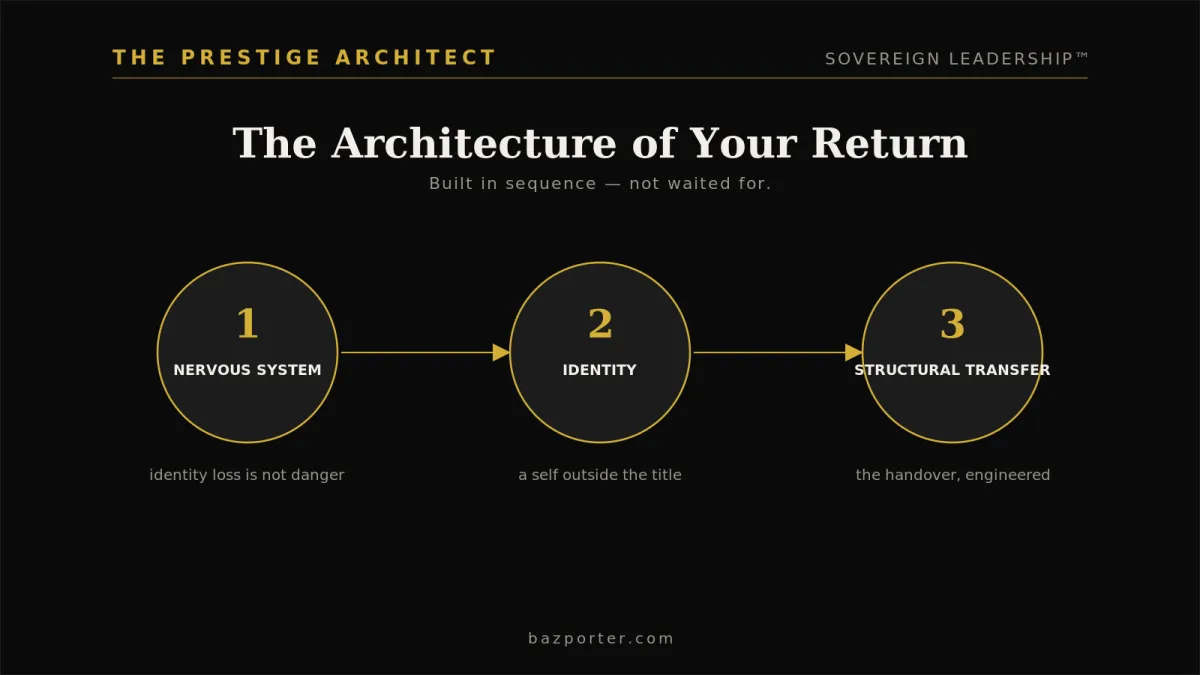
The architecture of your return
The return is built, not willed. You will not think your way back into caring. You will construct the conditions that make caring rational again.
That is the work of Sovereign Leadership™. It runs on architecture, not on effort. Inside The Gravity Code™, we build it with you, level by level.
Apply when you are ready to rebuild the drive you thought you had lost.
Do not wait for the caring to return on its own. It will not. Apathy hardens the longer it is left unnamed. Named early, it is a signal you can work with. Left long, it becomes the water you swim in. The point of leverage is now, while you can still tell the flatness is not you.
Frequently asked questions
What is executive apathy?
It is diminished goal-directed drive in a high performer who still functions. You keep delivering. You have stopped caring. It is a signal, not a character flaw.
Is executive apathy the same as burnout or numbness?
No. Burnout centres on exhaustion. Numbness is the loss of feeling. Apathy is the loss of drive. The effort no longer seems worth it, even when energy remains.
Why do high performers lose the drive they once had?
Because the reward stopped meaning something. The brain values effort against payoff. When wins go abstract, effort feels expensive, and drive quietly withdraws.
How do I recover drive without forcing motivation?
Stop forcing it. Rebuild the architecture instead. Reconnect results to reasons you own, close the gap between what you show and what you feel, and protect attention by design.
Can executive apathy be reversed?
Yes. Drive is a system, and systems can be rebuilt. The return comes from architecture, not from pressure. You reconnect results to reasons, protect attention, and let the reward signal recover.
When should apathy concern me clinically?
Persistent apathy or loss of pleasure can also signal depression. If it lasts, spreads beyond work, or brings hopelessness, speak with a qualified professional. This article is educational, not medical advice.
About the author
Baz Porter® is the founder of Baz Porter LLC® and The Prestige Architect®. He is a British Army veteran and an international bestselling author. He architects the return from Silent Collapse™ to Sovereign Leadership™.