Tired of Being the One Everyone Leans On
You are the one everyone leans on. You have been for years.
The calls come to you. The problems land on your desk. The family waits for you to decide. You carry it, because you always have, and because no one else seems to. But lately the weight has a different quality. You are not tired from the work. You are tired from being needed. This is the quiet ache that Silent Collapse™ names: the slow erosion of a leader who has become a load-bearing wall. If you want the larger map of what is happening to you, start with the manifesto.
What this page covers
Key takeaways
Being the one everyone leans on is not a character strength. It is a role, and roles have a cost.
The exhaustion is not about hours. It is about being needed without being known.
Underneath the over-giving is a quiet fear: that you are only worth what you do for others.
The move is not to stop caring. It is to let the load redistribute.
You can come back to a self that is more than useful, without the people around you falling.
Why you are so tired of being the one everyone leans on
You are tired because you have been carrying weight that was never meant to sit on one person. For years you were the reliable one. The strong one. The fixer. People learned to bring you their problems. You learned to solve them. That worked for a long time. It also quietly taught everyone, including you, that you are the structure holding things up. The fatigue you feel now is not weakness. It is the honest cost of being load-bearing for too long, with no one carrying you.
Notice what the tiredness is made of. It is not only the tasks. It is the sense that you are never off duty. That if you stop, something important drops. You have organized a whole life around being available. The bill for that is now coming due, quietly, in your body and your mood.
The hidden pattern underneath
There is a name for this in the research. Psychologists call it unmitigated communion: a focus on others so complete that the self drops out of view. Fritz and Helgeson, writing in the Journal of Personality and Social Psychology, found that people high in this trait neglect their own needs and over-involve themselves in the needs of others. The result is not sainthood. It is distress. The giving looks generous from the outside. Inside, it slowly empties you.
The workplace version compounds it. Bolino and Grant, in the Academy of Management Annals, describe how the most helpful people absorb more and more demands until the helping itself becomes a load. You became the go-to. So more goes to you. The pattern feeds itself. And because you are good at it, no one thinks to ask if you are alright. The strength that built your reputation is now the thing quietly draining you.
The RAMS reframe
The RAMS™ framework looks at the leader before the strategy. Here is how each pillar reads the weight you are carrying.
Results
You measure yourself by what you produce for others. When output is the only proof of worth, rest feels like failure. The reframe is simple. Your value is not a function of your usefulness. It never was.
Attitude
You tell yourself you do not mind. That you are fine. That others need you more than you need rest. Notice the story. It is the story that keeps the weight on you.
Authenticity
Being needed is not the same as being known. People lean on your strength. Few have met the part of you that is tired. Authenticity is letting someone see the second thing, not only the first.
Mastery
You have mastered carrying. You have not yet mastered handing back. The skill you are missing is not strength. It is the clean, unapologetic act of letting others hold their own weight.
Systems
A life where everything routes through one person is not a strong system. It is a fragile one. The repair is structural, not personal. You build a life with more than one load-bearing wall.
Here is the difference between the collapsed pattern and the sovereign one.
Collapsed: Everything runs through me, or it falls apart. Sovereign: The structure holds because the load is shared.
Collapsed: I cannot rest until everyone is handled. Sovereign: I rest, and the people I trust carry their part.
Collapsed: Asking for help means I failed. Sovereign: Letting myself be held is how I stay standing.
Collapsed: I am valued for what I do. Sovereign: I am worth something even when I do nothing.
The strong ones rarely collapse loudly. They just quietly run out of themselves, one yes at a time.
If you want to see exactly where your weight is going, and where it could be redistributed, begin with the Fast Future Freedom Blueprint. It is the free entry audit, and it starts with you, not your list of tasks.
A leader who put the weight down
A managing partner came to me certain of one thing. If they stepped back for even a week, the firm would stall. Clients would leave. The team would flounder. They had built that belief over fifteen years, and it felt like fact. We did not argue with it. We tested it. One handoff at a time, we moved real weight to real people. The first week was uncomfortable. Nothing collapsed. By the second month the team was stronger, because they were finally trusted. The partner slept. The firm did not fall. What fell was the story that it all depended on one person. That is the return. Not a smaller life. A life that no longer rests on a single wall.
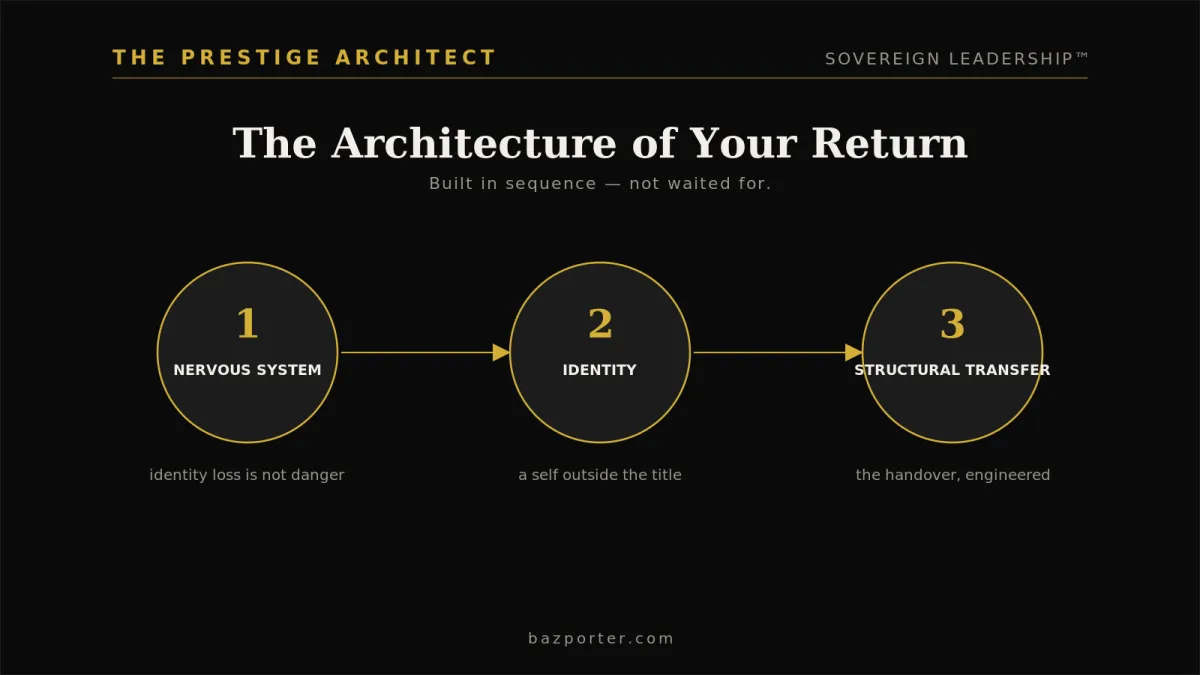
The architecture of your return
Coming back does not mean abandoning people. It means building a structure where being needed is not the only way you matter. You start small. One thing you always catch, you let someone else catch. One request, you answer with an honest no. One evening, you rest without earning it first. The people around you adjust faster than your fear predicts. And slowly, you meet the self that was buried under all the carrying. That self is still there. It is worth coming home to.
The Fast Future Freedom Blueprint is where that return begins. One free hour. A clear map of the load you carry, and the first weight to set down. Read the manifesto if you want the full picture first.
Your questions, answered
Why am I so exhausted when I love helping people?
Because helping and self-neglect can live in the same habit. Loving to help is real. So is the cost of never being on the receiving end. Exhaustion here is rarely about effort. It is about depletion that no one refills, including you.
Is being dependable not a good thing?
It is, until it becomes the only thing. Dependability turns costly when everything routes through you and the load never redistributes. A good system shares weight. A fragile one hangs it all on one person. You deserve to be more than the fragile one.
How do I stop being the one everyone leans on without letting people down?
You redistribute slowly, not all at once. Hand back one responsibility at a time to someone capable. Let the discomfort pass without rescuing. Most people rise to the trust you give them, and the relationships survive the change.
Why do I feel guilty when I rest?
Because you have tied your worth to being useful. When usefulness is the proof of your value, rest feels like a threat to it. The guilt is a signal, not a verdict. It points to a worth you have not yet let yourself believe is unconditional.
What is the first step to putting the weight down?
Name one thing you carry that is not truly yours to carry. Just one. Then hand it back, cleanly, without over-explaining. The Fast Future Freedom Blueprint can help you find that first piece and the right place for it to go.
About Baz Porter
Baz Porter® is the founder of The Prestige Architect™ and the creator of the RAMS™ framework. He works with capable, successful leaders who have quietly become the one everyone leans on, and helps them return to a self that is more than useful. His approach names the Silent Collapse™ under high achievement, and rebuilds a life that does not rest on a single wall.