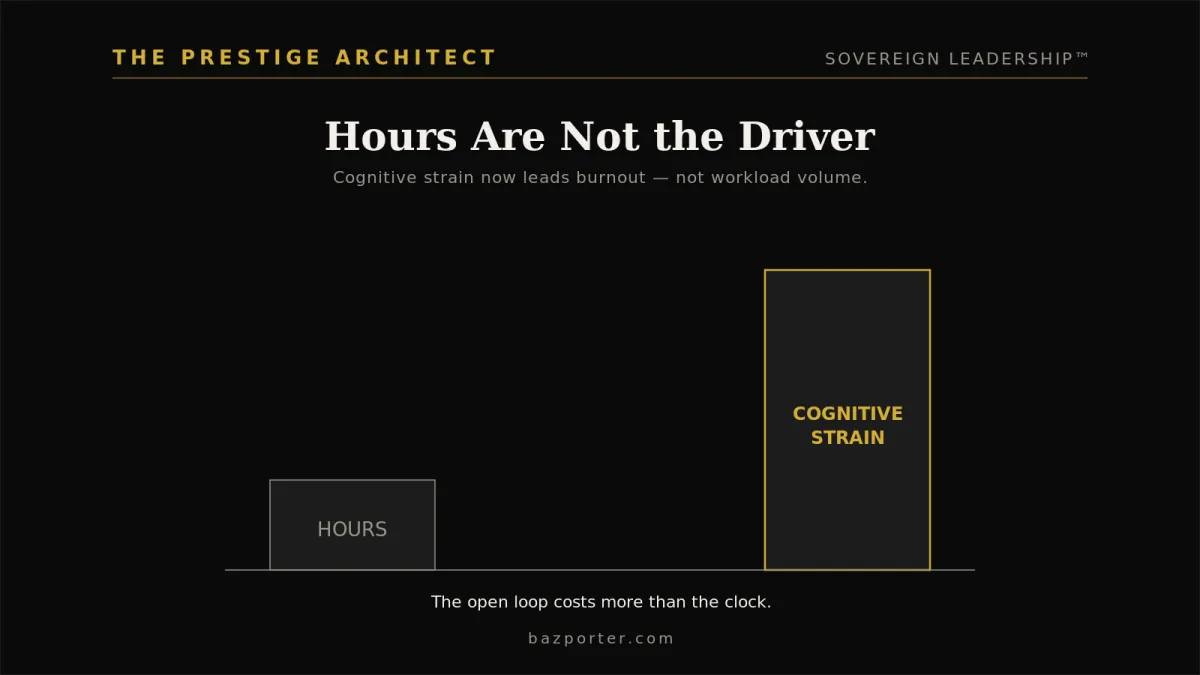
Emotionally Exhausted at Work: The Silent Collapse
You give everything at work. You come home with nothing left. Not tired — emptied. That state has a clinical name. The deeper version I call Silent Collapse™. It is depletion behind a composed face. You still deliver. You still lead. Inside, the gauge reads zero. This is not weakness. It is a resource problem. And resources can be rebuilt — which is the whole premise of my work.
In this article
Key takeaways
Emotional exhaustion is depletion of resources, not a flaw in you.
It is the core dimension of burnout, per Maslach’s research.
In 2026, 45% of workers feel emotionally drained; 51% feel used up by day’s end.
Leaders carry it worse. Managers report higher rates than their teams.
Willpower will not refill the tank. Structure will.
Recovery is an input, not a reward. Schedule it first.
The definitive answer
What is emotional exhaustion? It is the sense that your emotional resources have run dry. You have nothing left to give. Not to your team. Not to your family. Not to yourself. The work still gets done. The cost lands on you.
The data is stark. A 2026 Forbes analysis flagged leadership burnout as a boardroom priority. Gallup’s 2026 report ranks senior leaders higher on stress than the people they lead. Across workplaces, 45% of employees feel emotionally drained. Fifty-one percent feel used up at the end of the day. Managers report burnout near 71%, mid-level leaders higher still.
It shows up in small tells first. The inbox that used to take minutes now feels like a wall. The one-on-one you once enjoyed drains you. You reread the same line three times. You snap at home over nothing. You cannot feel the wins. None of these are character defects. They are readings on a gauge you have learned to ignore.
Leaders carry a second load most people never see. You absorb the room. You hold other people’s stress, then manage your own on top. Research finds leaders score markedly higher on exhaustion driven by other people’s emotions. You are the shock absorber for the whole system. No wonder the reserve runs down.
Here is the part high performers miss. Exhaustion is not a sign you are failing. It is a sign the demand has outrun the resource. You have been paying the gap out of yourself.
The hidden pattern
Emotional exhaustion is not laziness. It is arithmetic. Christina Maslach’s research in World Psychiatry names exhaustion as the core of burnout. It rises with demand and workload. It falls with the resources you actually have. When demand climbs and resources stay flat, the body draws down its reserves.
The body keeps a ledger. Chronic demand keeps stress hormones elevated. Recovery systems stay switched off. Sleep thins. Focus frays. The reserve that fuels judgment, patience, and warmth runs low. You do not notice the draw at first. You notice the overdraft.
The high achiever does one thing that deepens the hole. They refill from will, not from resource. They push harder into an empty tank. The push works for a while. That is the trap. Each recovery costs more than the last. The surface still looks strong. The reserve underneath keeps thinning.
The RAMS™ reframe
I do not treat the feeling. I rebuild the architecture. RAMS™ runs across five pillars — Results, Attitude, Authenticity, Mastery, Systems. It works at the level of the business and the nervous system at once. Exhaustion shows up in all five.
Results. An empty leader makes worse calls. Judgment narrows under depletion. Sovereign leaders protect the resource that produces every result. Output without reserve is a loan, and the interest is your health.
Attitude. You have framed rest as indulgence. Reframe it. Recovery is not a reward for output. It is the input that makes output possible. Skip the input long enough and the output stops on its own.
Authenticity. The mask that hides the drain costs the most energy of all. Drop one degree of performance. Say the true thing to one trusted person. Performance is expensive. The load lightens the moment you set it down.
Mastery. You mastered the work. You never mastered your own recovery. That is the next skill. It is learnable, and it compounds. A leader who can refill fast becomes hard to break.
Systems. Willpower cannot refill a resource. Structure can. Build recovery into the week by design, not by collapse. A calendar that only spends will always overdraw. Schedule the deposits first.
The Collapsed LeaderThe Sovereign LeaderRefills from willpowerRefills from real resourceTreats rest as a reward earnedTreats recovery as required inputHides the drain to look strongReads the drain as dataWaits for collapse to stopBuilds recovery into the design
Baz Porter does not motivate. He does not inspire. He does not counsel from theory. He architects the return.
Want to see where your own reserves are draining? Start with the free Silent Collapse Diagnostic™. It reads the signal you have been overriding.
A case vignette
Consider a composite leader. A founder. Two hundred people report to them. Revenue climbing. On paper, thriving. In private, hollow. They told me the smile at the all-hands took everything they had. By evening there was nothing left for the people they loved. They were not failing at work. They were paying for it in silence. We did not push them to grind harder. We rebuilt the resource. A weekly recovery block, held like a board meeting. One relationship with no performance in it. A hard line around the first hour of the day. Within a quarter, the gauge lifted off zero. The judgment sharpened. The dread thinned. The workload barely moved. The architecture did. They did not become a different person. They stopped running that person on empty.
The architecture of your return
You do not need more discipline. You have plenty. You need a structure that refills you as fast as the work drains you. That is not soft. It is the highest-leverage build a leader makes. The exhaustion is not the end of your capacity. It is your own system asking to be rebuilt. For leaders ready for that rebuild, I open a small number of private containers. The work will still be there. A version of you with something left to give will meet it differently. Apply here.
Frequently asked questions
What is emotional exhaustion at work?
It is the sense that your emotional resources have run dry. You feel drained, used up, and unable to give more. Maslach’s research names it the core dimension of burnout.
Is emotional exhaustion the same as being tired?
No. Tiredness lifts with sleep. Exhaustion is deeper. It is depletion of your emotional reserve, and rest alone rarely refills it. The demand-to-resource gap has to change.
Is feeling emotionally drained a sign I am weak?
No. It is a resource signal, not a character verdict. High demand plus thin resources produces it in strong people every day. Read it as data.
How is this different from burnout?
Emotional exhaustion is the core of burnout, not the whole of it. Burnout also includes cynicism and a drop in sense of achievement. Exhaustion is usually the first dimension to show.
What actually helps emotional exhaustion?
Structure, not willpower. Recovery built into the week by design. A resource audit of what drains and what refills. The free Silent Collapse Diagnostic™ maps where to start.
About the author
Baz Porter® is The Prestige Architect®, a British Army veteran, and an international bestselling author. He hosts the Rise From The Ashes podcast on the C-Suite Network. He guides high-achieving leaders from Silent Collapse™ to Sovereign Leadership™ — power without collapse, success without self-betrayal.