Why You Feel Most Unsure Right After a Win
Why You Feel Most Unsure Right After a Win
You closed the deal. You got the seat. You should feel sure. Instead the doubt gets louder. That is Silent Collapse™, and it often hits hardest right after a win. Your judgment feels shakiest at the exact moment it should feel strongest. This is doubt after a win, and it is not a character flaw. It is a load problem wearing a mask. If this is you, read the manifesto first.
What this covers
The short answer
Key takeaways
The hidden pattern behind post-win doubt
The RAMS™ reframe, all five pillars
A leader who lived it
The architecture of your return
Questions leaders ask
Key takeaways
Doubt after a win is common. Most high performers feel it at some point.
The win raises the stakes. More to protect means more to fear losing.
Your mind discounts the win faster than the win can land.
This is a self-trust problem, not a confidence problem. You do not talk your way out of it.
Trust returns as the result of a system, not a burst of willpower.
The short answer: why you feel most unsure right after a win
You feel most unsure right after a win because success raises the stakes and your tired mind cannot bank the proof. A win should add evidence that you can lead. Under chronic load, the mind does the opposite. It credits the win to luck or timing. It files the next test as the one that exposes you. So the doubt climbs the higher you climb. The problem is not your judgment. The problem is that your judgment is running with no record and no rest.
The hidden pattern behind post-win doubt
Researchers named this decades ago. In 1978, psychologists Pauline Rose Clance and Suzanne Imes described the imposter phenomenon in high achievers, published in Psychotherapy: Theory, Research and Practice. Their finding still holds. The people most likely to doubt their success are often the ones producing it.
Two forces drive it. The first is attribution bias. You credit each win to luck, timing, or charm. You credit each miss to proof you are not enough. So wins never count and misses always do. The Cleveland Clinic notes that imposter feelings touch an estimated seven in ten people at some point in their working lives. You are not the exception. You are the pattern.
The second force is load. Every win adds a new decision to carry. The team is bigger. The bets are larger. The margin for error feels thinner. You are now making heavier calls on a mind that never got to put the last win down. Doubt after a win is what an overloaded operating system sounds like when the demands go up and the recovery does not.
The RAMS™ reframe, all five pillars
Sovereign Leadership™ does not fix doubt with a pep talk. It rebuilds the system underneath the doubt. Here is post-win doubt seen through RAMS™, the five pillars of Results, Attitude, Authenticity, Mastery, and Systems.
Results
You keep score in your head, where the score always loses. A win you cannot see is a win your mind can delete. Move the record out of your head and onto a page. What you got right. What you learned. What you would keep. A visible record is the first defense against a mind that discounts.
Attitude
The story you tell after a win decides whether it counts. "I got lucky" ends the win. "I made a hard call under pressure and it held" banks it. This is not positive thinking. It is accurate thinking. Name the skill the win required. Then let it stand.
Authenticity
Doubt after a win often means you are still leading as the person you were before the win. The role grew. The self-image did not. Authenticity is closing that gap on purpose. You stop performing certainty you do not feel, and you start building the real thing. A leader who owns the win, plainly, becomes someone the win can finally belong to.
Mastery
Confidence is a feeling. Mastery is a track record you can point to. When you doubt the next call, you do not need more nerve. You need evidence. Mastery is the practice of collecting your own proof, so the next hard decision rests on the last ten, not on your mood that morning.
Systems
Willpower will not carry a growing load. A system will. Fewer decisions, one clear standard, and a written record turn self-trust from a feeling into an output. You do not feel your way back to trust. You build it, one standard at a time.
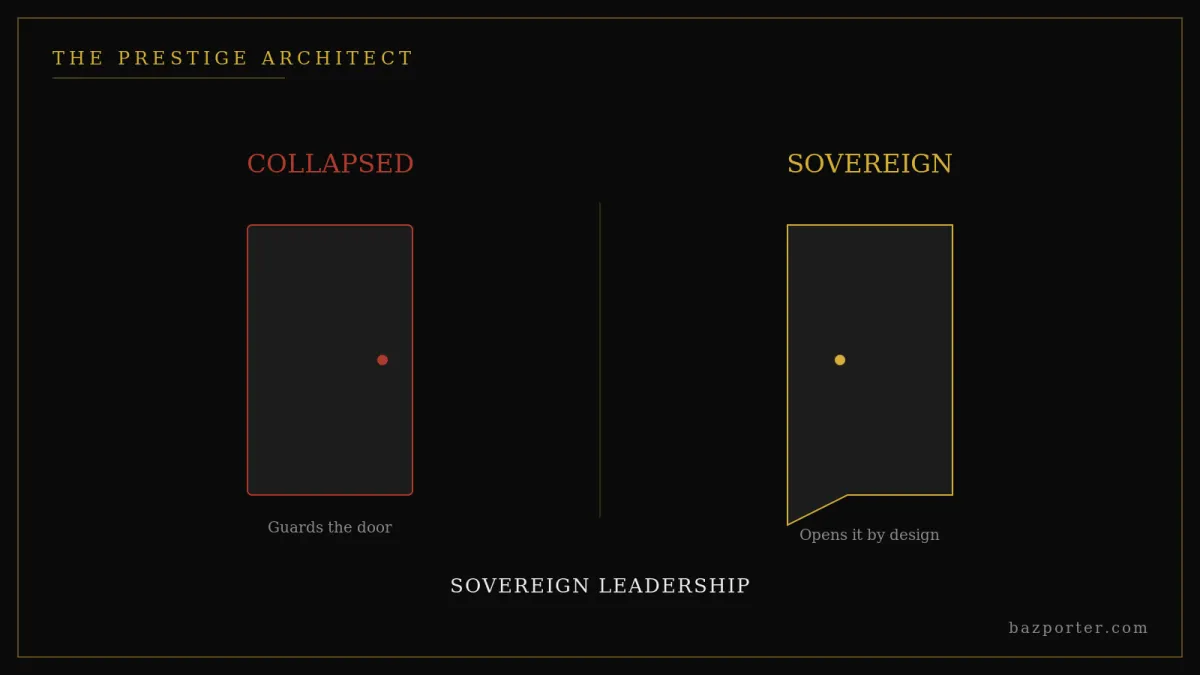
Here is the shift from a collapsed state to a sovereign one:
Collapsed: the win disappears by morning. Sovereign: the win is written down and stays.
Collapsed: "I got lucky." Sovereign: "I made the call, and it held."
Collapsed: every new decision starts from zero. Sovereign: every decision rests on a record.
Collapsed: you chase a feeling of confidence. Sovereign: you build proof of competence.
Collapsed: doubt runs the next move. Sovereign: your standard runs the next move.
The higher you climb, the louder the doubt, until you give your judgment a system to stand on.
If the doubt after a win has become the normal sound of your days, that is the signal to look under the hood. The Silent Collapse Diagnostic™ is where that starts. One clear hour on what is actually eroding your judgment, and what to rebuild first.
A leader who lived it
A founder closed the largest deal of the company's life. That night, alone, the win felt like a warning. If this was the peak, the fall was next. She stopped trusting her own read on the business. Small calls turned heavy. She replayed meetings that had gone well. She was not failing. She was winning, and drowning in it.
The fix was not more grit. It was a record. Each night she wrote three lines. The call she made. Why she made it. How it landed. In six weeks she had proof, in her own words, that her judgment was sound. The doubt did not vanish. It lost its authority. She was leading from a record instead of a mood.
The architecture of your return
Doubt after a win is not a verdict on you. It is a system asking to be rebuilt. You do not need to be more sure. You need a structure that makes your judgment visible, so a win can finally count and the next call has ground to stand on. That is the work of The Prestige Architect™: return, not repair, to the leader you already are underneath the load.
The first step is to see the pattern clearly. Apply for the Silent Collapse Diagnostic™. In one hour you will name what is eroding your self-trust and leave with the first piece of the system to rebuild it.
Questions leaders ask
Why do I feel more self-doubt after a win, not less?
Because a win raises the stakes and your mind cannot bank the proof while it is overloaded. Success adds more to protect and more to lose. A tired mind credits the win to luck and files the next test as the real judgment. The doubt is a load signal, not a truth about your ability.
Is doubt after a win the same as imposter syndrome?
They overlap. Imposter feelings are the belief that your success is not earned and will be exposed. Post-win doubt is that belief spiking right after an achievement. Both come from crediting wins to luck and misses to yourself. The repair is the same: build a visible record so wins finally count.
How do I rebuild self-trust after a big success?
Stop trying to feel confident and start collecting evidence. Each day, write the decision you made, why you made it, and how it landed. Within weeks you hold proof, in your own words, that your judgment is sound. Self-trust returns as the output of that record, not as a burst of willpower.
Does the doubt ever fully go away?
The goal is not to erase doubt. The goal is to remove its authority over your decisions. When your judgment rests on a written record and a clear standard, doubt becomes noise instead of the driver. It may still show up. It no longer runs the next move.
What is Silent Collapse™ and how does it connect to this?
Silent Collapse™ is the quiet erosion of self-trust in a capable leader that no one else can see. Doubt after a win is one of its clearest signs, because the collapse gets loudest at the moment success should feel best. The Silent Collapse Diagnostic™ is the first step back.
About the author
Baz Porter® is the founder of Baz Porter LLC and creator of Sovereign Leadership™ and the RAMS™ framework. Known as The Prestige Architect™, he counsels high achievers out of Silent Collapse™ and back to steady, sovereign command of their own judgment. Power without performance. Peace without retreat.™