Difficult Conversations: The Discipline of Candor
The sentence you did not say
Silent Collapse™ rarely opens with a breakdown. It opens with a sentence you chose not to say.
You rehearsed it in the car. You trimmed it down. Then you swallowed it whole.
The meeting closed with a nod and nothing resolved. The problem did not leave. It moved into your body and your calendar.
This is the conversation you keep postponing. The under-performer. The partner who over-reaches. The truth a peer needs to hear from you.
Avoidance feels like grace. It is a quiet tax on your authority, and it compounds. I do not train leaders to speak louder. I architect the return to their own voice.
What this covers
Key takeaways
A difficult conversation is not a skills gap. It is a nervous-system pattern.
Avoided conversations cost US organizations an estimated $359 billion a year.
Every crucial conversation a leader ducks costs roughly $7,500 and seven working days.
Self-silencing in conflict tracks with worse health outcomes, especially for women.
Candor is a discipline you build. It is not a trait you were born with.
The definitive answer
How does a leader hold a difficult conversation well? You regulate first, then you speak plainly.
The order matters. Most leaders reverse it. They wait to feel calm, so they never begin.
Here is the standard I hold my clients to. Name the issue in one clean sentence. State the impact. Ask one real question. Then stop talking and listen.
No preamble. No apology tour. No burying the point under five minutes of context.
The Harvard Business Review frames this as separating the person from the problem. That is correct, and it is not enough. The block is rarely the words. The block is your body bracing against the other person's reaction.
So the work starts one layer down. You steady your own system before you open your mouth. A regulated leader can say a hard thing without cruelty and without collapse.
What the silence costs
Leaders tell me avoidance is the safe choice. The numbers disagree.
Avoided conversations cost US organizations an estimated $359 billion a year. Every crucial conversation a leader ducks costs roughly $7,500 and seven working days of drag.
The frequency is the part that stuns me. Around seventy percent of employees avoid the hard talk entirely. Only a quarter face it head-on.
And this is not a knowledge problem. Six in ten leaders have never been trained to hold these conversations at all. You were handed the title and left to guess.
So the silence is never free. You pay it in stalled projects, lost talent, and your own eroding authority. The invoice simply arrives later.
The hidden pattern
There is a name for what you are doing when you swallow the sentence. It is self-silencing.
Self-silencing is the habit of suppressing your own voice to keep a relationship smooth. It looks like maturity. It behaves like a slow leak.
The data here is sobering. In the Framingham Offspring Study, researchers tracked women who silenced themselves during conflict for a decade. Those women carried roughly four times the risk of death of women who spoke (Eaker et al., Psychosomatic Medicine, 2007).
Read that again. The cost of the unspoken sentence is not only the stalled project. It is metabolic. It is cardiac. It lands in the body of the high achiever who prides herself on holding it all together.
This is why willpower fails you here. You are not weak. You are running a survival pattern that once kept you safe and now keeps you stuck.
The RAMS™ standard for candor
I run every leadership problem through RAMS™: Results, Attitude, Authenticity, Mastery, Systems. Candor is no exception. Each pillar names one shift.
Results. Measure the conversations you avoid, not only the ones you have. A ducked issue is a live liability on your books.
Attitude. Stop treating candor as an attack. Reframe it as respect. Withholding the truth tells someone you do not believe they can handle it.
Authenticity. The sentence you swallow is usually the most honest thing in the room. Your job is not to be liked. It is to be real and clear.
Mastery. Regulation is trainable. You can build the capacity to stay in your body while another person is upset with you.
Systems. Do not leave hard talks to mood. Build a cadence, a script spine, and a same-week rule so nothing rots.
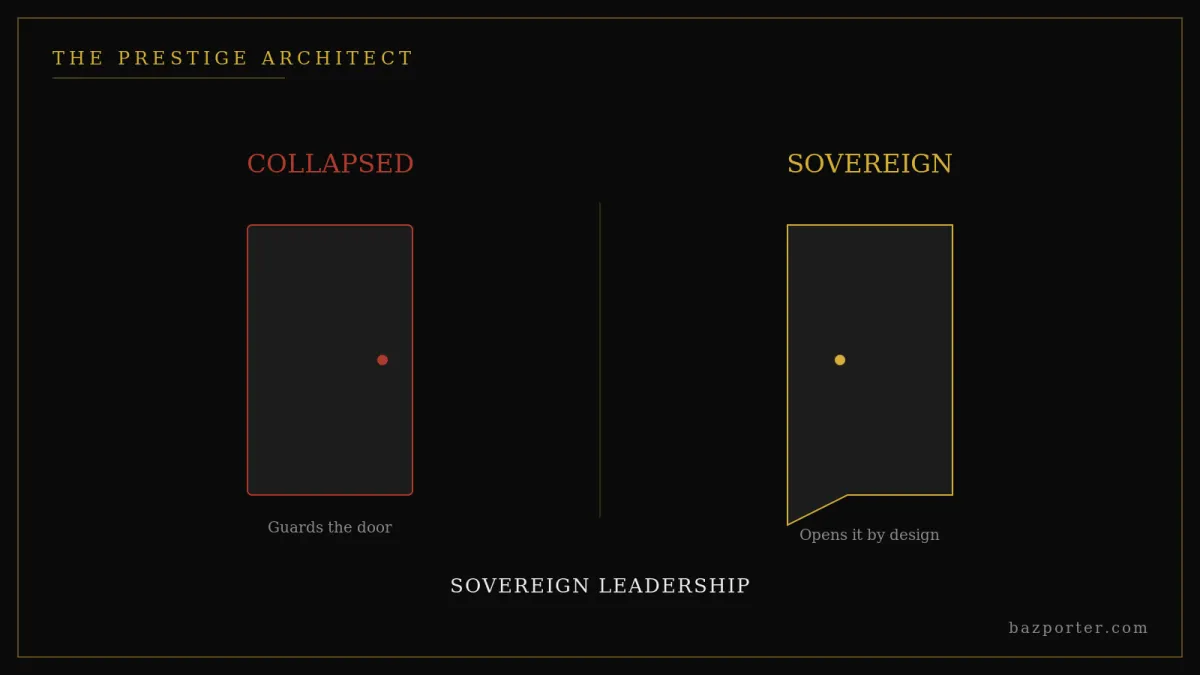
Collapsed vs Sovereign
The Collapsed LeaderThe Sovereign Leader Waits to feel calm, so never startsRegulates first, then speaks Buries the point in contextNames the issue in one sentence Reads silence as agreementReads silence as a signal to ask Absorbs the tension aloneShares the truth and the load Calls avoidance kindnessCalls candor respect
Baz Porter does not motivate. He does not inspire. He architects the return of the leader who went quiet inside her own company.
If your body tightens reading this, that is data. It means there is a conversation you already know you owe. The Silent Collapse Diagnostic™ is where we find it and name the cost. Sixty minutes, live with me.
A case from the room
A founder came to me carrying a co-lead she had outgrown. She had known for eight months. She had said nothing.
Every week the resentment grew. Every week her authority shrank. She told herself she was being loyal. She was self-silencing.
We did not rehearse a speech. We built her regulation first. Then we wrote one clean sentence and one real question.
She held the conversation in nine minutes. It was hard. It was also the first time in a year she felt like the owner of her own company.
Nothing about her had been damaged. A pattern had simply gone unnamed. Once named, it moved.
The architecture of your return
You do not need to become a harder person. You need a system that makes candor the default, not the exception.
That is what I build with the leaders I work with. We regulate the nervous system, install the script spine, and set the same-week rule. The avoided conversation stops being a monthly dread and becomes a weekly practice.
This is the work inside The Gravity Code™. It is for the leader ready to stop paying the silent tax and reclaim the room. Apply, and we will assess whether the standard is right for where you stand.
Power without collapse. Success without self-betrayal. That is the whole point of the return.
Questions leaders ask me
Why do I avoid difficult conversations even when I know I should not?
Because your body learned that conflict was a threat. Avoidance is a nervous-system reflex, not a character flaw. You change it by training regulation, not by trying harder.
What if the other person reacts badly?
They may. Your task is to stay regulated and clear, not to control their response. A steady leader can hold someone else's upset without taking it on.
How do I start a hard conversation without watering down the point?
Name the issue in one sentence. State the impact in one more. Ask one real question, then listen. Length is where clarity goes to die.
Is candor the same as being blunt or harsh?
No. Harshness discharges your discomfort onto another person. Candor delivers the truth with respect and a regulated body. One wounds; the other builds trust.
How often should these conversations happen?
Weekly, in small doses. Leaders who build a cadence report far less dread. The issues never grow large enough to threaten the team.
About the author
Baz Porter® is the founder of Baz Porter LLC® and The Prestige Architect®. A British Army veteran and international bestselling author, he guides high-achieving leaders from Silent Collapse™ to Sovereign Leadership™ through the Sovereign Leadership Architecture™. His work is a clinical, systems-level return to power without collapse.