Decision Fatigue Is a Silent Collapse Symptom, Not a Time Problem
Decision Fatigue Is a Silent Collapse Symptom, Not a Time Problem
You made two hundred decisions before lunch. None of them felt clear. By 4 p.m. you are choosing the path of least resistance on choices that used to be easy. This is not laziness. This is not a calendar issue. This is Silent Collapse™ wearing the mask of productivity. The nervous system that built your success is now rationing itself, and decision fatigue is the first warning light on the dash. I wrote The Manifesto for the leader reading this with a knot in their chest, because the symptom you are managing is not the problem you have.
Table of Contents
Key Takeaways
Decision fatigue is a regulation problem, not a willpower problem. The brain spends a finite metabolic budget on choice, and yours is overdrawn.
More decisions do not build more capability. Past a threshold, volume erodes judgment. Deloitte found nearly 70% of senior managers hit decision paralysis weekly.
The symptom is downstream of identity. When self-worth is fused to output, every small choice carries the weight of survival.
The fix is architectural. You do not need more discipline. You need fewer load-bearing decisions and a regulated system to carry them.
The Definitive Answer
Decision fatigue in leadership is the measurable decline in judgment quality after sustained choice-making, driven by a depleted nervous system rather than a packed schedule. For high performers it is an early signal of Silent Collapse™—the private erosion underneath visible success. The repair is not time management. It is rebuilding the internal architecture so the system stops paying survival prices for ordinary choices.
The Hidden Pattern Under Decision Fatigue
Every decision draws on the same metabolic account. Researchers call this the cost of cognitive control. When the account runs low, the brain defaults to the cheapest option: avoid, defer, or pick whatever ends the discomfort fastest. Korn Ferry research with business psychologists shows decision fatigue builds across the day and pushes leaders toward suboptimal, low-effort choices.
Now stack the load. Harvard Business Review reporting in 2025 found 85% of senior leaders facing an explosive rise in simultaneous transformation projects. The volume is real. But volume is not the root. The root is what the volume is hitting: a regulation system that has been running in deficit for years.
Think of it like a battery in a high-output device. The device still turns on. The screen still lights. But it dies by midday and you blame yourself for not charging it. The truth is the battery chemistry degraded under constant drain. That is your Sovereign Leadership™ capacity quietly losing its hold.
Why It Hides Behind Competence
Decision fatigue is invisible because competence masks it. You still deliver. You still close. So no one—including you—reads the numbness as a clinical signal. This is the cruelty of high-functioning decline: the better you perform, the longer the collapse stays hidden. The 60% of executives who report impaired judgment after prolonged decision sessions are not failing. They are succeeding past the point their system can sustain.
Decision fatigue is not a sign you are doing too much. It is a sign your system is paying a survival price for choices that should cost nothing.
The RAMS™ Reframe
The RAMS Framework™ reads decision fatigue across four pillars—Results, Attitude, Mastery, Systems. It treats the body and the business as one architecture. When one is dysregulated, both are compromised. Here is the map from the collapsed state to the sovereign one.
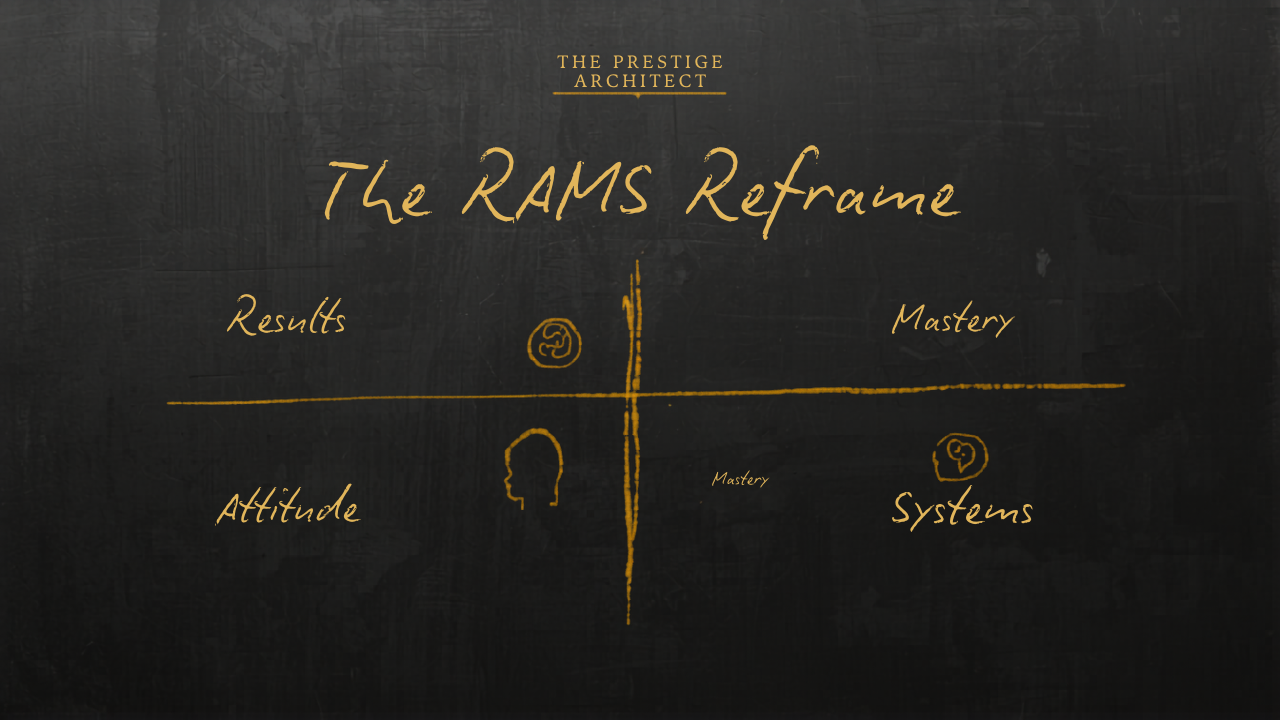
Collapsed state versus Sovereign Leadership™ across the four pillars:
Results — Collapsed: output proves worth. Sovereign: output expresses worth already held.
Attitude — Collapsed: "If I stop deciding, it falls apart." Sovereign: "The system holds when I step back."
Mastery — Collapsed: more decisions equal more control. Sovereign: fewer, cleaner decisions equal real control.
Systems — Collapsed: you are the load-bearing wall. Sovereign: the architecture carries the load.
Results: The Output-Identity Gap
Decision fatigue spikes hardest when results are fused to identity. Each choice stops being a task and becomes a referendum on whether you are enough.
The tell: small decisions feel disproportionately heavy.
The cost: the brain treats routine choices as threats.
Operational rule: separate the decision from the verdict on your worth before you make it.
Attitude: Where the Collapse Lives
Attitude is the internal operating system. The belief "if I stop, everything falls apart" keeps the nervous system in a low chronic alarm. That alarm is what drains the decision battery before the day begins.
The tell: you cannot delegate even what others handle well.
Command decision: name the false belief out loud, then test it with one delegated choice this week.
Mastery: Capability Over Volume
This is the contrarian core. More decisions do not equal more capability. Sovereign capability is the ability to make fewer, higher-leverage choices and let the rest fall away. Volume is the amateur's proxy for control.
The tell: your days are full of decisions only you "can" make.
Operational rule: each week, retire three recurring decisions into a standing rule.
Systems: The Architecture of the Return
Systems are where the repair becomes permanent. When the architecture carries the load, your nervous system stops being the single point of failure. This is the work of The Prestige Architect®—building the structure so the leader can step out of the wall and back into command.
If you recognize yourself in these pillars, start with the diagnostic. Take the Silent Collapse Diagnostic to see exactly where your architecture is leaking. For the wider library, the Sovereign Leadership Resource Hub maps each pillar in depth.
A Case Vignette
A founder running a mid-eight-figure company came to me certain the problem was her calendar. She had tried every productivity system. None held. We ignored the calendar. We audited her decision load instead. Forty-one recurring decisions ran through her alone each week. We moved twenty-nine into standing rules and a regulated weekly cadence. Within six weeks her judgment on the remaining twelve sharpened, and the 4 p.m. fog lifted. Nothing changed about her hours. Everything changed about her architecture.
The Architecture of Your Return
The return from decision fatigue is not a productivity hack. It is nervous-system sovereignty. You stop forcing a depleted system to behave like a full one. You rebuild the architecture so ordinary choices cost ordinary amounts. The science of cognitive depletion is clear that recovery is structural, not motivational. The leaders who reclaim their edge do not decide harder. They decide less, from a regulated state, inside a system that holds.
You do not need more willpower. You need fewer load-bearing decisions and an architecture strong enough to carry them.
When you are ready to rebuild that architecture deliberately, Apply to Work With Baz.
Frequently Asked Questions
Why do I feel mentally exhausted even when my workload is normal?
The exhaustion tracks decision load, not hours. If your self-worth is fused to output, your nervous system treats routine choices as threats and burns its budget early. The fatigue is real and it is a regulation signal, not a character flaw.
Is decision fatigue the same as burnout?
It is an early stage on the same line. Decision fatigue is the daily erosion of judgment. Left unaddressed inside a fused identity, it deepens into the wider private erosion I call Silent Collapse™. Catching it at the decision-fatigue stage is the easier repair.
Will better time management fix decision fatigue?
No. Time management organizes the symptom. It does not touch the cause, which is an under-regulated system carrying too many load-bearing decisions. The fix is architectural: fewer decisions through you, and a regulated state to make the rest from.
How do I know if this is Silent Collapse and not just a hard season?
A hard season ends and your clarity returns. Silent Collapse™ does not lift when the deadline passes, because it lives in the internal operating system, not the schedule. The diagnostic is the fastest way to tell the difference.
Can I rebuild capability without stepping back from my role?
Yes. The work is not retreat. It is redesigning where the load sits so you stop being the single point of failure. Most leaders find their authority grows once the architecture carries what their nervous system was carrying alone.
British military veteran. Two-time international bestselling author. Founder, The Prestige Architect®. Host, Rise From The Ashes podcast, C-Suite Network. Boulder, Colorado.