Decision Fatigue: Why More Choices Quietly Erode Your Capability
You make hundreds of calls a day. By evening, the easy ones feel impossible. You stand in the kitchen and cannot decide what to eat. This is not weakness. This is Silent Collapse™ wearing a competent face. The decisions still ship. The leader behind them is running on fumes. Most executives read this as a stamina problem. It is a capability problem. Before you reach for another productivity fix, Read The Manifesto.
Table of Contents
Key Takeaways
Decision fatigue is not exhaustion. It is the gap between the output you produce and the identity that has to hold it.
Volume is the symptom, not the cause. More choices do not build capability. They expose its missing architecture.
The nervous system decides before you do. When it dysregulates, judgment degrades while performance still looks intact.
Capability is structural. Sovereign leaders design fewer, cleaner decisions — they do not white-knuckle more of them.
The Definitive Answer
Decision fatigue at the top is the erosion of judgment that follows high decision volume without structural support. It is a leadership architecture failure, not a willpower failure. The fix is not more discipline. The fix is fewer decisions by design, anchored in a regulated nervous system.
The Hidden Pattern Beneath Decision Fatigue
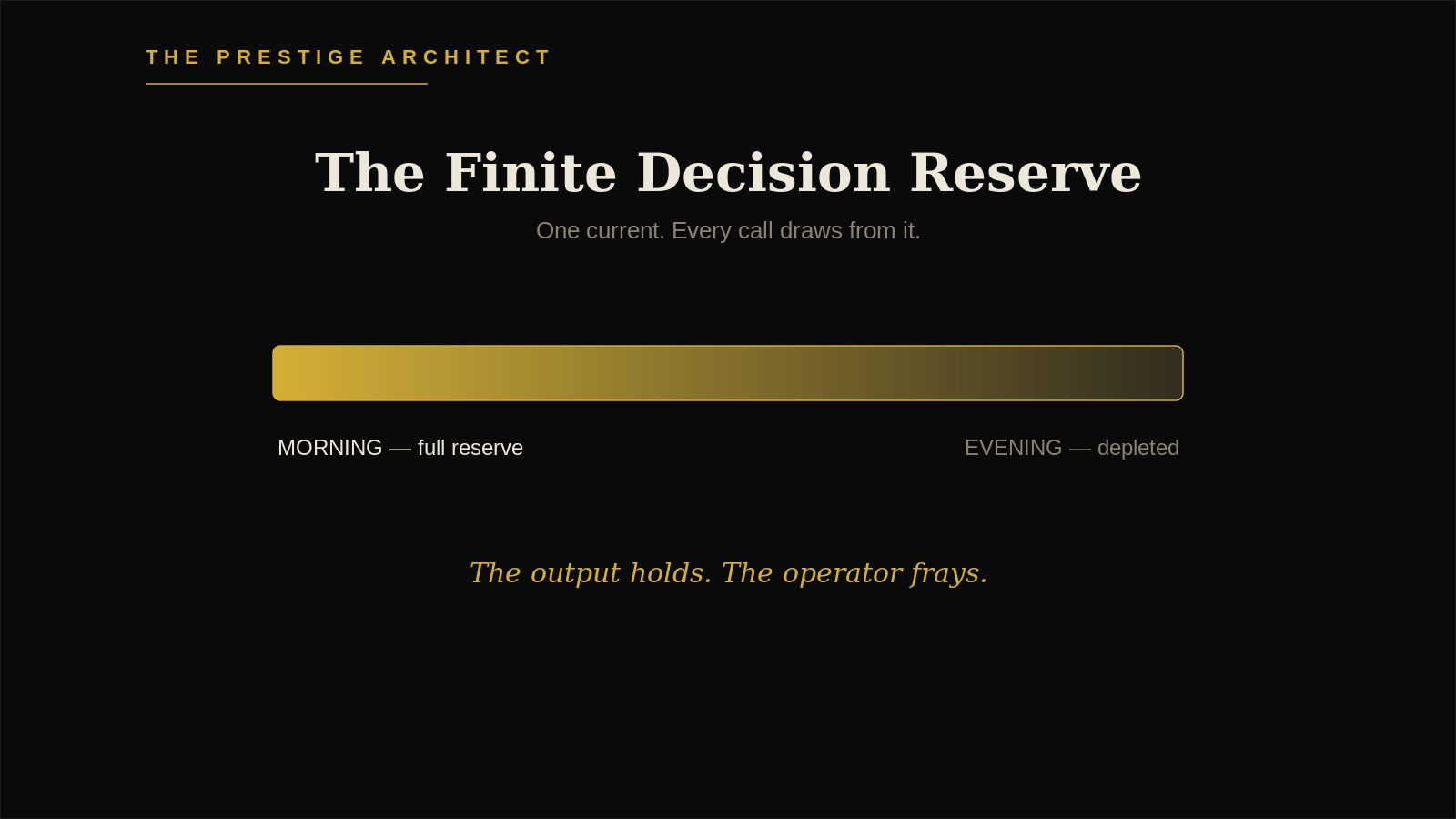
Every decision draws on the same finite reserve. Think of it as a current, not a switch. Each call pulls amperage from one line. By late afternoon the line dims. The lights still work. They run weaker than you notice.
Researchers documented this in a striking study of judicial rulings. Judges granted parole far more often early in the day than late, when their decision reserve had drained. The factor was time and depletion, not the merits of each case. You can read the study in the Proceedings of the National Academy of Sciences. The lesson lands hard for any leader: the order and volume of decisions shapes their quality as much as the facts.
The corporate version is louder now. A 2026 Gallup reading found 45% of US managers consistently exhausted. Harvard Business Review has long named the same trap — leaders treat every choice as equal and pay for it in degraded judgment. See the Harvard Business Review work on decision quality under load.
Here is what no dashboard shows. The output holds while the operator frays. This is the signature of Silent Collapse™ — the private erosion underneath public competence. You are not losing the ability to decide. You are losing the regulated state that makes deciding cost less. That is a structural problem, and structure is solvable. Start with the diagnosis, not the pep talk — Read The Manifesto.
The RAMS™ Reframe: Capability Is Architecture
I do not treat decision fatigue with time-management. I rebuild the system that holds the leader. The RAMS Framework™ runs on five pillars: Results, Attitude, Authenticity, Mastery, and Systems. It operates at the level of the nervous system and the business at once. The body and the company run on the same architecture. When one dysregulates, both pay.
Results — The Output and Identity Gap
Decision fatigue is the felt gap between what you produce and who you have to be to sustain it. The numbers rise. The person behind them empties.
The trap: you measure capability by decision volume.
The truth: volume past a threshold lowers quality.
Operational rule: if your output climbs while your recovery vanishes, the result is borrowed, not earned.
Attitude — Where the Collapse Lives
Attitude is the internal operating system. This is where collapse takes root first. The story underneath sounds like this: "If I stop deciding, everything falls apart." That belief keeps the line overloaded.
Decision fatigue is not the price of leadership. It is the evidence your capability is running without architecture.
Authenticity — The Private and Public Divide
The performed self decides with confidence. The lived self runs on empty. That divide is the engine of Silent Collapse™. Closing it is not vulnerability theater. It is restoring one honest signal between what you show and what you carry.
Mastery — Skill Versus Sovereign Capability
Skill is the ability to make a hard call. Sovereign capability is the ability to make it from a regulated state — and to design a system that needs fewer hard calls. Most leaders stack more skill onto a depleted operator. That is addition where the answer is architecture.
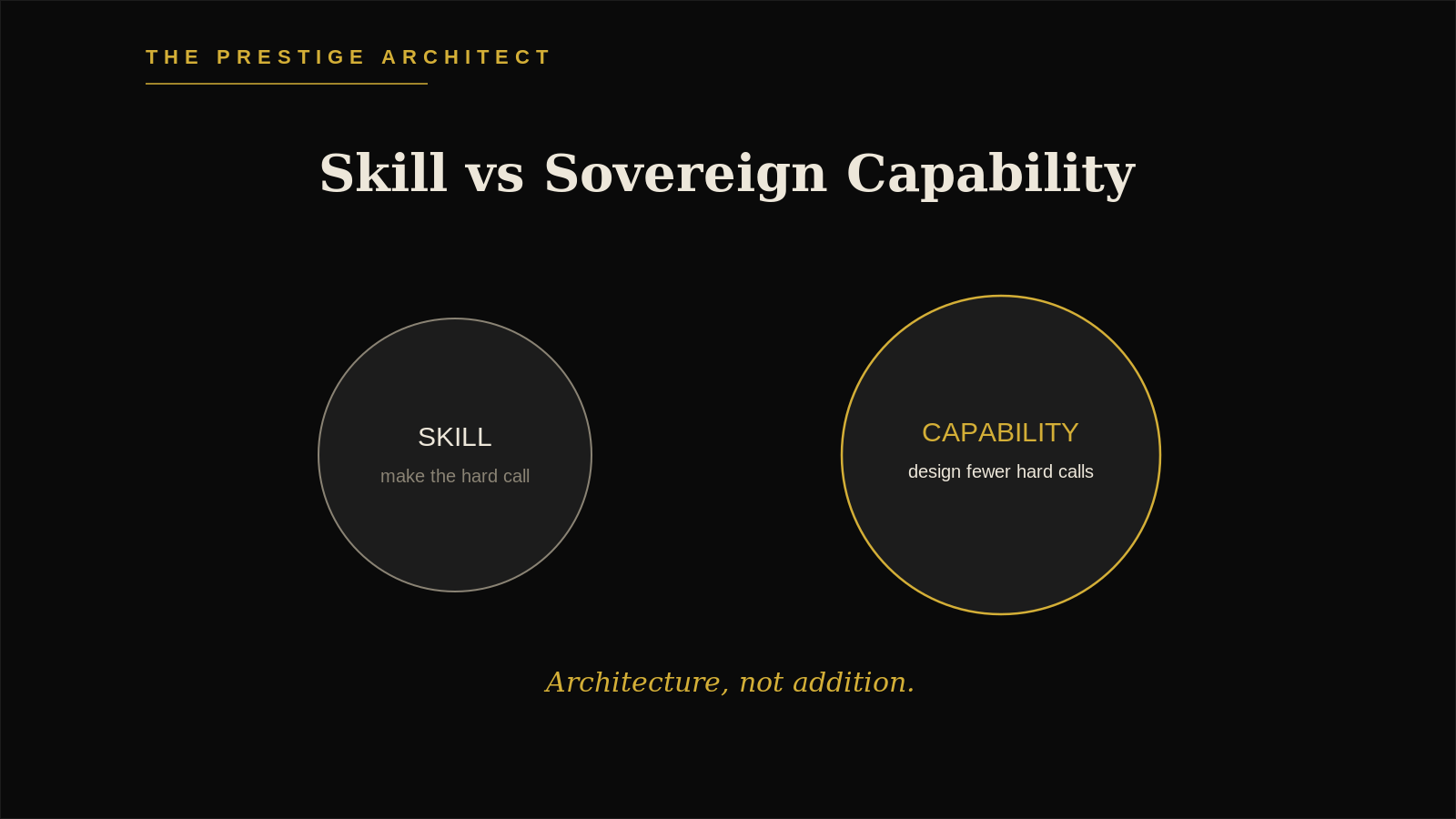
Command decision: stop raising your decision count. Start lowering it by design.
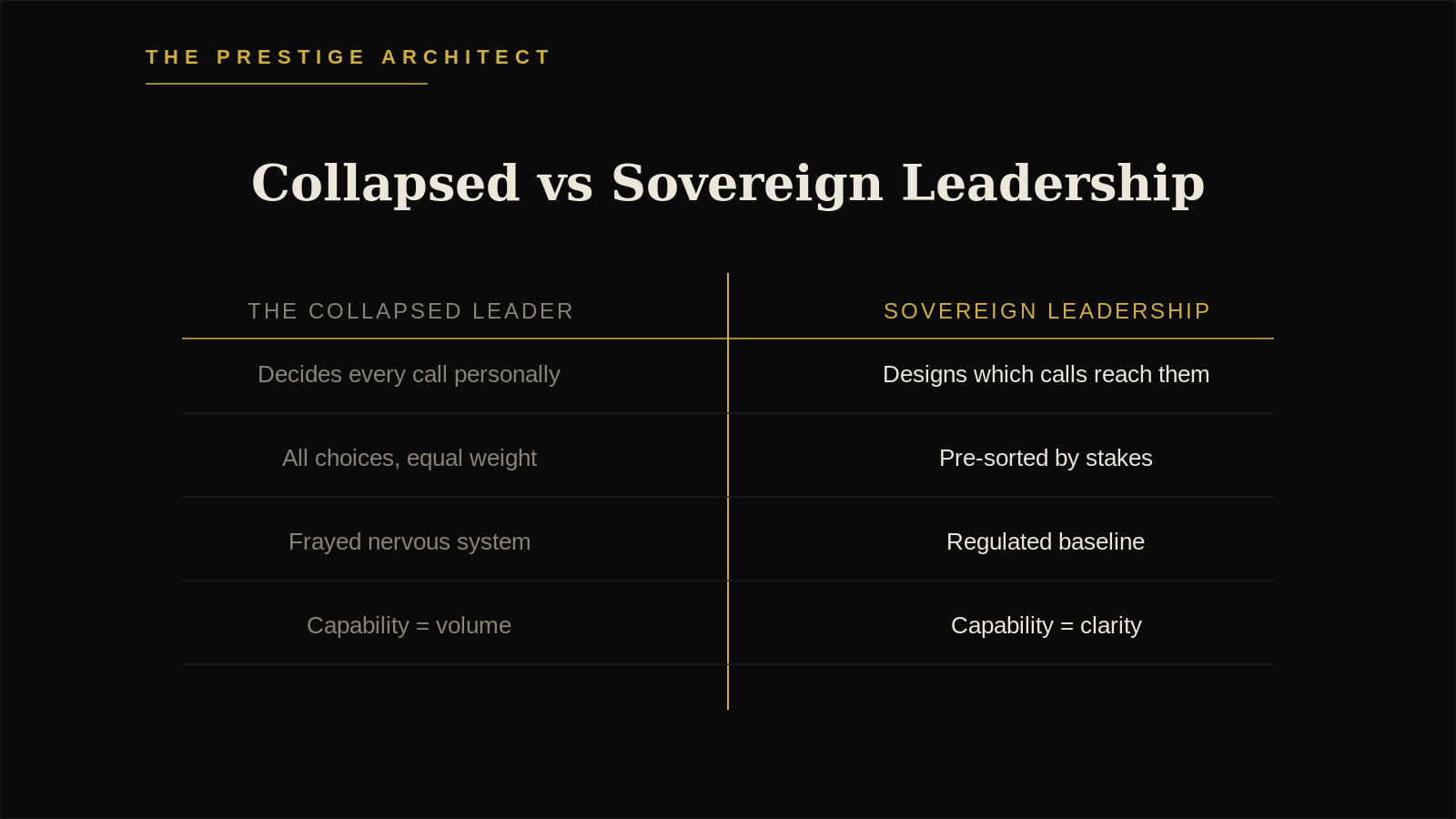
Collapsed leader vs Sovereign Leadership™:
Decisions: makes every call personally → designs which decisions reach them
Sorting: all choices carry equal weight → pre-sorted by stakes and reversibility
State: decides from a frayed nervous system → decides from a regulated baseline
Metric: capability measured by volume → capability measured by clarity
Recovery: collapses on weekends → recovers inside the architecture daily
If you recognize the left side, name it precisely. Take the Silent Collapse Diagnostic and see where your capability is leaking.
Systems — The Architecture of the Return
Systems convert insight into a structure that holds without you. This is the pillar that ends decision fatigue for real.
Decision tiers: route low-stakes calls away from you entirely.
Reversibility filter: decide reversible calls fast, irreversible calls rested.
Regulation first: protect the nervous-system baseline that all judgment draws on.
For the wider map of this work, visit the Sovereign Leadership Resource Hub.
A Case of Quiet Return
One founder ran a nine-figure operation and froze over a dinner order by 7pm. We did not add discipline. We rebuilt the system. We tiered the decisions. We routed 60% off the founder's desk. We anchored each morning in nervous-system regulation before the first call. Inside eight weeks, decision volume fell by half and decision quality rose. The output did not drop. The operator came back online.
The Architecture of Your Return
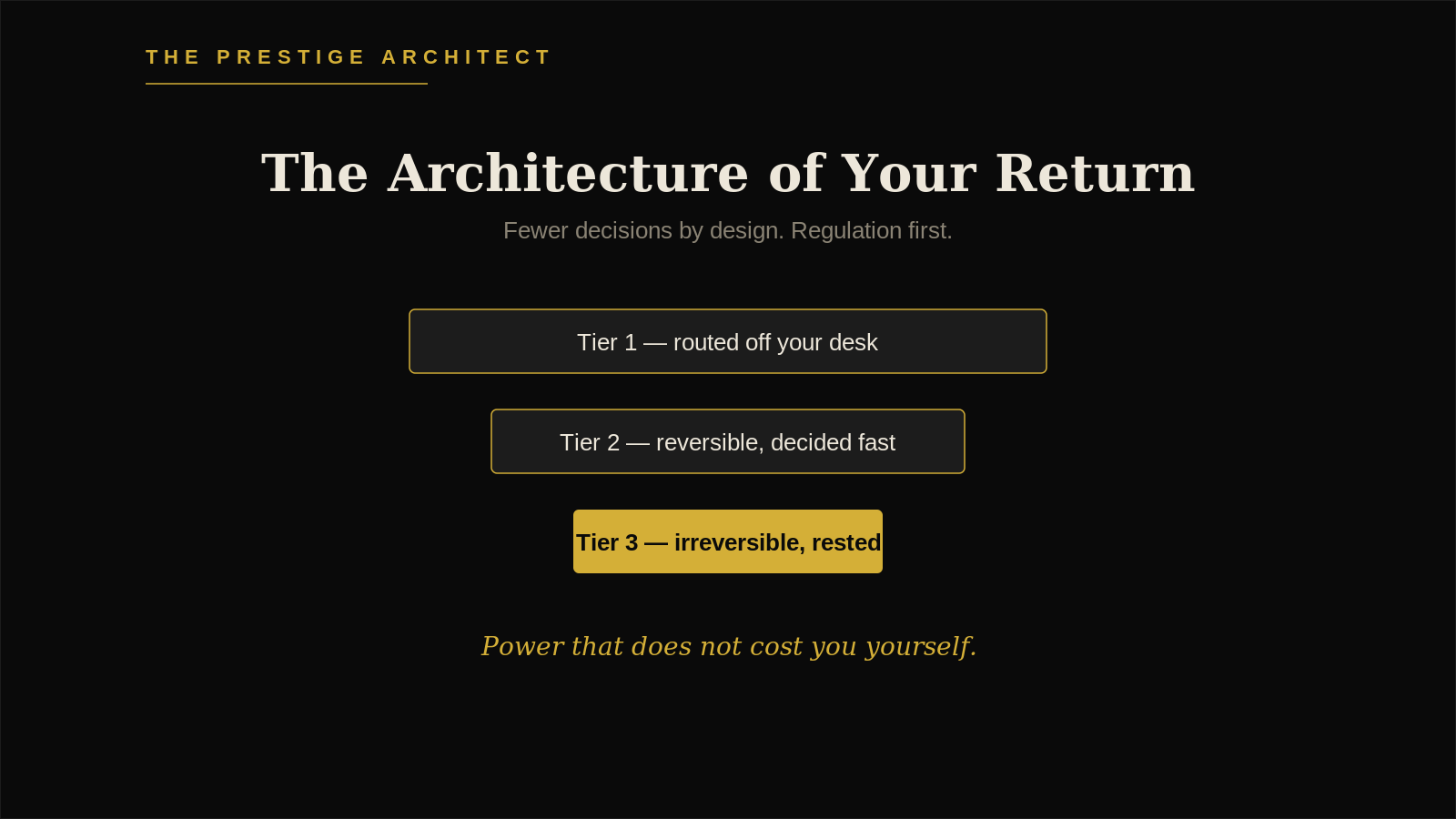
You do not return by deciding harder. You return by building the structure that makes most decisions unnecessary and the rest cheap. That is nervous-system sovereignty — judgment that runs from a regulated baseline, not a drained one. Sovereign Leadership™ is power that does not cost you yourself.
This is the work of The Prestige Architect®. Not another tactic on a tired operator. A rebuild of the system underneath the leader. When you are ready for that level of work, Apply to Work With Baz.
Frequently Asked Questions
Is decision fatigue the same as burnout?
No. Decision fatigue is a specific erosion of judgment under high choice volume. Burnout is broader exhaustion and detachment. Decision fatigue is often an early signal that the leadership architecture is failing before full collapse arrives.
Why do I feel sharp at work but useless at home by evening?
You spend your decision reserve on high-stakes calls during the day. The reserve is finite. By evening the low-stakes choices meet an empty tank. The pattern is normal physiology, and it is a sign your decision load needs structural redesign.
Does more discipline fix decision fatigue?
No. Discipline adds load to an already depleted operator. The durable fix lowers decision volume by design and protects the nervous-system baseline that judgment draws on. Architecture beats willpower here every time.
How do I know if this is Silent Collapse and not normal stress?
Normal stress eases with rest. Silent Collapse persists while your output stays high and your inner state empties. If you perform well and feel nothing, that gap is the marker. The Silent Collapse Diagnostic names it precisely.
About the Author
British military veteran. Two-time international bestselling author. Founder, The Prestige Architect®. Host, Rise From The Ashes podcast, C-Suite Network. Boulder, Colorado.