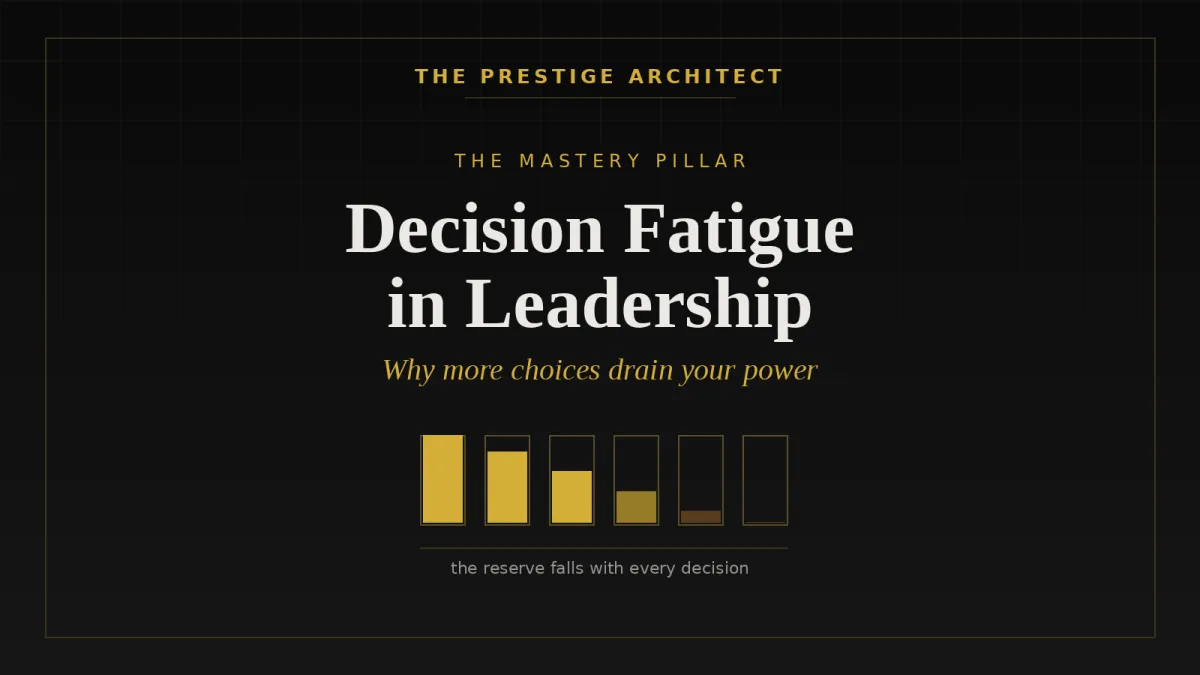
Decision Fatigue Leadership: Why More Choices Drain Your Power
You made forty decisions before your first coffee. By 3 p.m. your mind feels full. You say yes when you mean no. You stall on the call you should have made. This is not weakness. This is decision fatigue — and in leadership it wears a quiet mask. You still perform. You still deliver. Inside, the operator running the choices is running dry. That gap between visible output and inner depletion is the first signal of Silent Collapse™. Read The Manifesto before you read another productivity hack.
Table of Contents
The Hidden Pattern: Why Capable Leaders Default to the Safe Choice
A Short Return: The Operator Who Stopped Deciding Everything
Key Takeaways
Decision fatigue is a nervous-system event, not a character flaw. The quality of your choices falls as your reserve drains, regardless of how smart you are.
More decisions do not build capability. They tax the operator. Volume of choice is the tax; sovereignty is the structure that removes it.
The default under depletion is the safe, familiar option. Leaders deny, defer, and delay — and call it prudence.
The fix is architectural, not motivational. You design the system that decides for you so your reserve is spent only where it matters.
What Decision Fatigue in Leadership Really Is
Decision fatigue in leadership is the measurable decline in judgment that follows repeated choices, trade-offs, and self-regulation. Each decision draws from a finite reserve. As the reserve falls, thinking slows, impulse control weakens, and the need for certainty rises. You do not feel tired in the usual sense. You feel rigid. You reach for the option that asks the least of you. The problem is not the number of decisions. The problem is the absence of an architecture that protects the operator making them.
The Hidden Pattern: Why Capable Leaders Default to the Safe Choice
A landmark 2011 study in the Proceedings of the National Academy of Sciences tracked 1,112 parole rulings by experienced judges. Favorable decisions started near 65% after a food break and fell toward zero before the next one. Same judges. Same law. Different reserve. The depleted mind reverts to the status-quo answer — deny, defer, delay (Danziger et al., PNAS, 2011).
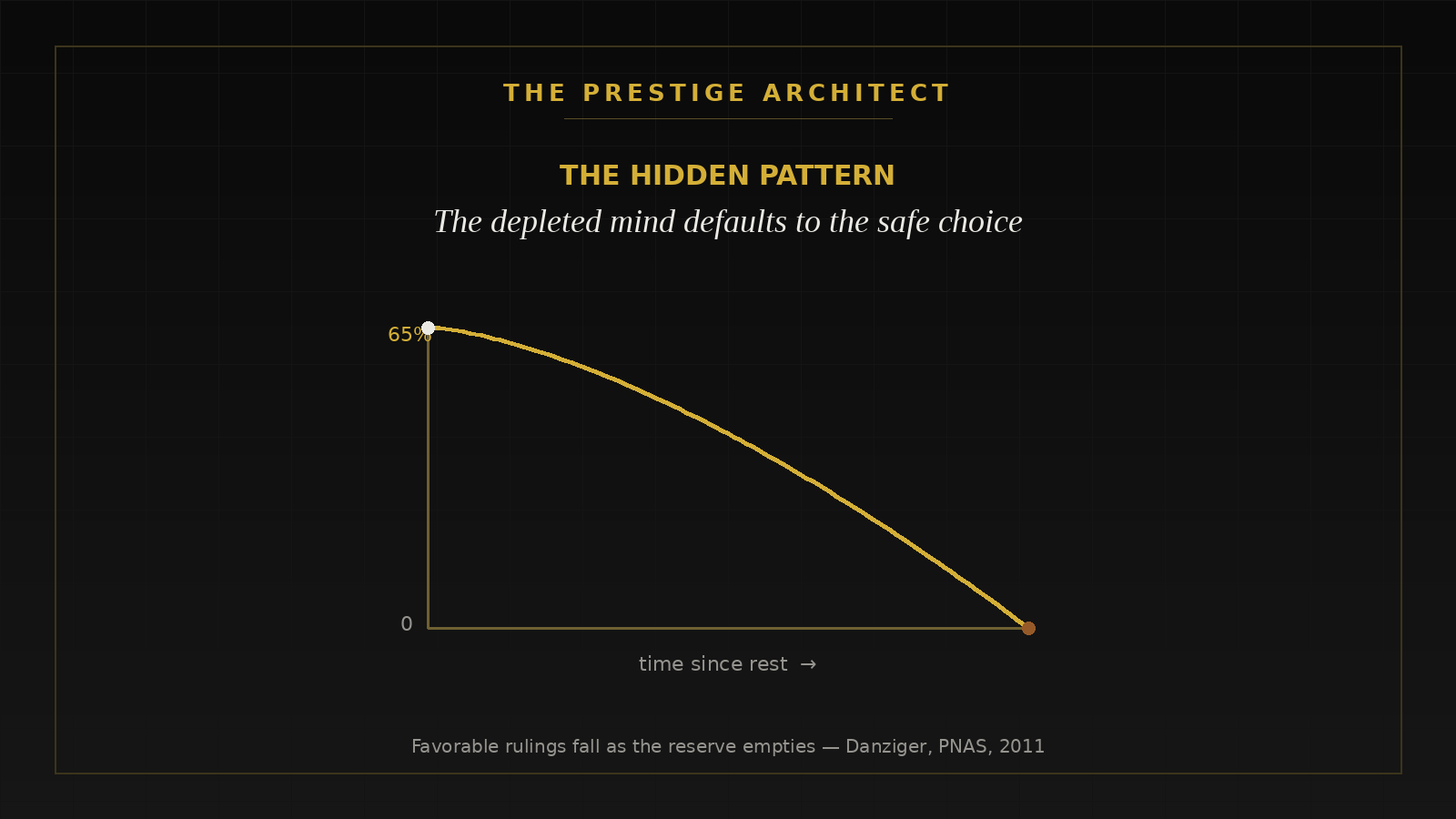
Read that as a leadership diagnosis. Under depletion, the brain conserves energy by choosing the familiar. The executive who "needs to think about it" is often not being careful. The reserve is empty. Harvard Business Review frames the same dynamic: judgment quality degrades as low-value choices consume the bandwidth high-value choices require (Harvard Business Review, Decision Making).
This is the mechanism beneath Silent Collapse™. The output holds. The capacity behind it erodes. No one sees it because nothing breaks in public. For the deeper map of that gap, the Sovereign Leadership Resource Hub holds the full body of work.
The RAMS Framework Reframe
The RAMS Framework™ reads decision fatigue at two levels at once: the business and the nervous system. The body and the business run on the same architecture. When one is depleted, both are compromised. Five pillars — Results, Attitude, Authenticity, Mastery, Systems.
Collapsed leader vs Sovereign Leadership™ — the five pillars:
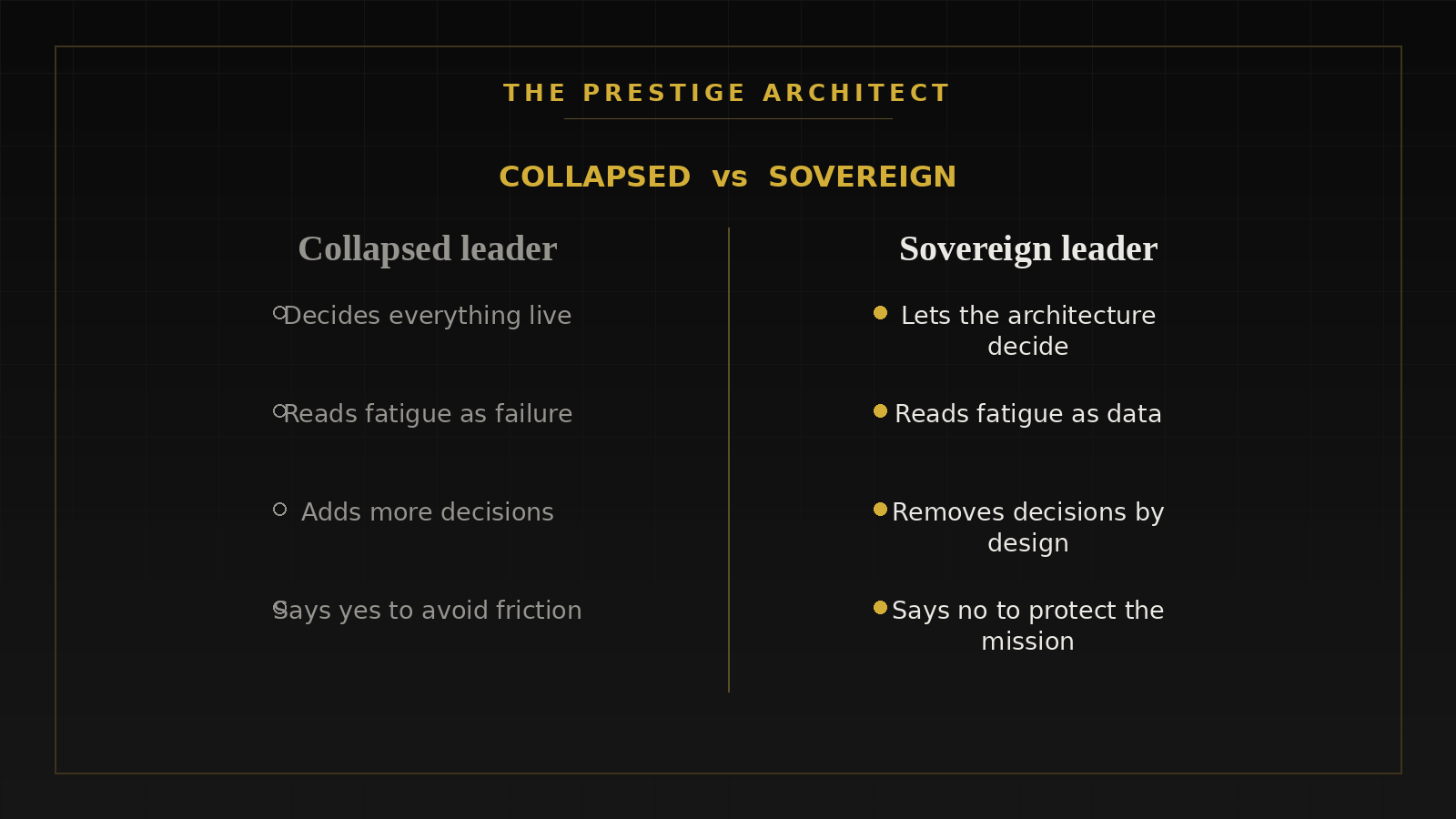
Results: Collapsed measures output and ignores the operator. Sovereign protects the reserve that produces output.
Attitude: Collapsed reads fatigue as failure. Sovereign reads fatigue as data.
Authenticity: Collapsed says yes to avoid friction. Sovereign says no to protect the mission.
Mastery: Collapsed adds more decisions. Sovereign removes decisions by design.
Systems: Collapsed decides everything live. Sovereign lets the architecture decide.
Results — Output vs Capability
Output is what the organization sees. Capability is what produces it. Decision fatigue widens the gap between the two. You hit the number while the engine behind the number wears thin. Operational rule: never confuse a delivered result with a sustainable one.
Attitude — Where the Collapse Lives
Attitude is the internal operating system. Under depletion, it whispers one line: "If I stop, everything falls apart." So you do not stop. You decide more, not less. The reserve drops further. Command decision: treat fatigue as a readout, not a referendum on your worth.
Authenticity — The Yes That Means No
Decision fatigue corrupts your honesty. You agree to the meeting, the favor, the project — because no asks more energy than yes. Each false yes is a withdrawal. The private cost compounds while the public face stays composed. That divide between the performed self and the lived one is the quiet driver of Silent Collapse™.
Mastery — Skill vs Sovereign Capability
Skill answers more questions. Sovereign capability removes the questions that should never reach you. The depleted leader proves competence by deciding everything. The sovereign leader proves it by deciding almost nothing — and only the decisions that matter.
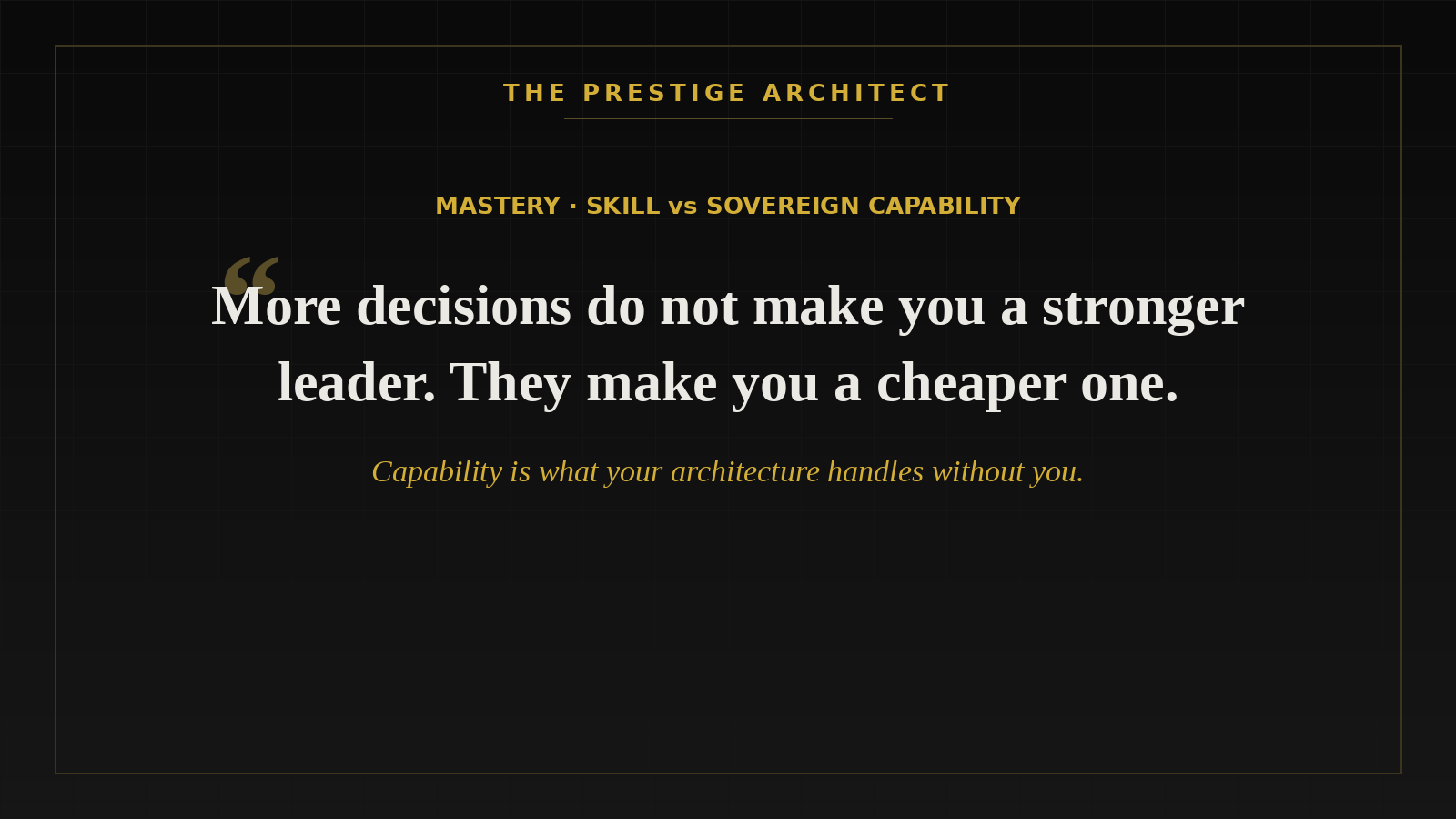
More decisions do not make you a stronger leader. They make you a cheaper one. Capability is measured by what your architecture handles without you.
If your reserve is already spent by mid-morning, name it. Take the Silent Collapse Diagnostic and see the pattern in plain terms.
Systems — The Architecture That Decides For You
Systems is the pillar that ends the tax. You design the rules, defaults, and boundaries that resolve low-value choices before they reach you. Research on cognitive load is direct: leaders think better when low-stakes decisions are removed, not endured. The same exhaustion that follows occupational burnout measurably reduces executive function — and recovers when the load is restructured (Occupational burnout and executive function, PubMed).
A Short Return: The Operator Who Stopped Deciding Everything
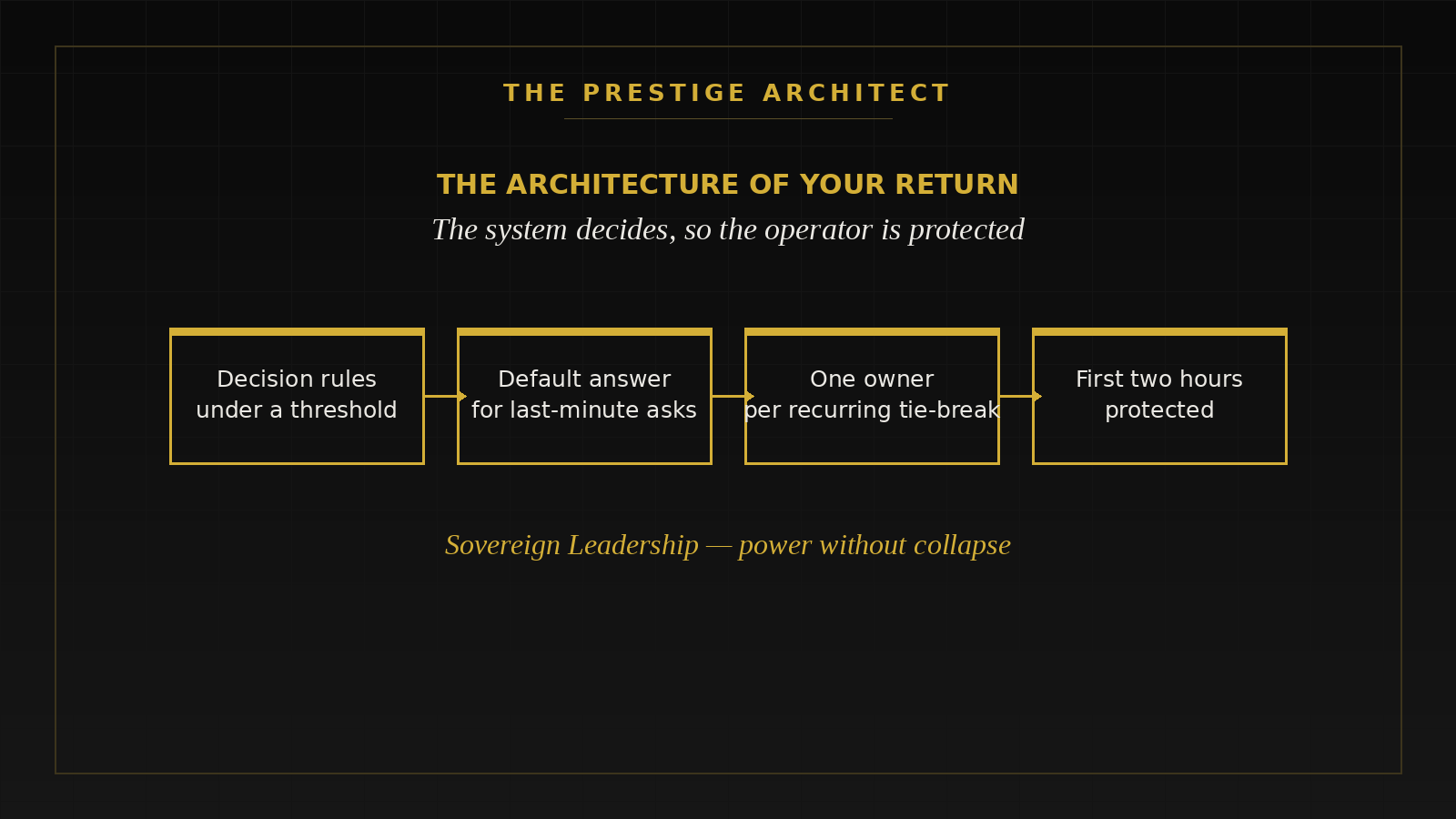
A chief operating officer came in deciding roughly two hundred things a day. Pricing exceptions. Calendar conflicts. Hiring tie-breakers. By evening, she had nothing left for her family or herself. We did not add discipline. We built architecture. Decision rules for anything under a set dollar threshold. A default answer for last-minute asks. One owner for each recurring tie-break. Within six weeks her live decisions fell by two-thirds. Her judgment on the decisions that remained sharpened. The return was not a feeling. It was a system.
The Architecture of Your Return
The return is not a motivational reset. It is nervous-system sovereignty — built, not summoned. You stop treating your reserve as infinite and start treating it as an asset to be governed. You move every low-value decision out of your hands and into a rule. You protect the first two hours of the day for the choices only you can make. You let the architecture absorb the rest.
This is the work of Sovereign Leadership™: power without collapse, success without self-betrayal. The leader is rebuilt before the strategy. That is the standard The Prestige Architect® holds. When you are ready to build the architecture that protects the operator, Apply to Work With Baz.
Frequently Asked Questions
How do I know if I have decision fatigue or something more serious?
Decision fatigue tracks the day. It worsens with each choice and eases after rest. If the emptiness, numbness, or dread persists for weeks regardless of rest, that points beyond fatigue toward high-functioning depression, and a clinician is the right next step.
Why do I feel rigid and reactive by the afternoon?
Your reserve is spent. The depleted mind conserves energy by defaulting to the familiar, safe option. Rigidity is not your personality hardening. It is your nervous system rationing what is left.
Will making fewer decisions make me look less capable?
The opposite. Capability is measured by what your architecture handles without you. Removing low-value decisions frees your judgment for the few choices that move the mission.
Is decision fatigue a willpower problem I can push through?
No. Pushing through spends more of the same reserve you are trying to protect. The resolution is structural — rules, defaults, and boundaries that decide for you — not more force.
Where does decision fatigue connect to Silent Collapse?
It is the entry point. The output holds in public while the operator drains in private. That gap, sustained over months, is the architecture of Silent Collapse™.
British military veteran. Two-time international bestselling author. Founder, The Prestige Architect®. Host, Rise From The Ashes podcast, C-Suite Network. Boulder, Colorado.