Decision Fatigue Isn't Overwork: A Missing Architecture
Decision Fatigue Isn't Overwork — It's a Missing Architecture
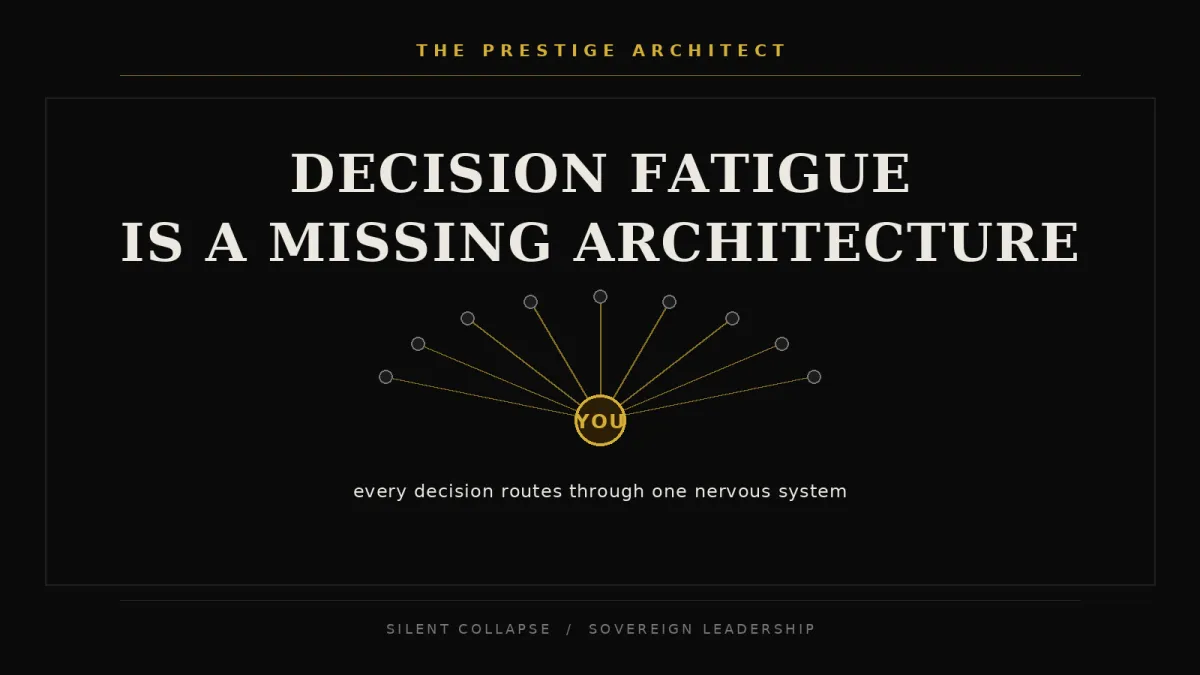
By 4 p.m. you cannot choose what to eat, yet your team still needs three answers before they leave. You are not tired. You are depleted at the level where judgment lives. This is the Silent Collapse™ hiding inside executive decision fatigue. The problem is not the volume of decisions. It is that every one of them routes through you. A leader who must decide everything is not powerful. They are the single point of failure. If that landed, start with the architecture, not the advice. Read The Manifesto.
Table of Contents
Key Takeaways
Decision fatigue is an architecture failure, not a willpower failure. You ran out of capacity because the system has no other place for decisions to go.
Executives spend close to 40% of their time deciding — and most of it is judged time poorly spent. The cost compounds quietly.
More decisions is not more capability. The leader who decides everything has built a company that cannot function without their nervous system.
The fix is structural. You build decision rights and thresholds so the org decides without routing every call to you.
The Definitive Answer
Executive decision fatigue is not caused by working too hard. It is caused by a missing decision architecture. When every choice funnels to one person, that person's judgment depletes by mid-afternoon. The fix is to build the structure that decides without you — on purpose, before the depletion forces a bad call.
The Hidden Pattern: Why Your Judgment Runs Out
Decision-making is metabolic. It draws on a finite resource. Spend it on forty small calls before noon and the large call at 4 p.m. gets a depleted brain. This is not weakness. It is biology. McKinsey research found executives spend nearly 40% of their time making decisions, and over half of that time is thought to be used ineffectively — an inefficiency that costs a typical Fortune 500 company roughly $250 million a year in wasted wages.
Here is the metaphor. Your judgment is a power grid. Every decision draws current. With no circuits, no load sharing, no other substations, the whole grid runs through one transformer — you. It holds for years. Then one hot afternoon the transformer overloads, and the lights go out across the company. That blackout is Silent Collapse™ wearing a competence mask.
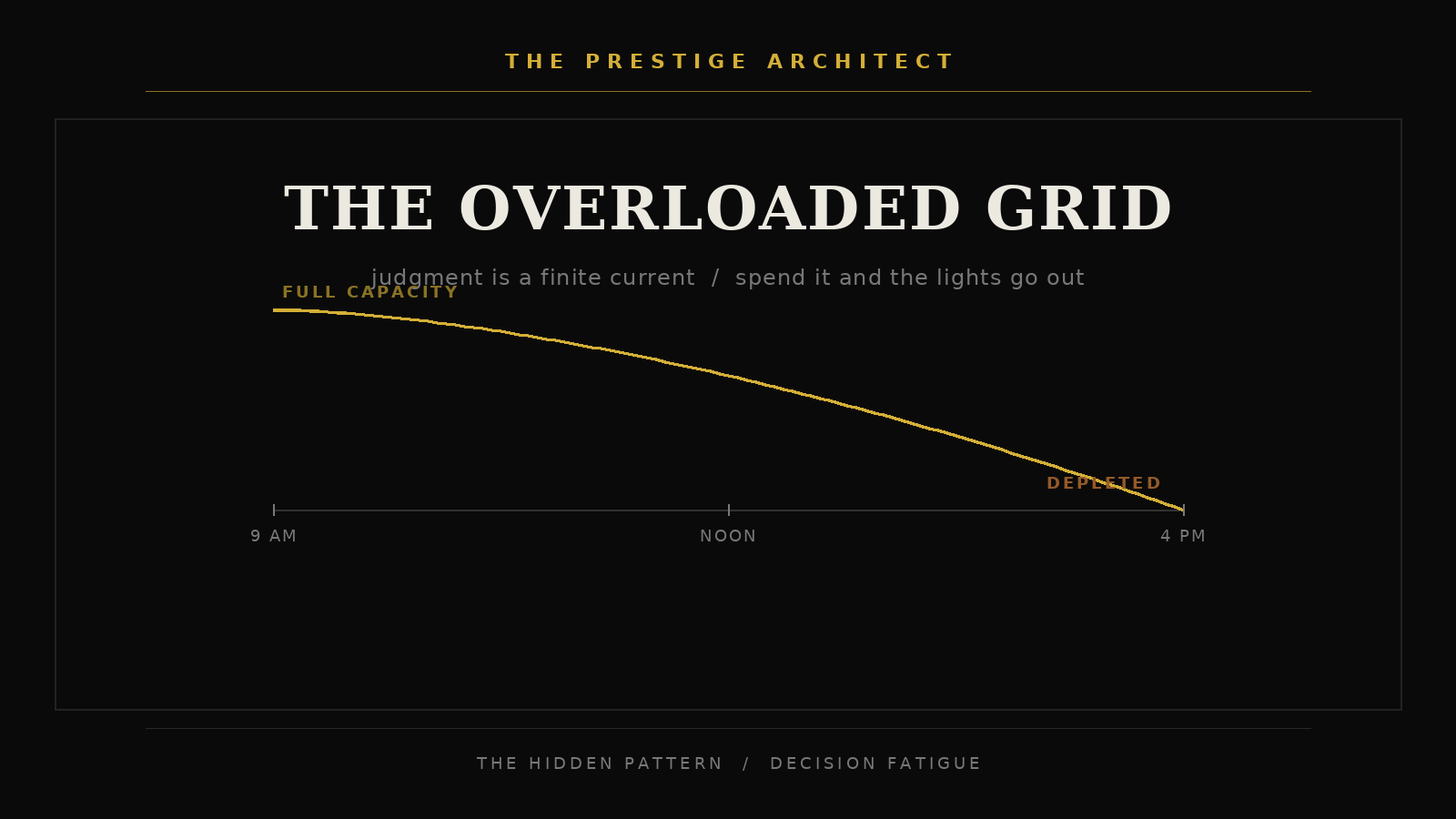
The body does not separate a trivial decision from a critical one once they all land on the same nervous system. The font on the deck and the layoff both pull current from the same grid. This is why a brilliant leader makes a reckless call at the end of the day. The grid is empty. The capacity is gone. If you want the deeper map of how this overload forms, start at the Sovereign Leadership Resource Hub.
The RAMS™ Reframe: Decisions as a System
I do not tell people to "prioritize better." I rebuild the architecture underneath the overload. The RAMS Framework™ — Results, Attitude, Authenticity, Mastery, Systems — works on the leader before the strategy. Decision fatigue runs all five pillars. Walk them in order.
Results: The Output–Identity Gap
You came to measure worth by how many calls you make. Being the decider felt like being indispensable. So delegating a decision feels like shrinking. That gap between output and identity is the wound under the overload.
The trap: "If I am not deciding it, I am not leading."
The rebuild: leadership becomes designing who decides, not deciding everything.
Operational rule: measure yourself by the decisions that resolve correctly without you, not the ones that wait for you.
Attitude: Where the Collapse Lives
Attitude is the internal operating system. The belief running under the overload is simple: "If I don't decide it, it goes wrong." That belief feels like responsibility. It is actually a cage. Name it, and the grip loosens.
A leader who must decide everything is not powerful. They are the single point of failure their company cannot afford.
Authenticity: The Competent Mask
In the room, you are decisive. Fast. Certain. In private, you are running on fumes by lunch and dreading the next question. That divide between the performed competence and the lived depletion is the engine of Silent Collapse™. Close it, and you stop performing a capacity you no longer have.
Command decision: tell your second-in-command which decisions you are done owning. The mask survives in silence.
Mastery: Deciding Less Is the Higher Skill
You are a master decider. That is the problem. Making every call is a skill. Building a system that decides without you is a higher capability you were never trained in. Sovereign Leadership™ is the capacity to lead through structure, not through constant judgment.
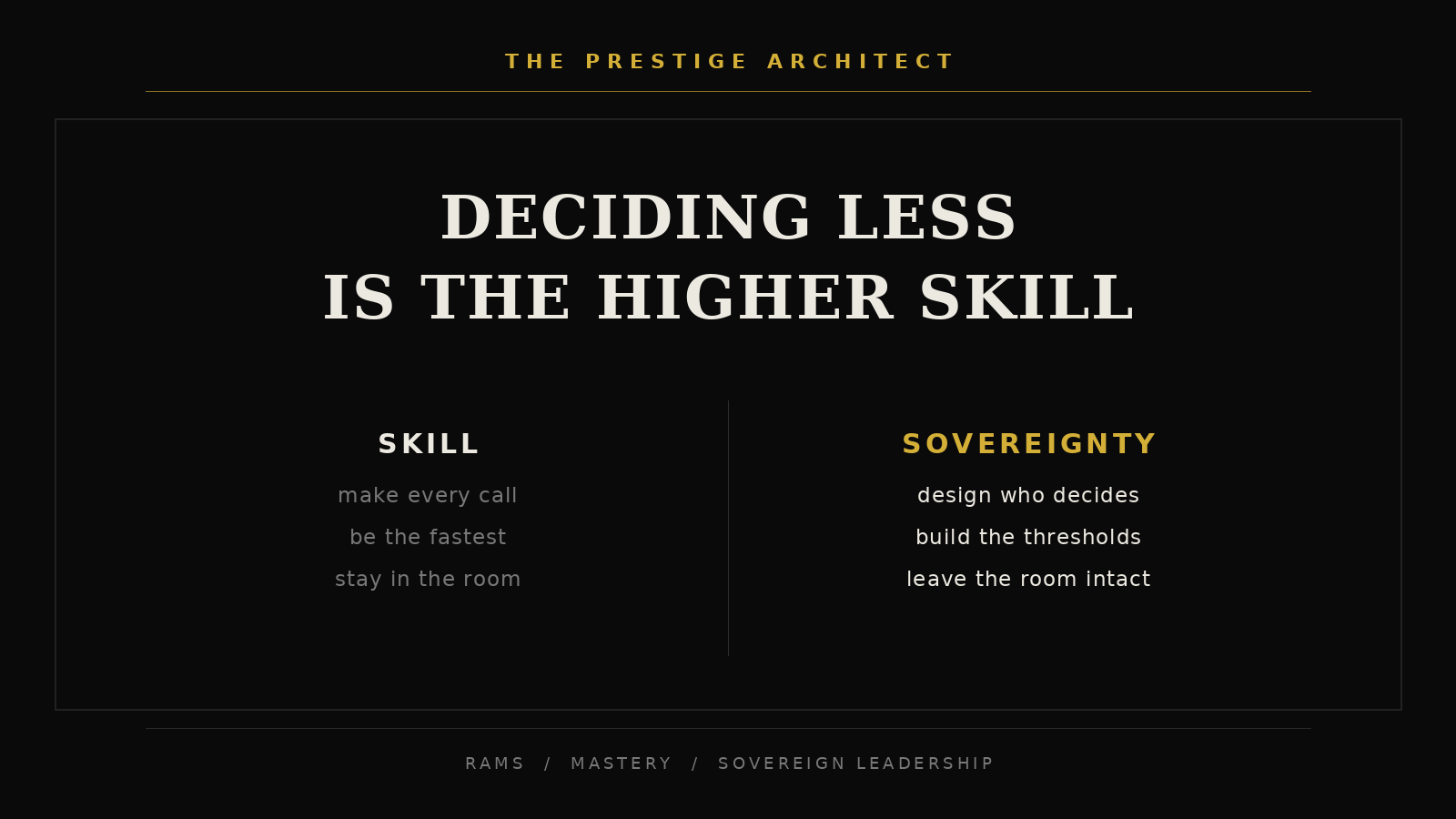
Skill: making the right call faster than anyone.
Sovereignty: designing the rules so the right call gets made without you in the room.
Systems: The Decision Architecture
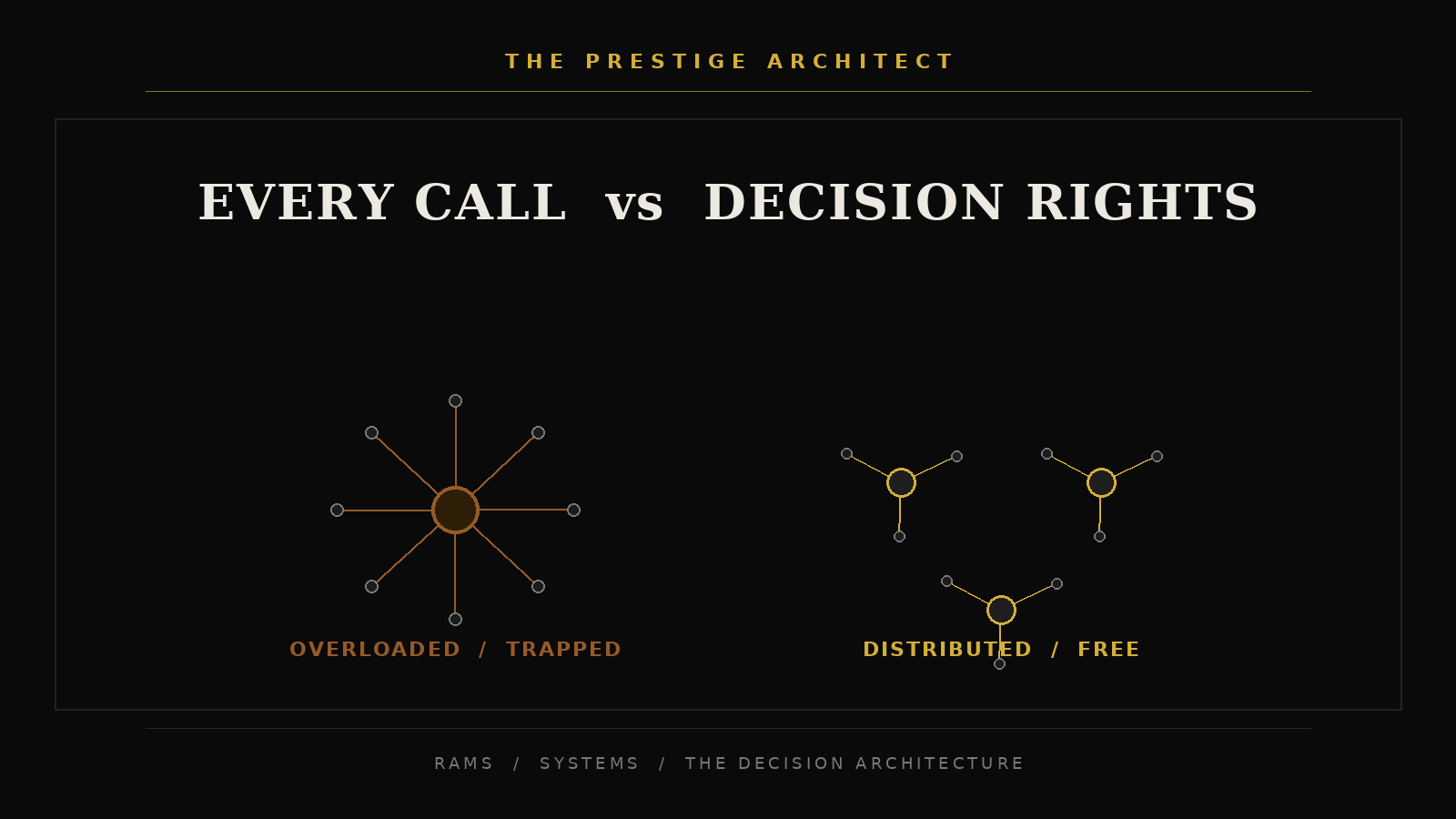
This is where the overload ends. A decision architecture defines who owns which call, at what threshold, with what guardrails. Harvard Business Review frames the failure precisely: most companies get decision rights wrong, so authority and ownership blur, and everything escalates back to the top. Fix the rights, and the grid gets its circuits.
The Overloaded LeaderSovereign Leadership™ Every call routes to one personDecision rights distributed by threshold Worth measured in volume of callsWorth measured in calls resolved without them Judgment depleted by mid-afternoonJudgment reserved for the few calls that need it "If I don't decide it, it goes wrong"The system is built so it goes right Indispensable and trappedRemovable and free
If you recognize the left column, that is the most useful thing you will read today. Naming the pattern is the first structural move. Get the precise read on your own architecture here: Take the Silent Collapse Diagnostic.
A Case Vignette: The Leader Every Call Routed To
A founder I worked with answered forty Slack pings a day, each one a decision someone else should have owned. They thought it was loyalty. It was a design flaw. We did not teach them to say no faster. We built thresholds — spend under this amount, hire below this level, refund inside this window, decide it yourself. We named the owner for each class of call. Within three weeks the pings dropped by two-thirds. The decisions still got made. They just stopped landing on one nervous system.
The Architecture of Your Return
Ending decision fatigue is not an act of discipline. It is an act of engineering. You do not push through with more willpower, because willpower is the exact resource that depletes. You build the structure that spends less of it. That means defining decision rights on paper. It means setting the thresholds below which no call reaches you. It means training your body to read a delegated decision as safety, not risk. This is nervous-system sovereignty, not productivity advice. It is the difference between a leader who burns out at the top and one whose capacity is reserved for the few calls only they can make. When you are ready to build that architecture with the precision it deserves, Apply to Work With Baz.
Frequently Asked Questions
Why do I lose the ability to make good decisions by the end of the day?
Because decision-making draws on a finite resource. Spend it on dozens of small calls and the important call at 4 p.m. meets a depleted brain. The fix is not more rest. It is fewer decisions routed to you in the first place.
Is decision fatigue a sign I am not cut out to lead?
No. It is a sign your company has no decision architecture. You became the single circuit every call runs through. That is a design flaw, not a character flaw, and it is fixable with structure.
How do I know if this is Silent Collapse and not normal busyness?
Normal busyness eases when the week eases. Silent Collapse™ gets heavier the more capable you appear. If you are decisive in the room and depleted in private, you are looking at an architecture problem, not a workload problem.
What is the first move if every decision routes to me?
Stop trying to decide faster. Build the structure that decides without you. Define decision rights by class of call. Set thresholds below which nothing reaches you. Name the owner for each. Put it on paper, in detail.
Won't delegating decisions mean things get done wrong?
Only without thresholds and guardrails. With them, the right call gets made without you in the room. That is the whole work of Sovereign Leadership™: leading through architecture, so the company runs right when your hand is off the grid.
British military veteran. Two-time international bestselling author. Founder, The Prestige Architect®. Host, Rise From The Ashes podcast, C-Suite Network. Boulder, Colorado.