How to Build a Company That Runs Without You
How to Build a Company That Runs Without You
Take a two-week holiday. Tell no one how to reach you. If that thought just spiked your pulse, you found it. You do not own a company. You own a job with your name on the door. This is Silent Collapse™ — the version where the business looks healthy and the founder cannot leave the room. A company that stops when you step away is not an asset. It is a dependency. Before you build another process, Read The Manifesto.
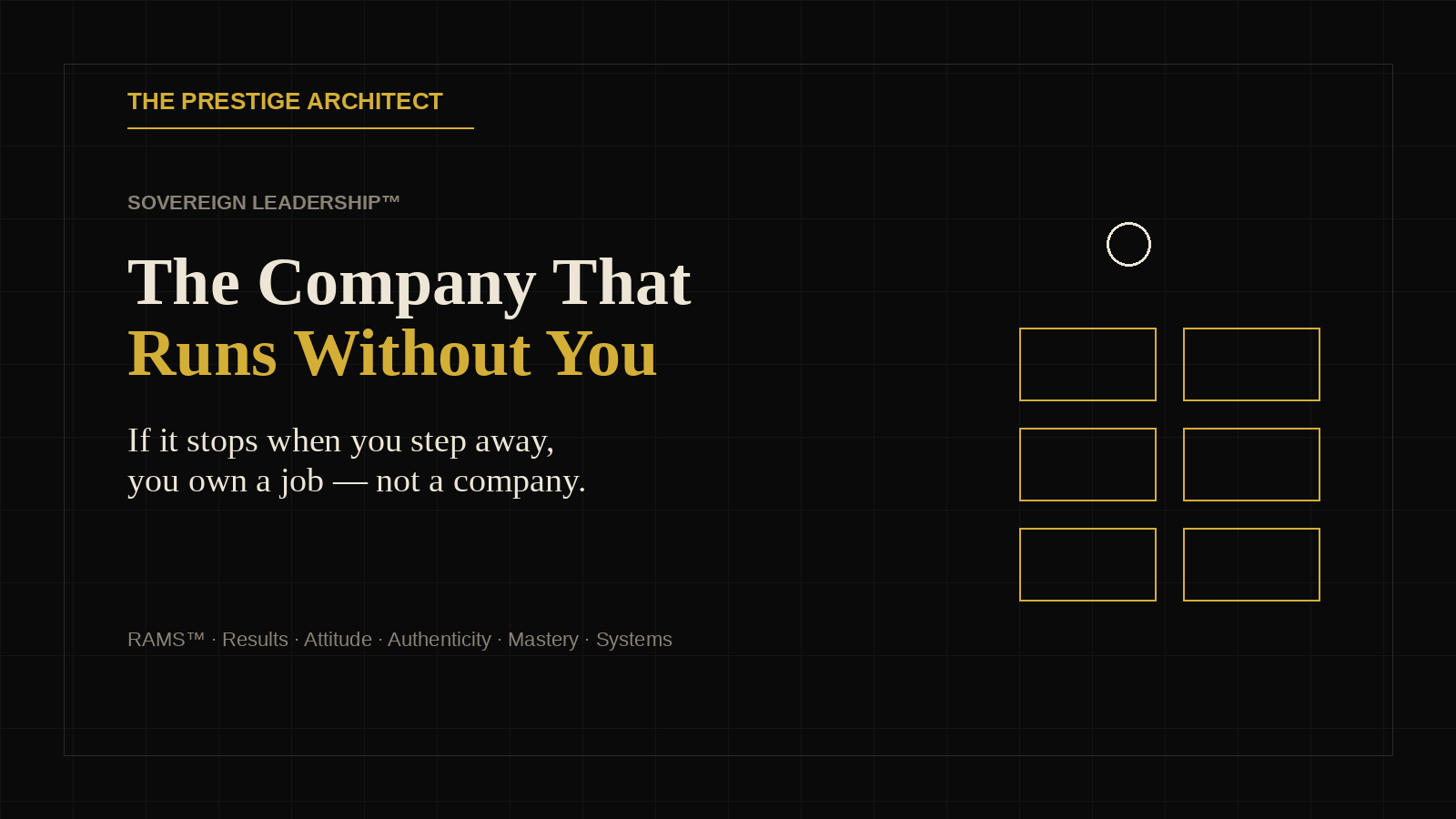
Table of Contents
Key Takeaways
If the business stops when you step away, you own a job, not a company. Owner dependency is the hidden ceiling.
You did not fail to delegate. You were rewarded for being indispensable — until it became the trap.
A self-running company is built at the nervous-system level first, then the org chart. Regulate the founder, then remove the founder from the path.
Sovereign Leadership™ means the architecture holds when you are not in the room.
The Short Answer
You build a company that runs without you by removing yourself from every decision path, on purpose, one function at a time. The block is not process. It is the identity that made being needed feel like being safe. You solve it at the level of Systems and identity together — not with one more tool.
The Hidden Pattern: Why You Built the Dependency
No founder plans to become the bottleneck. You became it by being good. Early on, every answer had to be yours because there was no one else. You were rewarded for it. The habit hardened into an identity. Now the whole thing routes through you, and you call that leadership.
It is not leadership. It is a load-bearing wall. The building stands because you stand. Harvard Business Review describes the founder who cannot exit as fused to the enterprise — the fear is irrelevance, not collapse. Under that fear, we do not release the thing we are bonded to. We grip harder.
The cost is not only your calendar. Owner dependency lowers what the company is worth. Succession research shows owners who stay central until the last moment pay in valuation, options, or stress. A business that needs its founder is a business a buyer discounts.
That is Silent Collapse™ in operational form. Outwardly indispensable. Inwardly unable to rest. If this is landing, the map out is in the Sovereign Leadership Resource Hub.
A company that cannot run without its founder is not a company. It is a very expensive job the founder cannot quit.
The RAMS Reframe: An Architecture, Not a Hope
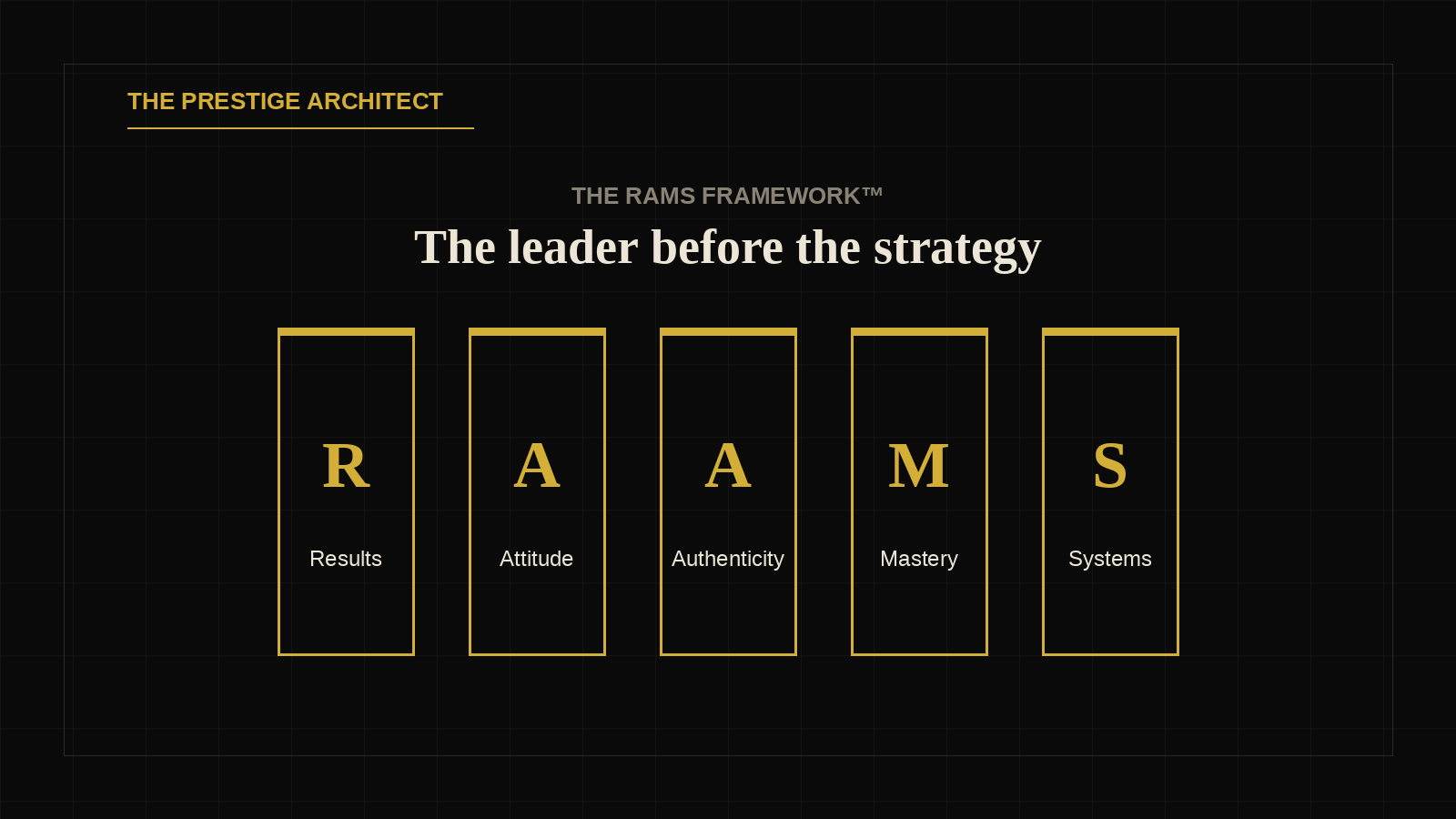
The RAMS Framework™ rebuilds the leader before it touches the strategy. Five pillars — Results, Attitude, Authenticity, Mastery, Systems. It runs at two levels at once: the nervous system and the business architecture. A self-running company built on a founder who cannot let go is a plan that quietly reverses itself.
Results — Measure What Runs Without You
You measure output. Revenue, headcount, the fact that it all still moves. Change the metric. The real number is how much runs when you are unreachable. That figure, not gross output, tells you what you actually own.
Command decision: stop counting what the company produces. Start counting what it produces without you in the room.
Operational rule: a result that needs your presence is not an asset. It is a liability with your name on it.
Attitude — The Indispensability Reflex
Attitude is the internal operating system — where the reflex lives. The belief underneath is unspoken: if I step back, it all comes apart. That is not a strategy. It is a nervous-system state running on old evidence from when you truly were the only one.
Delegation fails at the nervous-system level long before it fails on the org chart.
Authenticity — The Delegation You Only Perform
In public you have a team and you trust them. In private you approve everything and reopen settled calls. The distance between those two people is the exact size of your Silent Collapse™. Authenticity closes it. You stop performing delegation and start building it.
Mastery — From Doing to Designing
You mastered the work. You never built the capability to design the system that does the work without you. One kept you central. The other sets you free. Sovereign capability is being whole when the task is no longer yours to touch.
Systems — The Company That Runs Without You
This is the literal answer. A self-running company is an architecture, not a hope. Every function has one clear owner who is not you. Every recurring decision has a written rule, so the answer does not live in your head. The chain does not route through you. You build it one owned function at a time, and you sit with the discomfort of not being needed while it holds.
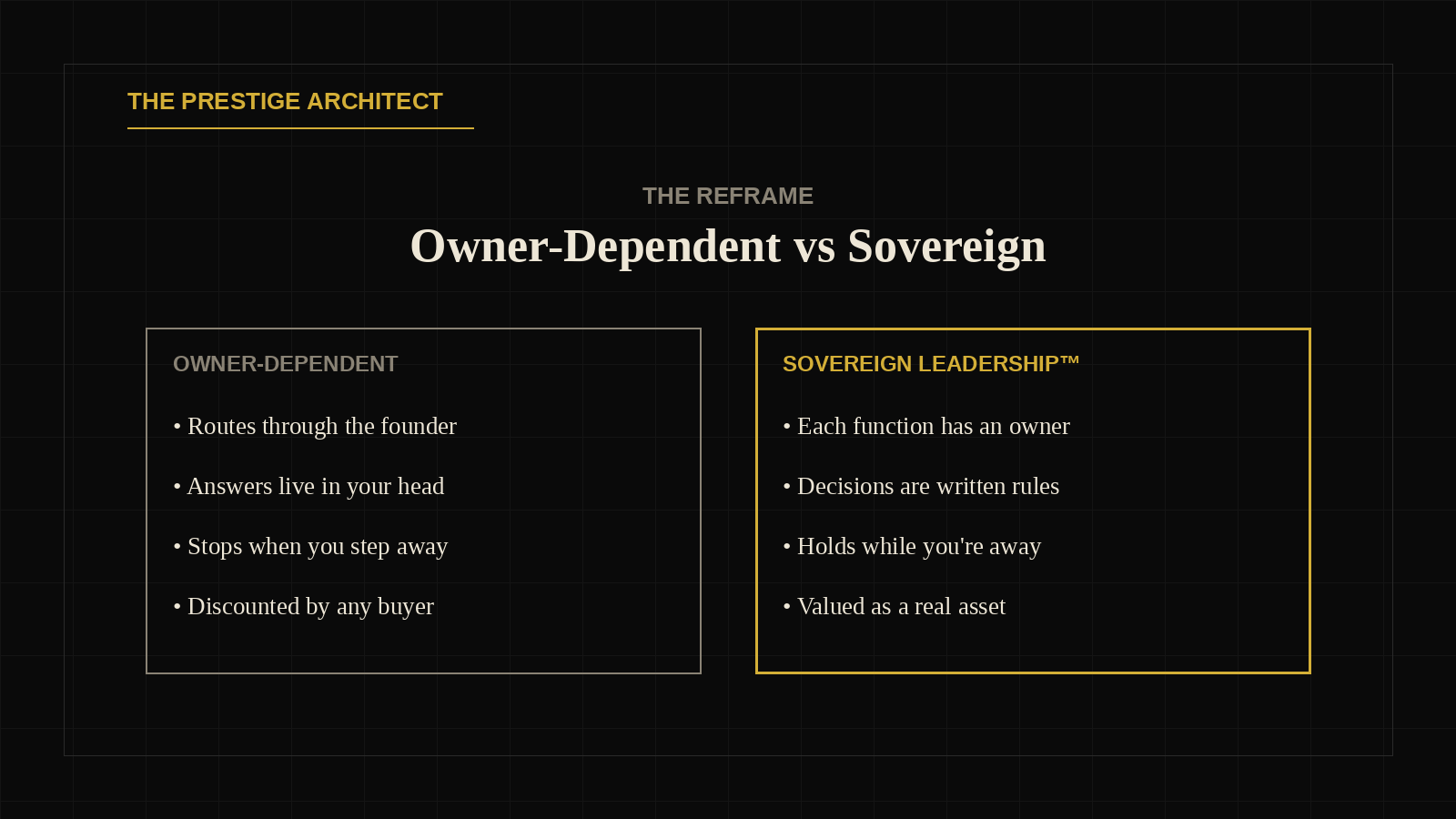
Owner-dependent versus Sovereign Leadership™ — the shift, line by line:
Every decision routes through the founder → each function has an owner who is not you.
Answers live in the founder's head → recurring decisions live in written rules.
Stops when the founder steps away → holds while the founder is unreachable.
Discounted by any serious buyer → valued as a real, transferable asset.
Being needed feels like being safe → the founder is whole with hands open.
If you recognize the left column, name it before you build anything else. Take the Silent Collapse Diagnostic. It shows you where the dependency sits before it costs you the company.
A Founder Who Left the Room
One founder had not taken an unplugged week in nine years. Every function bounced back to their desk within days. We did not start with the org chart. We started with the nervous system.
We built the Systems layer and the identity layer together. First, one function fully owned by someone else — and the founder sitting with the discomfort of not being needed, on purpose. Then the next. Written rules replaced the answers in their head. They took three weeks off and stayed unreachable. The company grew that month. That is a return, not a retreat.
The Architecture of Your Return
You do not fix this with willpower. Willpower is what made you the wall. You fix it with architecture — a deliberate rebuild of the founder underneath the company. Nervous-system sovereignty first, so absence stops reading as a threat. Then the Systems that let the company stand without you, because now you can let it.
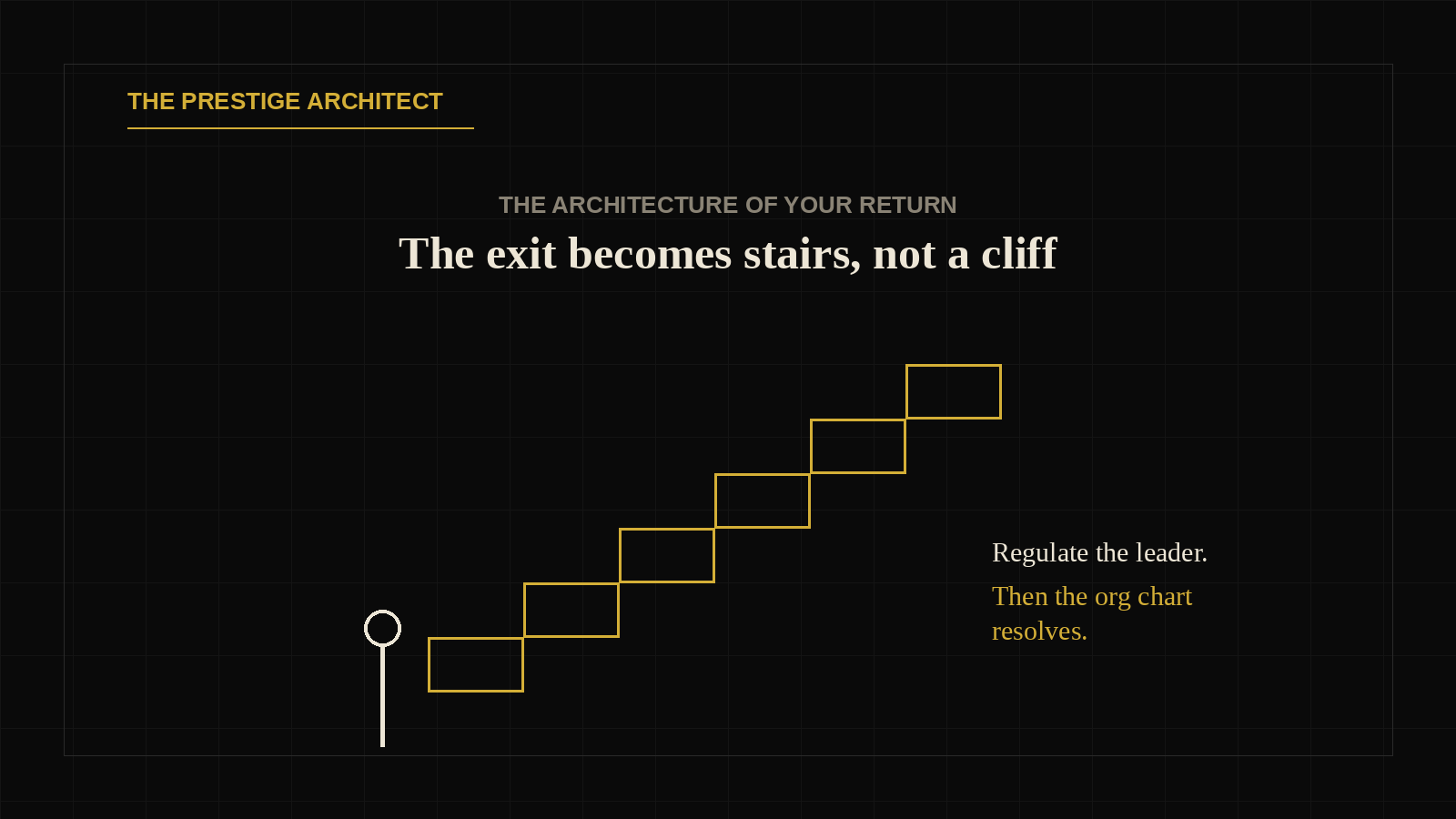
The order matters. Regulate the leader, and the org chart resolves. Reverse the order, and the plan reverses itself the first time stress spikes. This is Sovereign Leadership™: power without the collapse, a company that runs without you and is still yours.
If the business cannot run for two weeks without you, that is the moment to build the architecture, not defer it. Apply to Work With Baz.
Frequently Asked Questions
How do I build a company that runs without me?
Remove yourself from one decision path at a time. Give each function a single owner who is not you. Turn every recurring decision into a written rule so the answer stops living in your head. Then test it by stepping away and letting it hold. The architecture, not your presence, is what makes it run.
Why does my business fall apart when I step away?
Because it was built to route through you. You were the only one early on, and the habit hardened into the structure. Every answer, approval, and fix still lands on your desk. That is owner dependency. It is not a discipline problem. It is an architecture that never separated the company from the founder.
Is being indispensable in my company a bad thing?
For the company, yes. Being indispensable feels like value and reads like a liability. A business that needs its founder is one a buyer discounts and a founder cannot leave. Indispensability is Silent Collapse™ wearing a productivity mask. The goal is a company that is strong precisely because it does not need you.
How do I stop being the bottleneck in my own company?
Stop measuring what the company produces with you present. Start measuring what it produces without you. Hand a full function to someone else and sit with the discomfort of not being needed. The discomfort is the work. Do it early, on purpose, while the choice is still yours to make.
British military veteran. Two-time international bestselling author. Founder, The Prestige Architect®. Host, Rise From The Ashes podcast, C-Suite Network. Boulder, Colorado.