Always Working, Never Home: It's an Architecture Problem
You are in the room. You are not in the room. The laptop is closed and your mind is still open to the office. Your family learned to talk to the version of you that is half-listening. You call it dedication. It is Silent Collapse™ wearing the mask of work ethic. The problem is not that you lack discipline. The problem is the architecture that keeps pulling you back to the desk. Read The Manifesto.
Table of Contents
Key Takeaways
The calendar is not the problem. The architecture is. Time management fails because it treats a structural problem as a scheduling one.
Past 60 hours a week, burnout risk doubles — yet the always-on executive keeps adding hours to fix a problem hours created.
Being home is not the same as being present. The body arrives; the nervous system stays at work. That gap is Silent Collapse™.
The fix is built, not scheduled. It runs on Sovereign Leadership™ and the RAMS Framework™ — regulate the state, then redesign the system.
The Definitive Answer
You are always working and never home because the business is built to need you every hour. The role has no edges. Until you design edges into the architecture, no calendar will hold them. This is a structural problem, not a willpower problem. You do not need more discipline. You need a system that runs without your hand on it.
The Hidden Pattern: The Always-On Nervous System
The always-on executive is not lazy about boundaries. The nervous system has been trained to treat rest as risk. Stop, and a low alarm fires. So you reach for the phone. The reach is not a choice. It is a state.
The data is blunt. CNBC reported in May 2026 that executives are burning out and do not know how to cope. Research shows that once weekly hours pass sixty, the risk of burnout doubles. The always-on leader answers that risk by adding more hours. That is Silent Collapse™ — the outward picture of commitment, the inward picture of a system with no off switch.
Think of the mind as a house with no doors. Work does not stay in one room. It seeps into dinner, into sleep, into the space where your family lives. Studies from organizational psychology link the inability to detach from work to sharp declines in recovery and health. The issue is not the hours on the clock. The issue is the missing walls. Sovereign Leadership Resource Hub.
The RAMS™ Reframe: Rebuild the System, Not the Schedule
The RAMS Framework™ runs the problem through five pillars — Results, Attitude, Authenticity, Mastery, Systems. It treats the nervous system and the business architecture as one machine. When the machine has no edges, the leader has no edges. Here is the shift under each pillar.
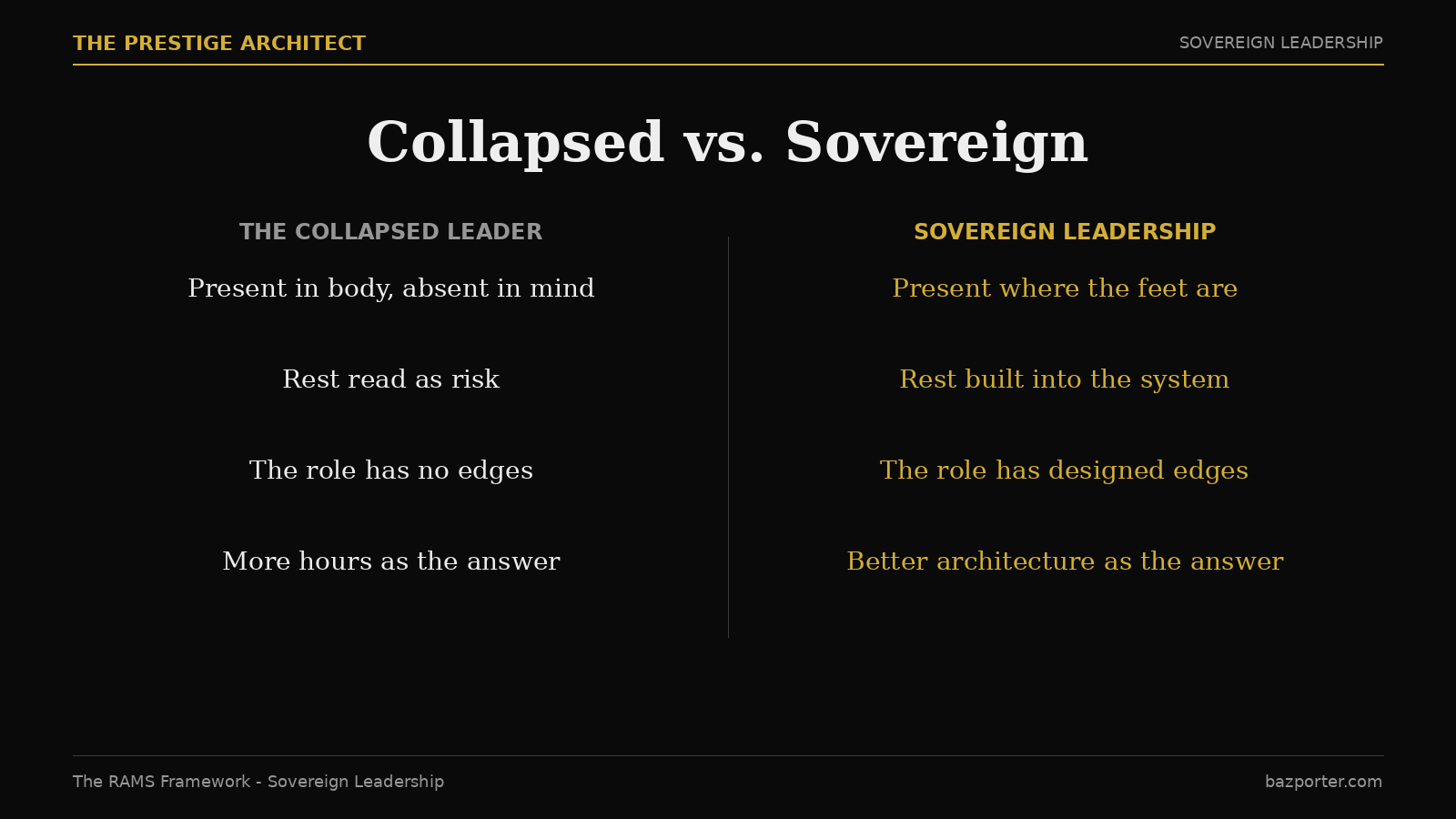
The Collapsed LeaderSovereign Leadership™Present in body, absent in mindPresent where the feet areRest read as riskRest built into the systemThe role has no edgesThe role has designed edgesMore hours as the answerBetter architecture as the answerThe business needs you hourlyThe business runs without your hand
Results — The Output vs. Identity Gap
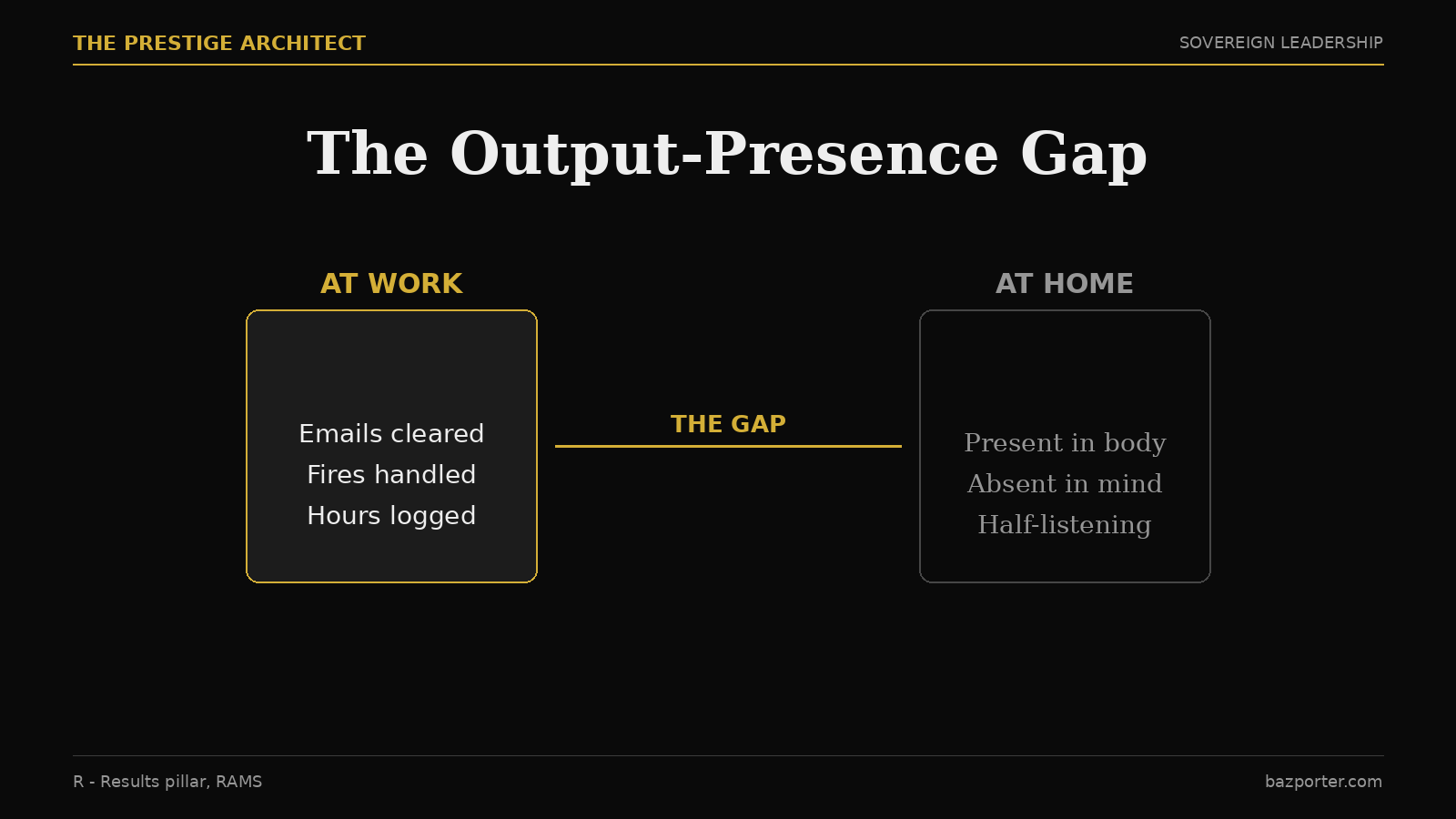
You measure the day in output. Emails cleared, fires handled, hours logged. The gap opens at home, where none of that counts. The self that only knows how to produce has nothing to do in a room that asks for presence. So it reaches for the phone.
Command decision: define what "done for the day" means as a structure, not a feeling.
Operational rule: if the work has no defined end, the nervous system assumes there is none.
Attitude — Where the Collapse Lives
Attitude is the internal operating system. The always-on leader runs on one line: if I stop, I lose ground. That line is not logic. It is a threat state. It fires faster than reason. Until you regulate the state, every boundary you set at night gets overridden by morning.
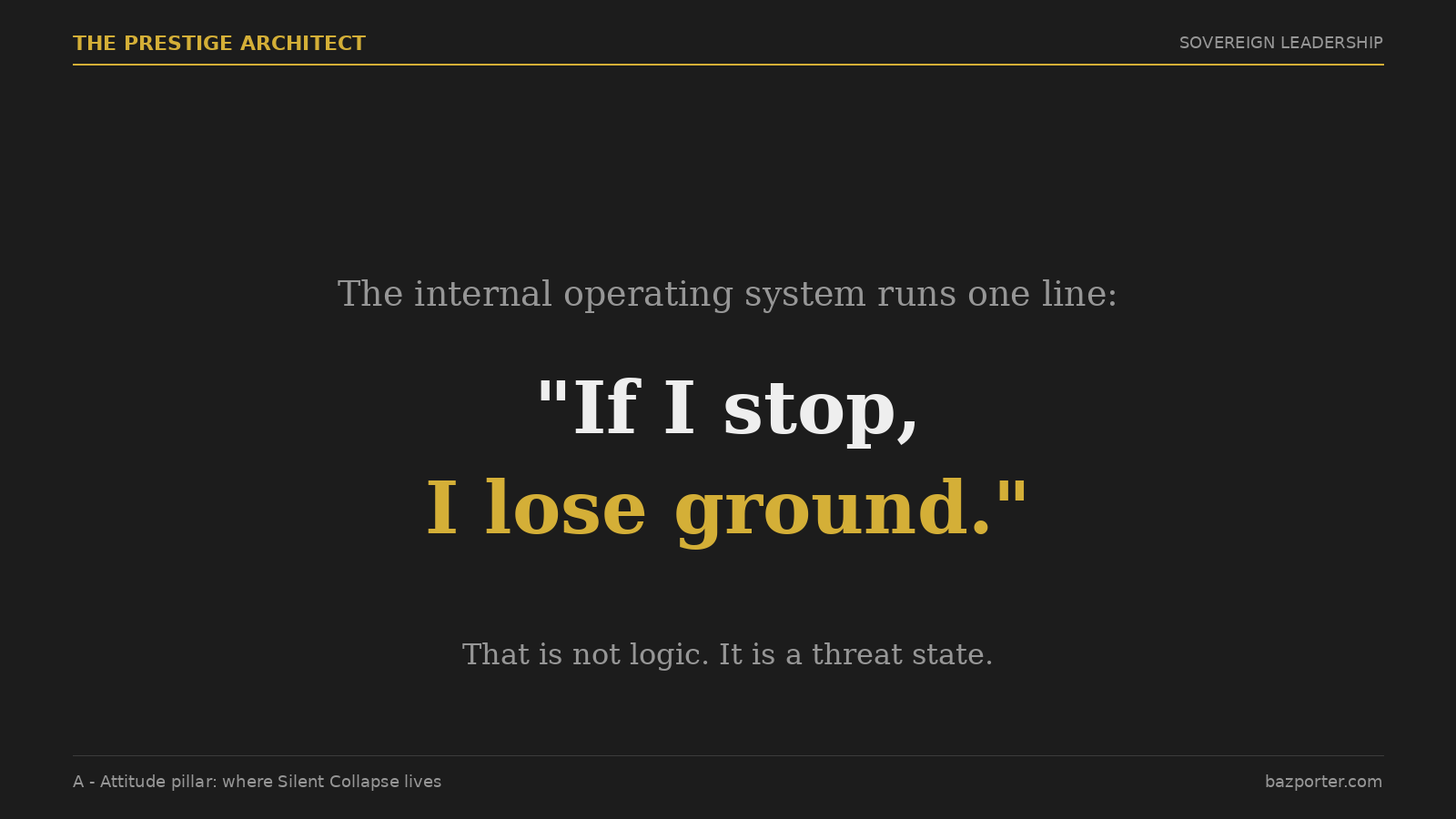
"The executive is not always working because the work demands it. The executive is always working because stopping feels unsafe."
Authenticity — The Private/Public Divide
In public, you call it commitment. In private, you know you cannot switch off. That divide is the engine of Silent Collapse™. The performed dedication hides the fact that you have not been fully home in years. Closing that divide is the first honest move.
Mastery — Skill vs. Sovereign Capability
You have skill. Skill is why the business leans on you. Sovereign capability is different — it is the capacity to be off and trust the system to hold. Mastery here means building people and structures that do not need you at 10 p.m., then trusting them. That is not neglect. That is leadership.
If you recognize the state in yourself, name it before you plan around it. Take the Silent Collapse Diagnostic.
Systems — The Architecture of the Day
The day is a system, not a feeling. The calendar is not the problem. The architecture is. Build structures that carry the load your presence currently carries, and the pull to the desk loses its grip.
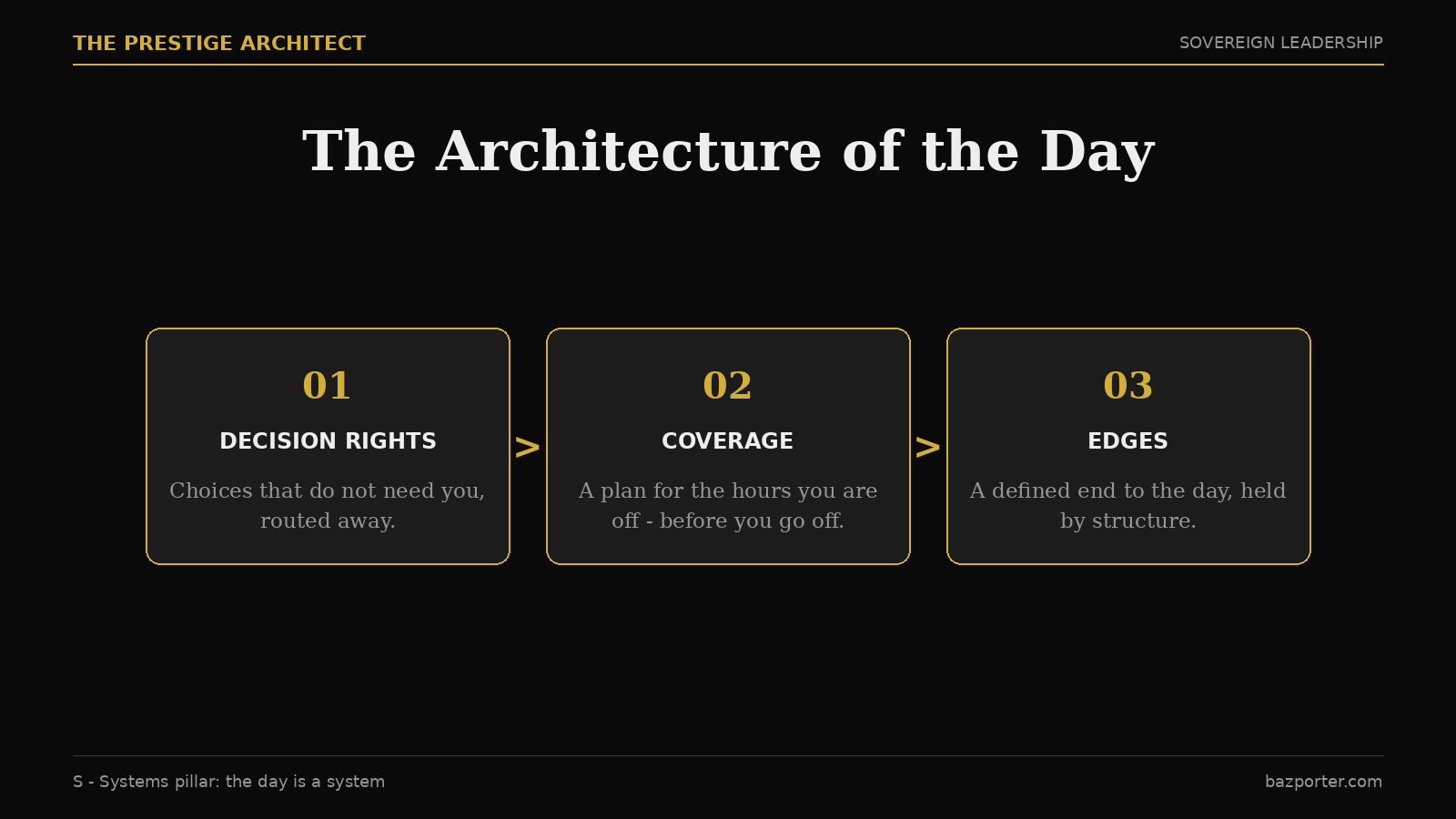
Decision rights: map which choices do not need you, and route them away.
Coverage: the business has a plan for the hours you are off, before you go off.
Edges: a defined end to the working day, enforced by structure, not mood.
A Case Vignette: The Executive Who Left the Phone Downstairs
One leader I worked with checked messages at every red light and every dinner. She framed it as being responsive. We did not start with a phone rule. We started with the alarm state under the habit. Once she could feel safe being unreachable for an hour, we rebuilt the coverage around her — a clear owner for after-hours calls, a defined end to her day. Ninety days later the phone stayed downstairs through dinner. The company did not miss a beat. Her family got the whole person back. The architecture held what her willpower never could.
The Architecture of Your Return
The return is not working less for its own sake. The return is coming home to your own life. It runs on nervous-system sovereignty — the capacity to feel safe when you are not producing. That is built, not summoned. You regulate the state first. Then you design the edges into the system. Then being home stops being a place you visit and becomes a place you live.
This is the work of The Prestige Architect®. Power that does not cost you yourself. If you are ready to build a life with edges instead of surviving one without them, Apply to Work With Baz.
Frequently Asked Questions
Why am I always working even when I am home?
Because the role has no edges and your nervous system treats stopping as risk. Being home is not the same as being present. Until the architecture of your day has a defined end, the pull to the desk overrides intention every time.
Is being unable to switch off a sign of a bigger problem?
Often, yes. The inability to detach is frequently a symptom of Silent Collapse™ — outward commitment, inward alarm. If rest feels unsafe rather than restful, the signal is worth reading, not overriding.
Will better time management fix it?
Rarely, on its own. Time management treats a structural problem as a scheduling one. The calendar is not the problem. The architecture is. You fix it by building coverage and edges into the system, then regulating the state that resists them.
What is the first step to actually being home?
Regulate the alarm state that reads rest as danger. Then design a defined end to the working day and route after-hours decisions away from you. The internal work comes first because it governs whether the structural work survives contact with a stressful week.
About the Author
British military veteran. Two-time international bestselling author. Founder, The Prestige Architect®. Host, Rise From The Ashes podcast, C-Suite Network. Boulder, Colorado.