Am I Burnt Out or Something Worse? The Truth Under the Collapse
Am I Burnt Out or Something Worse? The Truth Under the Collapse
You ran the quarter. You hit the number. You felt nothing. The question arrives at 9:40 PM, alone: am I burnt out or something worse? You are not tired in the way sleep fixes. You are functioning at full output while something underneath has gone quiet. This is Silent Collapse™ — the high-functioning shutdown no one around you can see. It does not look like exhaustion. It looks like excellence. Read The Manifesto.
Table of Contents
Key Takeaways
Burnout is not exhaustion. It is the gap between what you produce and who you have become.
The "something worse" has a name. When output stays high and meaning goes dark, that is Silent Collapse™, not ordinary fatigue.
Rest does not fix it. A vacation restores energy. It does not restore identity. The architecture has to change.
The return is engineered, not inspired. Sovereign Leadership™ rebuilds the nervous system and the business on the same four-pillar frame.
The Definitive Answer
If you are asking whether you are burnt out or something worse, the honest answer is usually: worse, and quieter. Clinical burnout names emotional exhaustion, detachment, and a falling sense of accomplishment. What high performers describe is different. The accomplishment keeps coming. The detachment grows anyway. That split — full output, empty interior — is the signature of Silent Collapse™. It is not a workload problem. It is an identity problem wearing a workload costume.
The Hidden Pattern Under Burnout
Burnout research keeps circling one finding. For high achievers, the damage is not the hours. It is the fusion. You built an identity almost entirely out of usefulness. Research on burnout and identity loss frames the core wound as a single question: who am I when I stop producing? The nervous system answers before the mind does. It treats rest as threat.
Think of a generator wired straight to the building it powers. It keeps the lights on. It also never stops. Remove the load for one evening and it does not relax — it surges, searching for the next demand. That is the executive nervous system in collapse. The body learned that stillness is danger. So you stay loud to stay safe.
This is why the standard advice fails. Telling a high performer to rest is telling the generator to fear the dark. The fix is not less work. It is a different wiring. The leadership literature has documented the cost for years — sustained high performance erodes the self that produced it. Recognition is the first repair. Naming Silent Collapse™ is not self-pity. It is diagnosis. Sovereign Leadership Resource Hub.
The RAMS™ Reframe: Four Pillars
The RAMS Framework™ runs on four pillars at once — Results, Attitude, Mastery, Systems. It treats the body and the business as one architecture. When one is dysregulated, both are compromised. Burnout is not a corner of your life. It is the whole frame, mispriced.
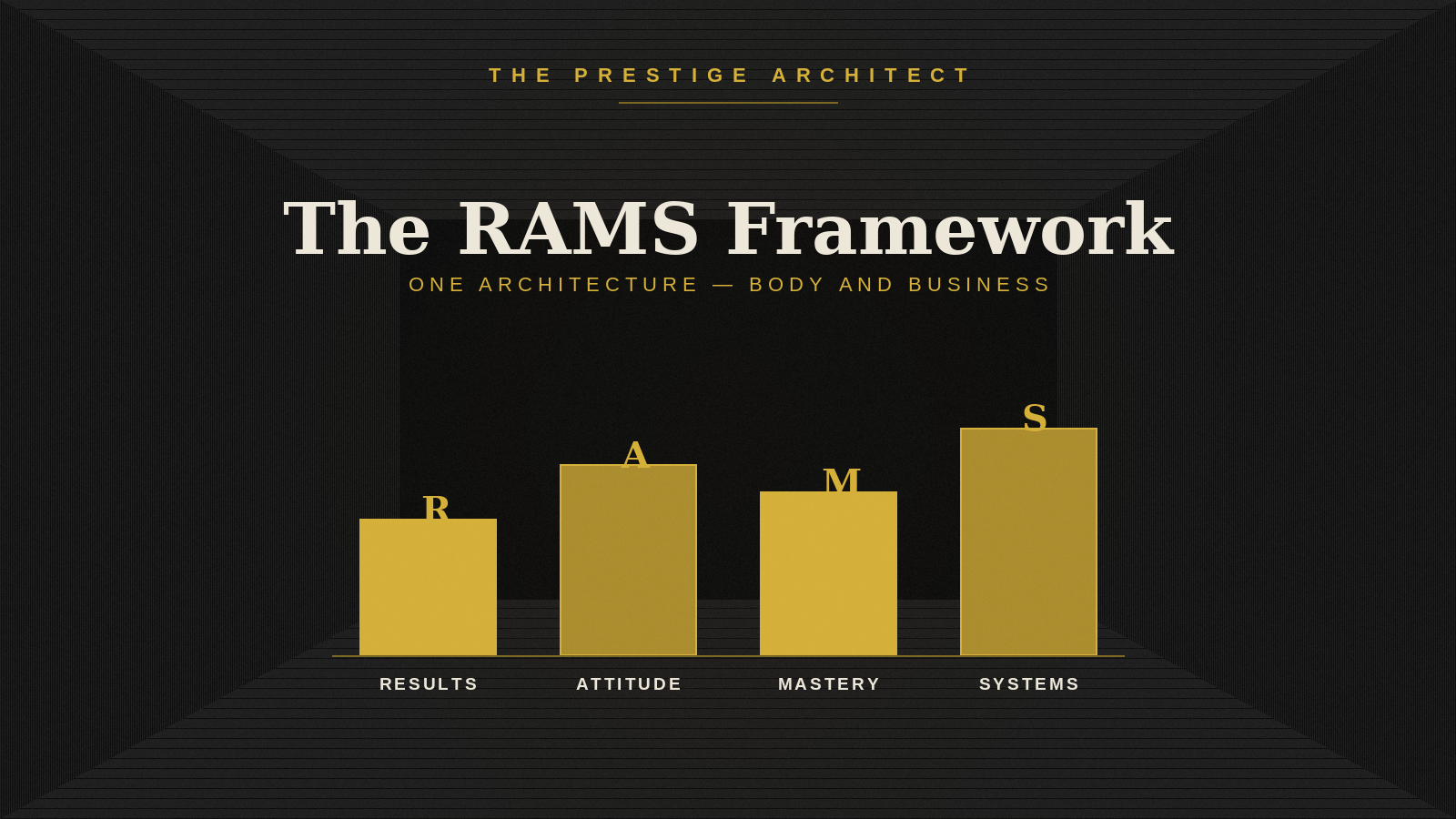
Results — The Output and Identity Gap
Results measure what you produce. Collapse measures who you became while producing it. The two numbers diverge silently. You hit targets and lose yourself on the same calendar.
The metric trap: you track revenue, not erosion. The dashboard is green while the operator is grey.
The applause gap: external praise climbs as internal signal flatlines. More wins, less feeling.
Operational rule: if your output is rising and your interior is falling, you do not have a performance problem. You have a Silent Collapse™ problem.
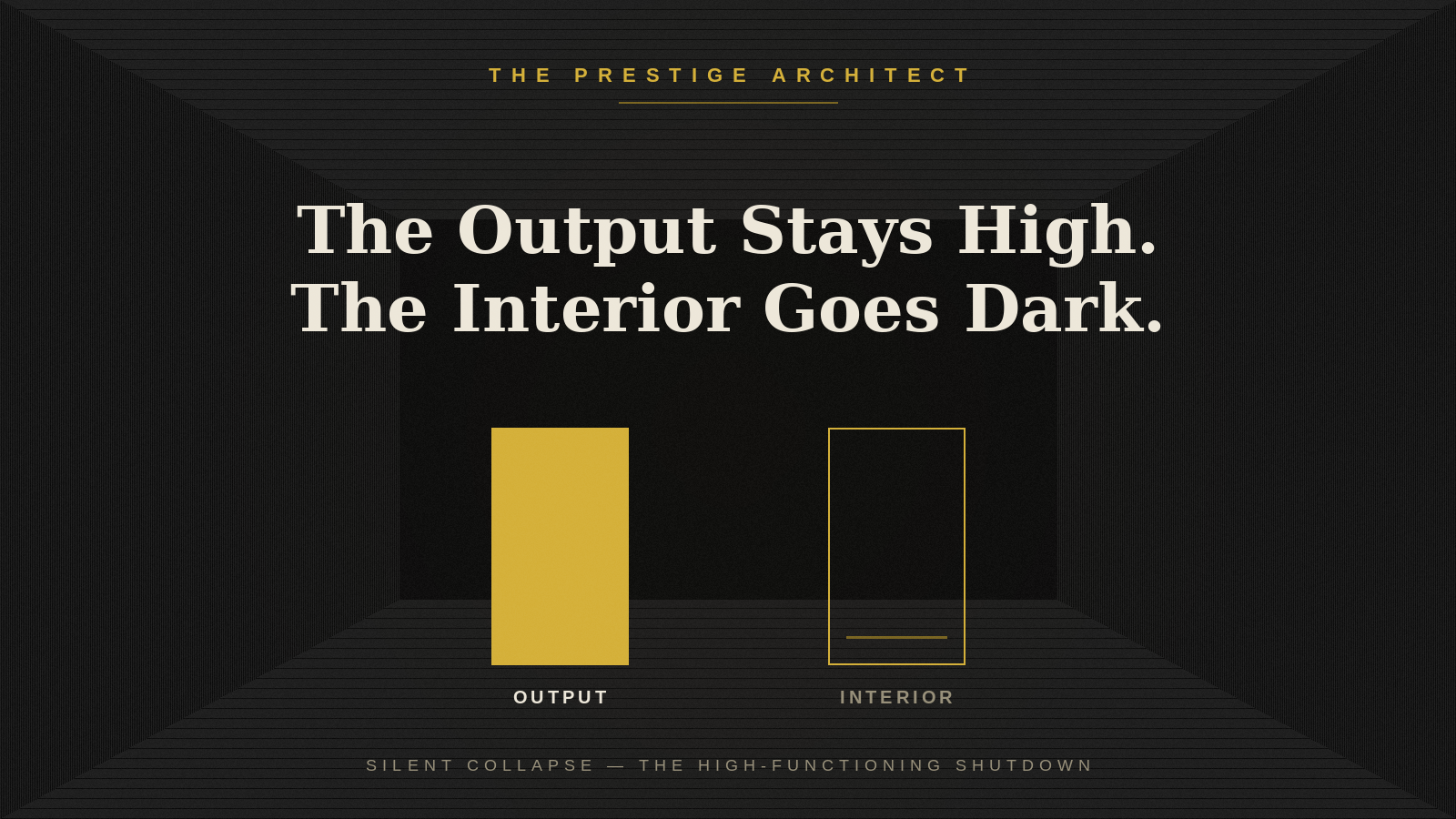
Attitude — Where the Collapse Lives
Attitude is the internal operating system. Collapse does not live in your schedule. It lives here, in the private rules you run. "If I stop, it all falls apart." "Feeling is a liability." Those rules were survival code once. Now they are the leak.
Burnout is not exhaustion. It is the gap between what you produce and who you have become.
Command decision: the internal OS gets rewritten on purpose, or it keeps running you on default. Default ends in collapse.
Mastery — Skill Versus Sovereign Capability
You have skill. Skill is doing the hard thing well. Sovereign capability is doing it without abandoning yourself to do it. High performers confuse the two. They scale skill and call it growth while capability quietly shrinks.
More decisions do not equal more mastery. Executives now carry a documented cognitive load — long hours, compressed sleep, relentless micro-judgments — and the volume itself degrades judgment. Capacity is not the same as capability. Doing more is not becoming more.
Systems — The Architecture of the Return
Systems are the architecture that holds everything else. Willpower is not a system. Discipline is not a system. A nervous system that has learned safety is a system. This is the pillar that engineers the return.
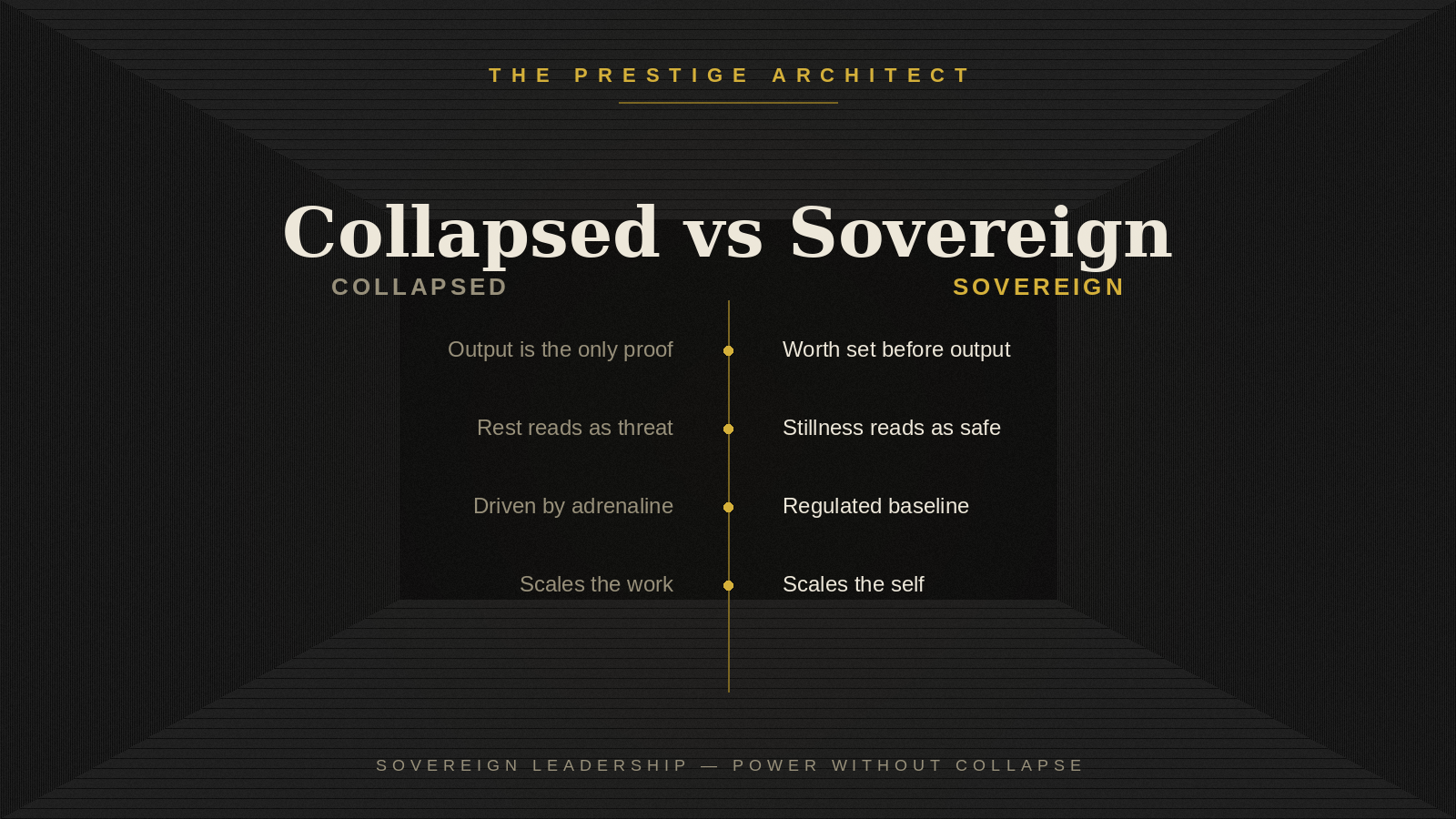
Collapsed LeaderSovereign Leadership™ Output is the only proof of worthWorth is set before the output Rest registers as threatStillness registers as safe Drives on adrenaline and fearOperates from a regulated baseline Hides the collapse behind resultsNames the state and rebuilds it Scales the work to outrun the feelingScales the self to hold the work
Collapsed Leader
Sovereign Leadership™
Output is the only proof of worth
Worth is set before the output
Rest registers as threat
Stillness registers as safe
Drives on adrenaline and fear
Operates from a regulated baseline
Hides the collapse behind results
Names the state and rebuilds it
Scales the work to outrun the feeling
Scales the self to hold the work
Collapsed Leader vs Sovereign Leadership™ — the shift, line by line:
Proof of worth: collapsed makes output the only proof; sovereign sets worth before the output.
Rest: collapsed registers rest as threat; sovereign lets stillness register as safe.
Drive: collapsed runs on adrenaline and fear; sovereign operates from a regulated baseline.
The collapse: collapsed hides it behind results; sovereign names the state and rebuilds it.
Scaling: collapsed scales the work to outrun the feeling; sovereign scales the self to hold the work.
The first move out is recognition, not effort. A short diagnostic shows you which pillar is leaking. Take the Silent Collapse Diagnostic.
Case Vignette: The Operator Who Felt Nothing
A founder came in after the best revenue year of the company's life. On paper, untouchable. In private, flat. No grief, no joy, no signal — only the next quarter. He assumed he needed a longer break. He had taken three. None held.
We did not start with rest. We started with architecture. We mapped where his identity had fused to output, and rebuilt the Systems pillar first — a regulated morning, a hard boundary the calendar cannot override, a daily marker of worth set before any result. Within ten weeks the signal came back. Same company. Same numbers. A different operator holding them.
The Architecture of Your Return
The return is not a feeling you wait for. It is a structure you build. Sovereign Leadership™ restores the nervous system first, because a regulated body is the precondition for everything you want the business to do. You do not motivate your way out of Silent Collapse™. You re-engineer the conditions that produced it.
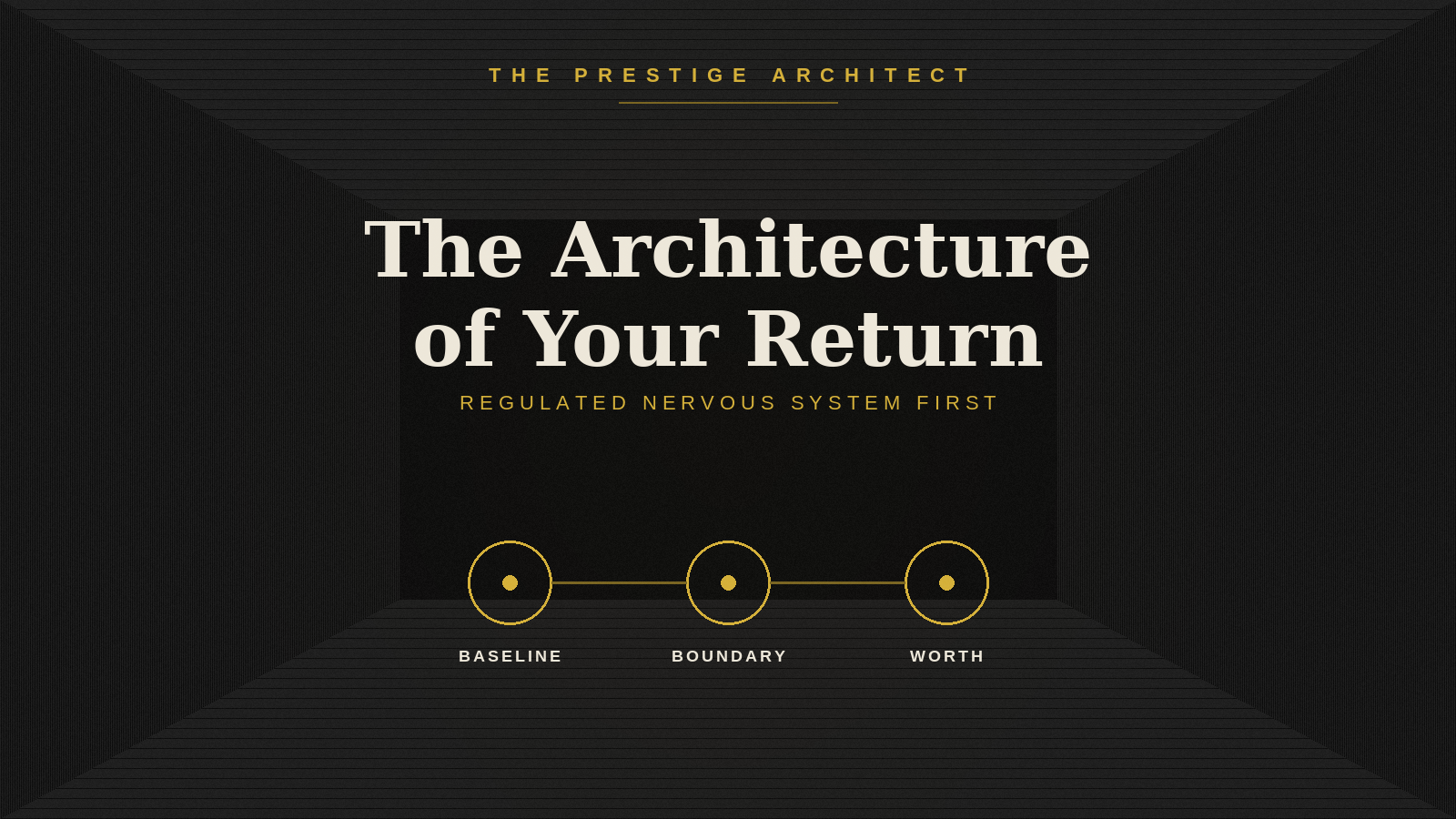
This is the work I do as The Prestige Architect® — power without collapse, success without self-betrayal. It is reverse-engineered from the leader you are returning to, not bolted on from the outside. The question is no longer whether you are burnt out or something worse. The question is what you build now that you can name it. Apply to Work With Baz.
Frequently Asked Questions
How do I know if I am burnt out or something worse?
Watch the split between output and interior. Ordinary burnout drags performance down with the mood. Silent Collapse™ keeps performance high while meaning goes dark. If you are producing at full strength and feeling almost nothing, that is the "something worse" — and it has a structure you can address.
Why does rest not fix my burnout?
Rest restores energy. It does not restore identity. When the collapse is an identity fused to output, time off returns you to the same wiring that drained you. The repair is architectural, not recreational. The nervous system has to relearn that stillness is safe.
Is high-functioning collapse the same as depression?
They overlap and they are not identical. Depression is a clinical condition that warrants professional care, and persistent emptiness is worth raising with a qualified clinician. Silent Collapse™ names a specific executive pattern — full external function, hollow internal signal — that responds to rebuilding identity and nervous-system regulation. Address the clinical and the structural together.
Can I recover without stepping back from the business?
Yes. The return is built inside the work, not outside it. You do not exit the company to rebuild the operator. You change the architecture the operator runs on — boundaries, baseline, and a measure of worth set before results. Same role, different wiring.
About the Author
British military veteran. Two-time international bestselling author. Founder, The Prestige Architect®. Host, Rise From The Ashes podcast, C-Suite Network. Boulder, Colorado.