How to Build Psychological Safety: A Sovereign Guide
Psychological safety is the most misdiagnosed lever in modern leadership. Most leaders treat it as a technique. They run tighter meetings. They ask cleaner questions. They read the frameworks and rotate the speaking order. And the room still goes quiet. The reason is structural, not tactical. Safety is not a policy you install. It is a signal your nervous system either broadcasts or betrays. This is the first principle of Sovereign Leadership Architecture™, and it sits directly on the fault line beneath Silent Collapse™. If you have never named that pattern in yourself, begin with the Manifesto.
What This Guide Covers
Key Takeaways
The Definitive Answer
The Hidden Pattern Under Psychological Safety
How to Build Psychological Safety: The RAMS™ System
A Case From the Room
The Architecture of Your Return
Frequently Asked Questions
Key Takeaways
Psychological safety is a physiological signal before it is a cultural value.
A dysregulated leader cannot manufacture safety with better questions.
The five-part RAMS™ system rebuilds safety from the inside out.
Team Gravity forms around a regulated leader, not a performing one.
Your own diagnosis begins at the Silent Collapse Diagnostic™.
The Definitive Answer
To build psychological safety as a leader, regulate your own nervous system first, then make candor structurally safe. Psychological safety is the shared belief that a team can take interpersonal risks without punishment or humiliation. It is built when the leader stays regulated under pressure, rewards the messenger, and removes the private cost of honesty. The work starts inside the leader. A reactive leader signals danger before a single word is spoken. A regulated leader signals safety in the same silence. Technique sits on top of state. State comes first.
The Hidden Pattern Under Psychological Safety
Harvard’s Amy Edmondson named this in 1999. Her study in Administrative Science Quarterly found something strange. The safest teams reported more errors, not fewer. They were not failing more often. They were hiding less. A decade later, Google’s Project Aristotle studied 180 teams and reached the same verdict. Psychological safety was the single strongest predictor of high performance, above talent, above resources.
The pattern beneath both findings is inconvenient. Safety is not authored by policy. It is transmitted by the leader’s state. Research summarized by Harvard Business School Online and the Center for Creative Leadership both land on the same requirement. Before a leader can regulate a culture, the leader must regulate the self. A team never reads the memo. It reads the nervous system that wrote it.
How to Build Psychological Safety: The RAMS™ System
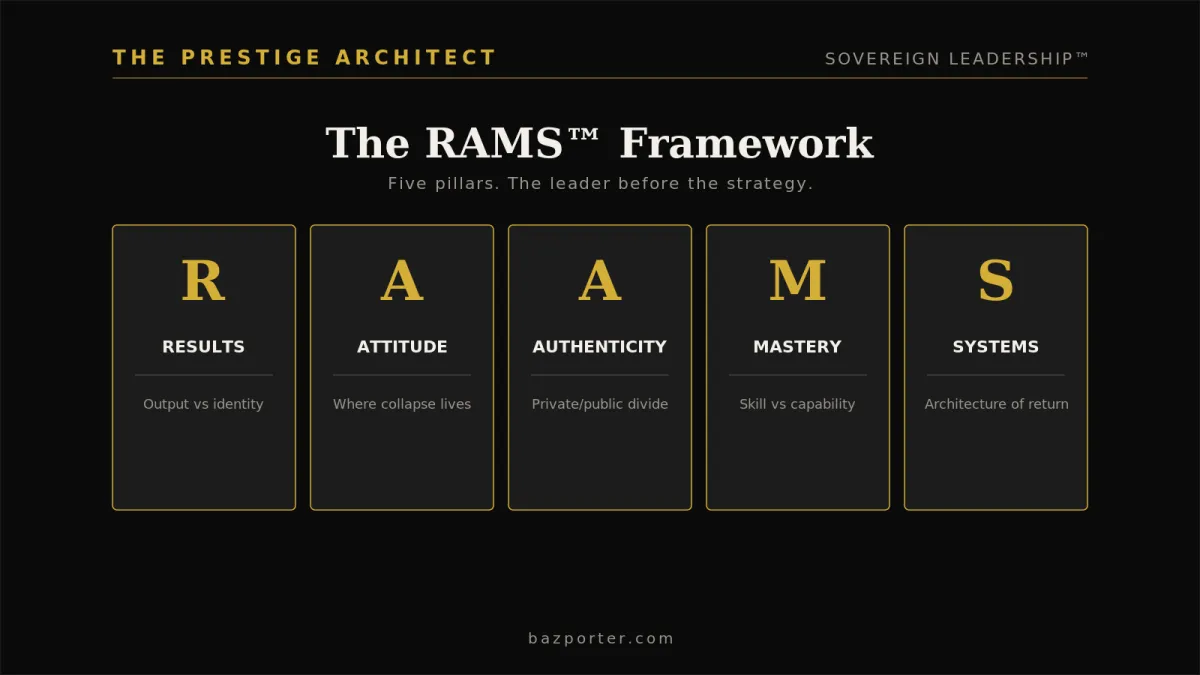
Most safety advice is a list of behaviors. Behaviors fail when the leader underneath is in threat. The RAMS™ system rebuilds psychological safety at the level it actually lives. It operates on the business and on the nervous system at once. Five pillars, in order.
Results
Fear does not raise standards. It hides the truth that protects them. When honesty is punished, bad news travels slowly and arrives late. Safety is not softness. It is the fastest route to real information. A leader who wants results makes the truth cheap to deliver.
Attitude
The room takes its cue from your face. Your calm is contagious. So is your threat. When you meet a hard update with a steady voice, you teach the team that hard updates are survivable. Attitude is not a mood. It is a signal the whole system copies.
Authenticity
Performed leadership manufactures performed teams. If you pretend to have every answer, your people learn to pretend too. The moment a leader says “I do not know yet,” the ceiling on honesty lifts for everyone. Authenticity is not exposure. It is the permission structure the room has been waiting for.
Mastery
Safety without standards becomes drift. Real psychological safety holds two things at once. High care and high candor. You can be safe to challenge and still accountable to deliver. Mastery is the discipline that keeps safety from collapsing into comfort. The bar stays high. The fear stays low.
Systems
Culture that depends on your good mood is not a system. It is a gamble. Build the safety into the structure. Name the norm that the messenger is thanked. Make the retrospective blameless by design. Put honesty on the calendar, not on your willpower. A system holds the safety when you are tired.
Here is the shift, pillar by pillar.
Collapsed: The leader performs calm while the body signals threat. Sovereign: The leader is regulated, so the calm is real and the room believes it.
Collapsed: Bad news is punished, so it arrives late and distorted. Sovereign: The messenger is thanked, so the truth arrives early and clean.
Collapsed: Safety depends on the leader’s mood that day. Sovereign: Safety is built into norms that hold without the leader present.
Collapsed: Comfort is confused with safety, and standards quietly erode. Sovereign: High candor and high care hold together, and the bar stays high.
A reactive leader cannot legislate safety. The room reads the nervous system, never the memo.
If you recognize the collapsed column in your own team, the pattern is nameable and it is rebuildable. The 60-minute Silent Collapse Diagnostic™ maps exactly where your own signal is broadcasting threat, and what to rebuild first.
A Case From the Room
A COO I will call Elena led a team that looked high performing on paper. Numbers held. Meetings ran on time. Yet no one brought her a problem until it was a fire. She had read every book on candor. She rotated speaking order. She asked the open questions. Nothing moved.
We did not start with her meetings. We started with her state. Under every review, her body was braced for impact. The team read that brace. They mirrored it back as silence. Once she rebuilt her own regulation, the questions she already knew how to ask finally landed. Within a quarter, problems surfaced early. The fires stopped. Nothing in her technique had changed. Her nervous system had.
The Architecture of Your Return
You cannot install psychological safety from the outside. It forms as a field around a regulated leader. This is Team Gravity, one property of Sovereign Leadership Architecture™. It is not built with a workshop. It is rebuilt from the inside of the person the team is watching.
The first move is not another framework. It is an honest diagnosis of where your own system is broadcasting threat you cannot see. That is the work of the Silent Collapse Diagnostic™, a 60-minute session conducted personally by Baz Porter. Apply, and you will leave with the exact architecture of your return, in order.
Frequently Asked Questions
What is psychological safety at work?
Psychological safety is the shared belief that a team can take interpersonal risks without being punished or humiliated. It means a person can raise a concern, admit an error, or ask a hard question and stay respected. It is not about being nice. It is about making honesty survivable.
How do you build psychological safety as a leader?
You build it from the inside out. Regulate your own nervous system so your calm under pressure is real, not performed. Then thank the messenger, admit what you do not know, and hold high standards alongside high candor. Finally, build the norms into structure so safety does not depend on your mood.
What is the difference between psychological safety and trust?
Trust is about a specific person over time. Psychological safety is about the group in the moment. Trust asks whether I can rely on you. Safety asks whether this room will punish me for speaking up. You can trust an individual and still not feel safe to be honest with the team.
Can a team have too much psychological safety?
Not real psychological safety. What looks like too much is usually safety without standards, which is just comfort. True safety pairs high candor with high accountability. If challenge disappears and the bar drops, the problem is not safety. It is the absence of shared standards holding the safety in place.
Why does psychological safety fail even when leaders try?
It fails when leaders treat it as a technique and skip their own state. A leader can run every recommended practice and still signal threat with a braced body and a clipped tone. The team reads the signal, not the script. Safety recovers when the leader’s regulation becomes real first.
About the Author
Baz Porter is the founder of Baz Porter LLC and The Prestige Architect. A British Army veteran of six and a half years, he is an international bestselling author and the host of the Rise From The Ashes podcast on the C-Suite Network, with more than 100 episodes. He is the architect of Sovereign Leadership Architecture™, the structural rebuild of the identity beneath high performance. He works with founders and executives living in Silent Collapse™, guiding them from power that costs everything to power that sustains itself.