When Being Needed Stopped Feeling Like Being Loved
I am so tired of being the one everyone leans on.
If that sentence landed in your chest, read the next line slowly. You are not tired from the work. You are tired from being needed. That is a different kind of exhaustion, and it has a name. I call it Silent Collapse™: the quiet erosion of a capable leader who is still functioning, still delivering, and slowly disappearing inside their own life. You can read the whole of it in the manifesto.
Here is the ache underneath. Being needed stopped feeling like being loved. People reach for you all day. Almost no one reaches you.
On this page
Key takeaways
Being needed is about your function. Being known is about your self. They are not the same hunger.
You can be surrounded and still unseen. That is the core wound of Silent Collapse™.
Over-responsibility trains people to meet your role, not you. The reaching never reaches you.
The move is not to be needed less. The move is to be known again. I call it RETURN, the way back to a self that is more than useful.
You rebuild this on purpose, through Sovereign Leadership, one honest relationship at a time.
Why being needed stopped feeling like being loved
Being needed and being loved use the same word in your head. They are not the same experience. One values what you do. The other values who you are.
For years the two felt identical. You helped, and help was how you were held. Then something shifted. The requests kept coming. The warmth drained out of them.
This is the heart of Silent Collapse™. You are the dependable one, the fixer, the load-bearing wall. People lean on the wall. Nobody asks the wall how it is. Being needed became proof of your use, not proof of your worth. And use, repeated long enough, feels like being hollowed out.
The hidden pattern: reached for, not reached
There is a reason this ache is so precise. Belonging is not built from contact alone. It is built from being cared for as a person.
Roy Baumeister and Mark Leary mapped this in their 1995 paper in Psychological Bulletin, The Need to Belong. They found that belonging needs two things at once. Frequent interaction, and a stable bond of mutual care. Interaction without the bond does not satisfy the need. It can even deepen the loneliness.
Read your days against that. You have the interaction. You have more of it than anyone. What you are missing is the second thing. You are reached for constantly and reached almost never.
Edward Deci and Richard Ryan named the same gap from another angle. In their 2000 work in Psychological Inquiry, they describe relatedness as a core human need, the need to feel valued as yourself, not for what you provide. When every bond runs on your output, relatedness starves. You stay busy. You stay hungry.
So the ache is not weakness. It is an accurate reading. Being needed was never going to feed the part of you that wants to be known.
The five-pillar reframe
I work this through RAMS™, the operating system behind Sovereign Leadership. Five pillars. Here is how the needed-not-known ache moves across each one.
Results
Collapsed, your results are measured by how much weight you carry. The more you hold, the more you matter. Sovereign, results include whether you are known by the people closest to you. A life that only measures output will always read you as a tool.
Attitude
Collapsed, you believe asking to be seen is needy. So you stay useful and silent. Sovereign, you treat being known as a legitimate need, not a weakness. The posture changes before the circumstances do.
Authenticity
This is the pillar that holds the whole ache. Collapsed, you show people the function and hide the person. They cannot know a self you keep offstage. Sovereign, you let a few people meet the real one underneath the role. Being known requires being shown. You cannot be reached through a wall.
You are not hard to love. You are hard to find. You hid the self and offered the service, then wondered why only the service got a response.
Mastery
Collapsed, your skill is proof you need no one. Competence becomes a hiding place. Sovereign, mastery includes the harder skill of receiving. Letting someone carry a piece of you is not failure. It is range.
Systems
Collapsed, every relationship is wired to your usefulness. The system only knows how to take. Sovereign, you rebuild a few bonds that are not transactions. A relationship that survives you being unhelpful is the one that actually knew you.
If the collapsed column is your whole life right now, that is the signal to start. The free entry point is the Fast Future Freedom Blueprint. It is an honest audit of where the weight sits and where you went missing.
What this looks like
A leader came to me at 51. Built life, strong company, full calendar. Everyone relied on them. They said one line I still carry. “I am the most depended-on person I know, and I have never felt more alone.”
We looked at their relationships one by one. Every single bond ran on their output. Team, family, friends. Each connection had a job attached. None of them knew the person with the job removed.
The work was not to help less. It was to be known again. They chose two people. With those two, they practiced showing the self instead of the service. It was slow. It was uncomfortable. It was the first time in years they felt reached. Not made into someone new. Returned to someone real.
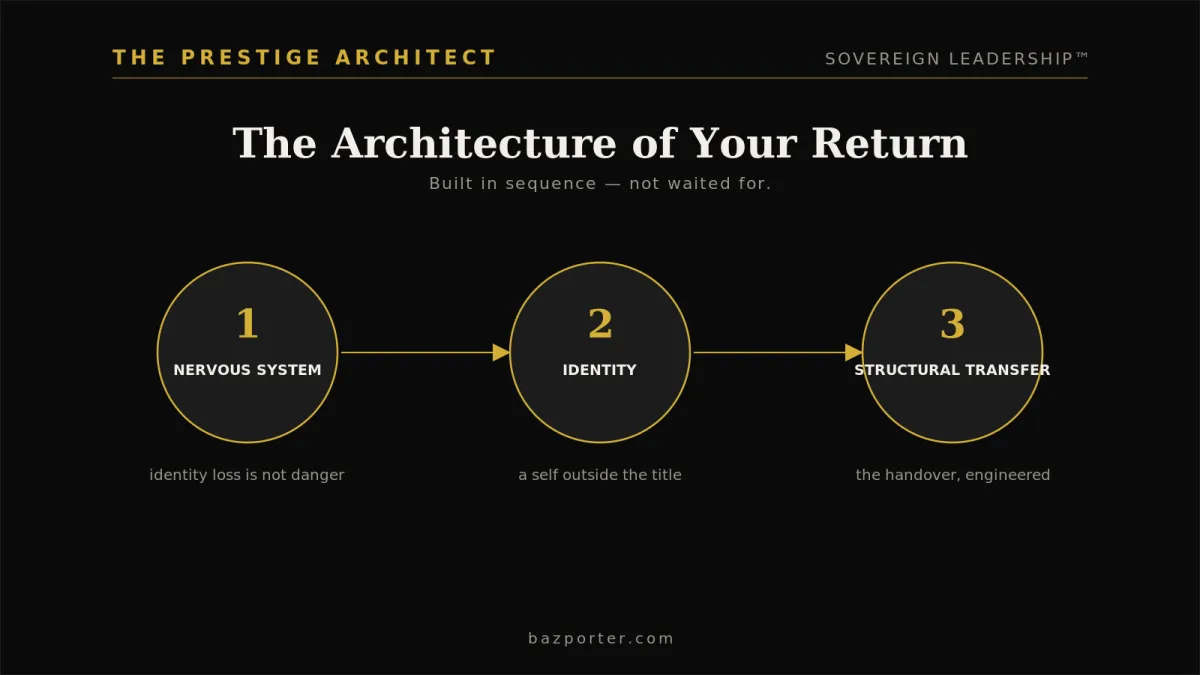
The architecture of your return
You do not fix this by being needed less. You fix it by being known more. That is the return.
It is built, not wished. You choose a small number of people. You let them see the self under the role. You practice receiving instead of only giving. You let a few bonds stop being useful and start being true. This is the daily work of Sovereign Leadership, and it is the opposite of disappearing inside your own life.
If you want a map for where to begin, start with the Fast Future Freedom Blueprint. It is free. It shows you, honestly, where you stopped being known and what the first move back looks like. You can also sit with the manifesto if you want the full picture of the collapse and the way out.
You were never only useful. You just forgot to let anyone find that out.
Questions people ask
Why does being needed feel lonely?
Because need is about your function, and loneliness is about your self. People can depend on you all day while knowing nothing about who you are. Frequent contact without genuine care does not meet the need to belong. You end up surrounded and still unseen.
What is the difference between being needed and being loved?
Being needed values what you provide. Being loved values who you are, with the providing removed. The test is simple. If you stopped being useful tomorrow, who would still want you there? The people who remain are the ones who actually know you.
Why do I feel unseen even though everyone relies on me?
Because reliance is not the same as recognition. When every relationship runs on your output, people learn to meet your role instead of you. The reaching lands on the function, not the person. That is why more dependence can feel like more invisibility.
How do I stop tying my worth to being useful?
You start by letting a few people see you when you are not performing a service. Worth that is not tied to output has to be practiced in real relationships. It will feel exposed at first. That exposure is the path back to being known, not a sign you are doing it wrong.
Can you be needed and known at the same time?
Yes, but only when some bonds are not built on need. Keep the useful relationships. Then build a small number that survive you being unhelpful. Those are the ones that reach the person, not the role, and they are what the return is made of.
About Baz Porter
Baz Porter® is the founder of The Prestige Architect™ and the author of the Sovereign Leadership body of work. He counsels successful leaders through Silent Collapse™ back to a self that is more than useful, using the RAMS™ framework. His work names the quiet erosion high-functioning people rarely say out loud, and maps the return. Begin with the Fast Future Freedom Blueprint.